Published work / LIMINA
Un solo paso en la ceniza
From the SITUS series
- Size
- 31.5 × 47.2 in / 80 × 120 cm
- Series
-
LIMINA
 Painting series
LIMINA
In LIMINA, Maurizio Valch constructs territories of transit through superimposed planes, contained horizons, unstable enclosures, and suspended forms. The painting sustains an elemental architecture while seepage, drips, and incisions introduce a mobility that prevents any definitive orientation. View series
Painting series
LIMINA
In LIMINA, Maurizio Valch constructs territories of transit through superimposed planes, contained horizons, unstable enclosures, and suspended forms. The painting sustains an elemental architecture while seepage, drips, and incisions introduce a mobility that prevents any definitive orientation. View series
- Context studies
- 12
Conceptual Note
The Artwork and its Creator
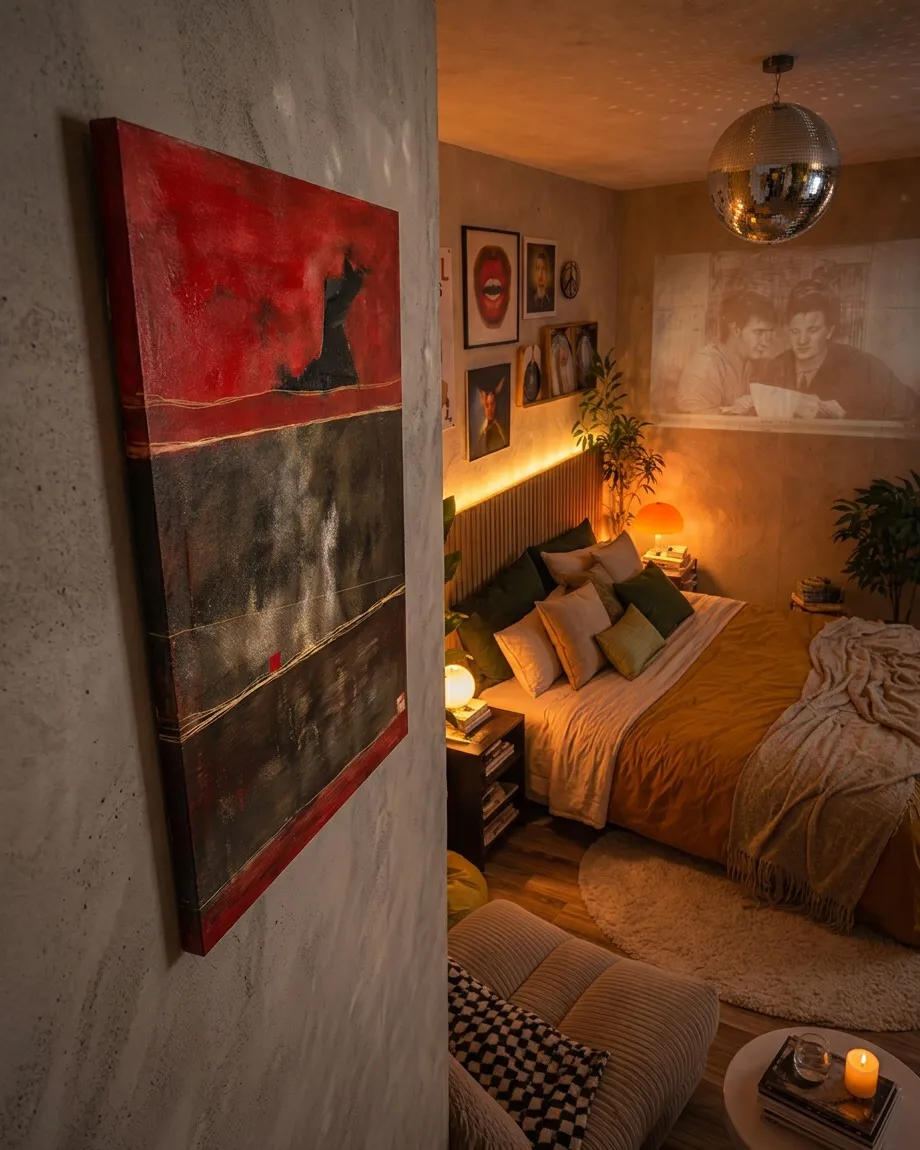
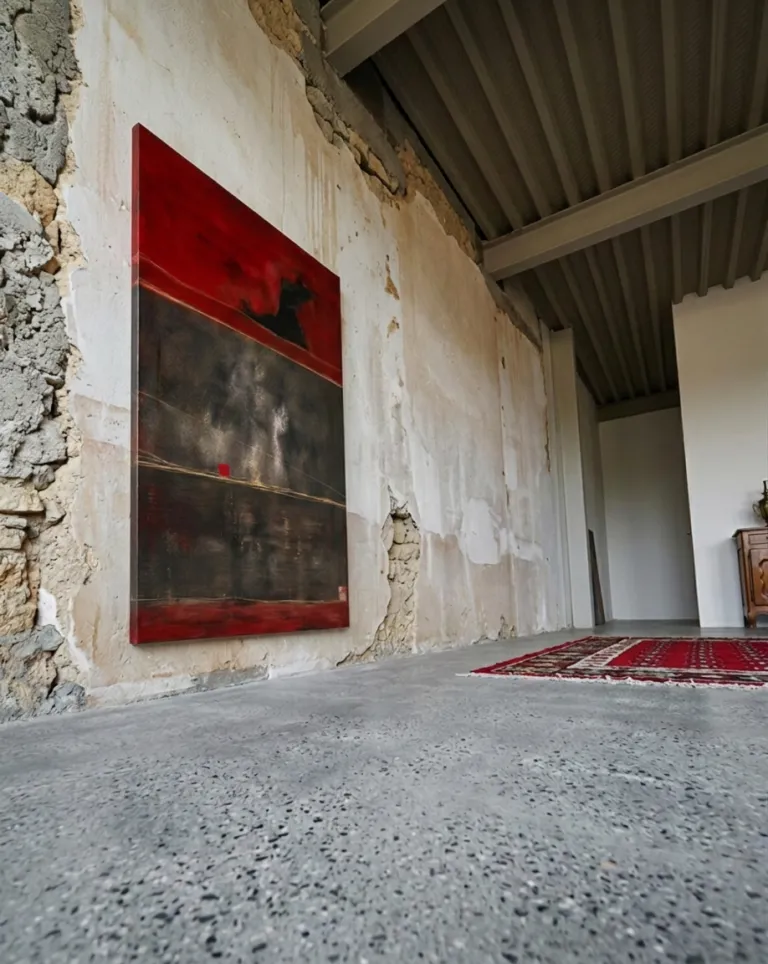
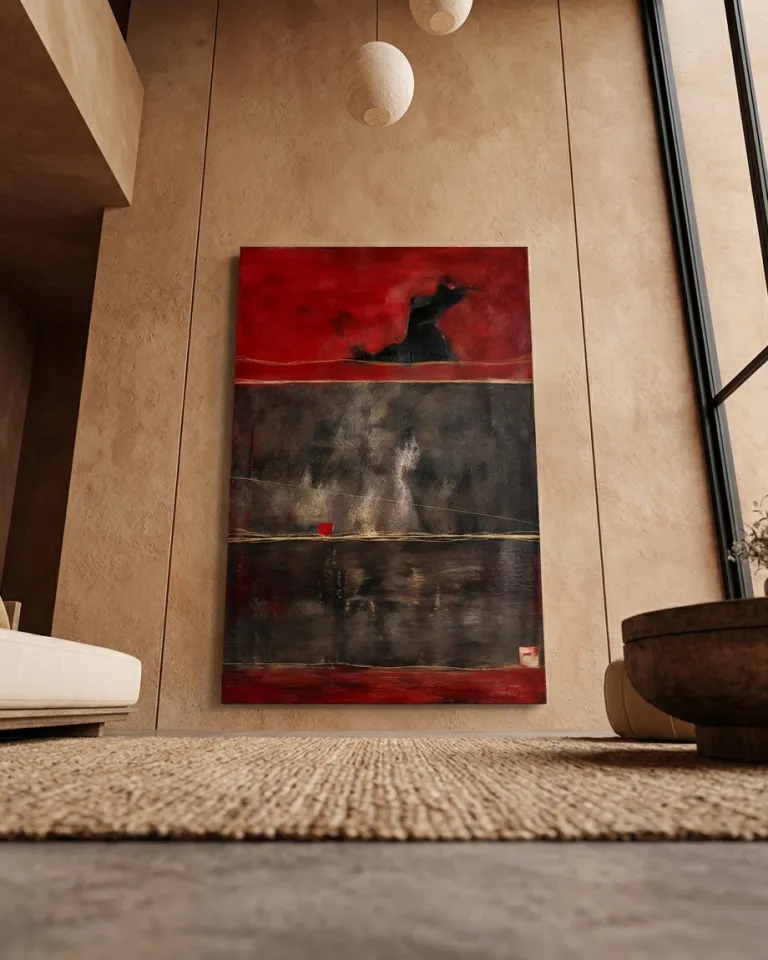
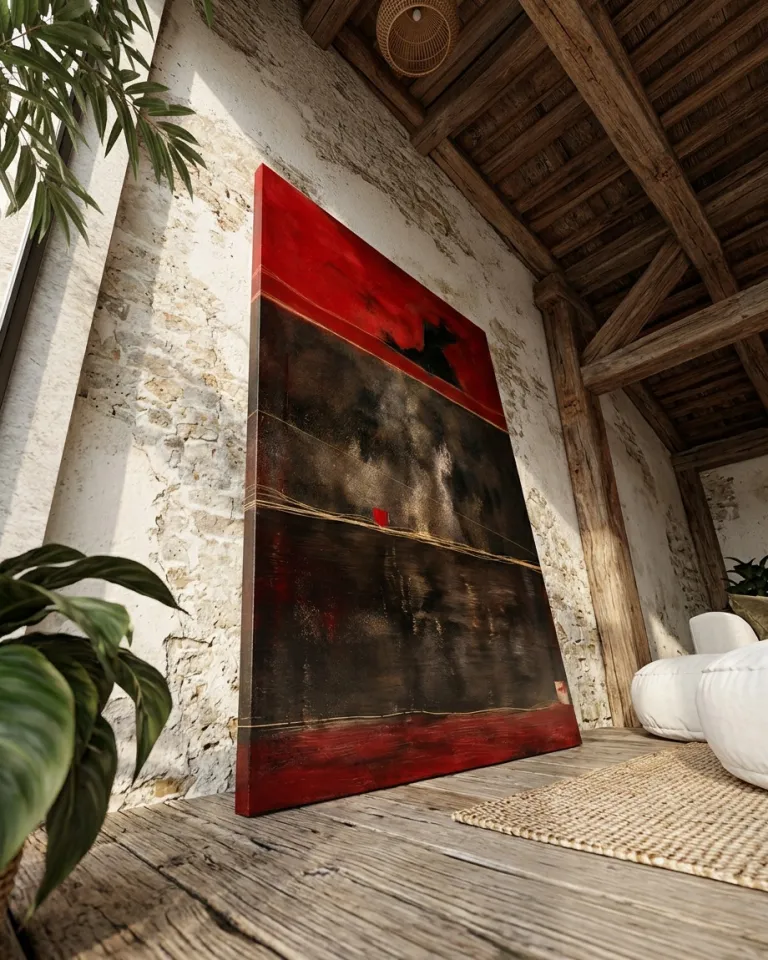
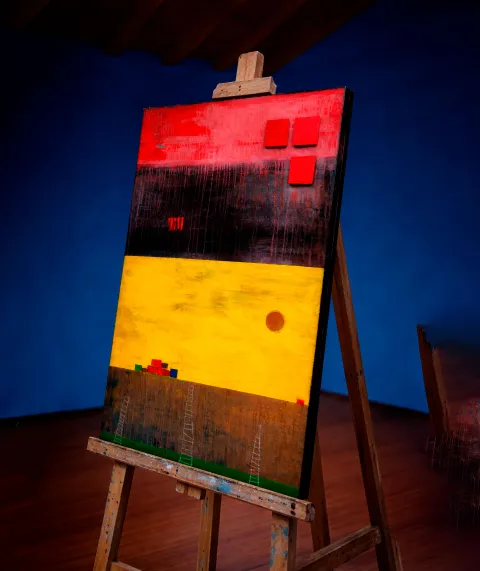
Un solo paso en la ceniza is part of the SITUS series, a pictorial inquiry addressing the position, boundary, and distance of forms within a territory. For Maurizio Valch, whose practice is nourished by physical transit and the accumulated experience of the landscape, the canvas does not function as a window of representation, but as a material ground where time and memory sediment. This work presents itself as a threshold where the artist's concerns with elemental structures and eroded surfaces acquire a geological weight, placing the viewer before a geography that has discarded any illustrative intent to become pure spatial presence.
The Perspective
The piece opens an essential question about the scale of our existence within an immense and apparently devastated environment: how to inhabit a territory when its coordinates have been reduced to the bare minimum? The tension of the work does not reside in dramatic conflict, but in the subtle relationship of forces between the large chromatic fields and the microscopic presences that interrupt them. The viewer confronts the contrast between the dark organic mass crowning the painting and the vulnerability of the small geometric blocks, raising a reflection on resistance, the search for orientation, and the need to define a minimal refuge in the face of uncertainty.
Artistic Affinities
This composition reveals a formal affinity with the dense chromatic masses of Nicolas de Staël, which always oscillate between abstract block and landscape structure. However, while de Staël pursues a luminous synthesis of reality, Valch organizes space through an austerity and divisions that dialogue with the linear tension of Barnett Newman and the material wound of Alberto Burri. Valch's uniqueness lies in the fact that his lines are not ornamental additions, but physical incisions (incised marks) that cut through the layers of pigment, allowing the surface to reveal its reverse side and function as a tactile edge where order and fracture coexist.
Visual Reading
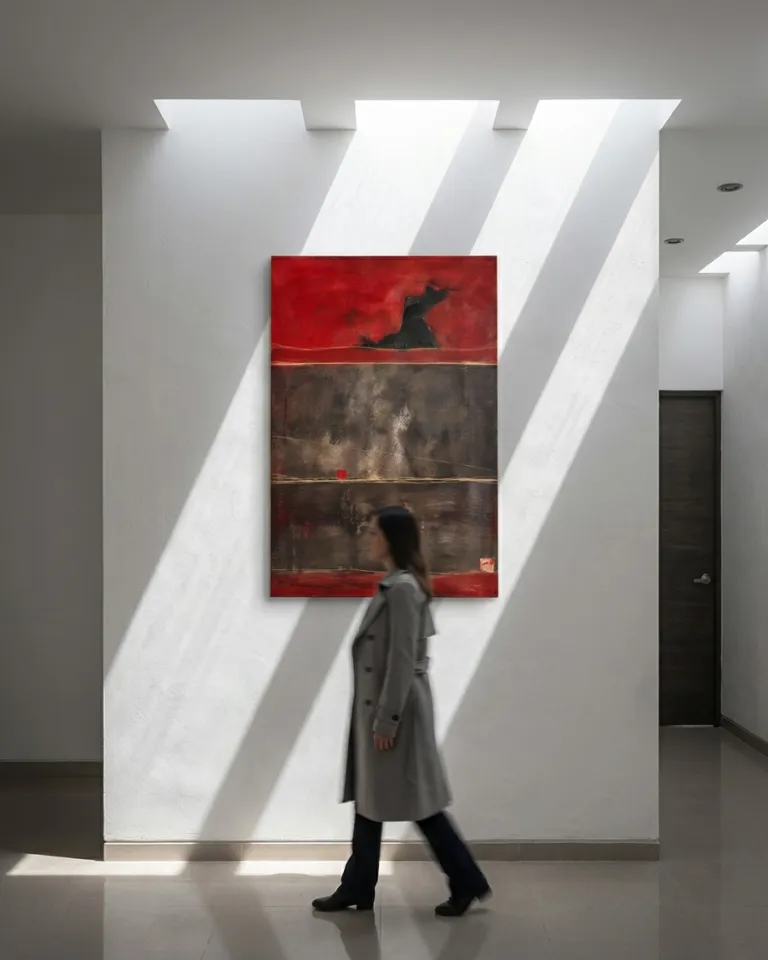
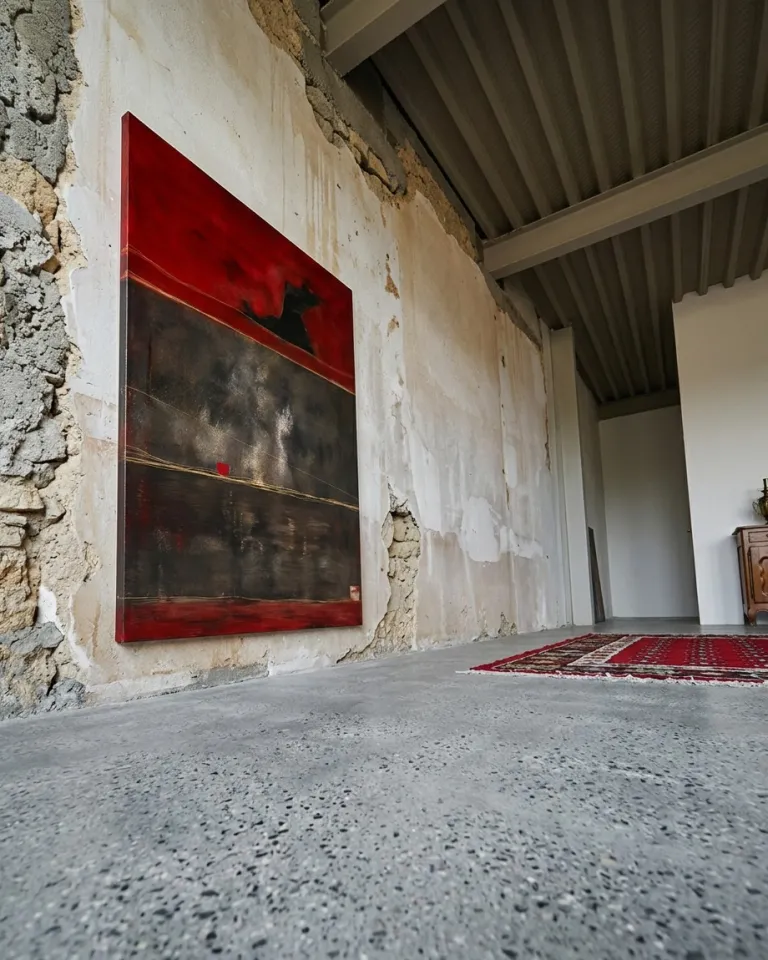
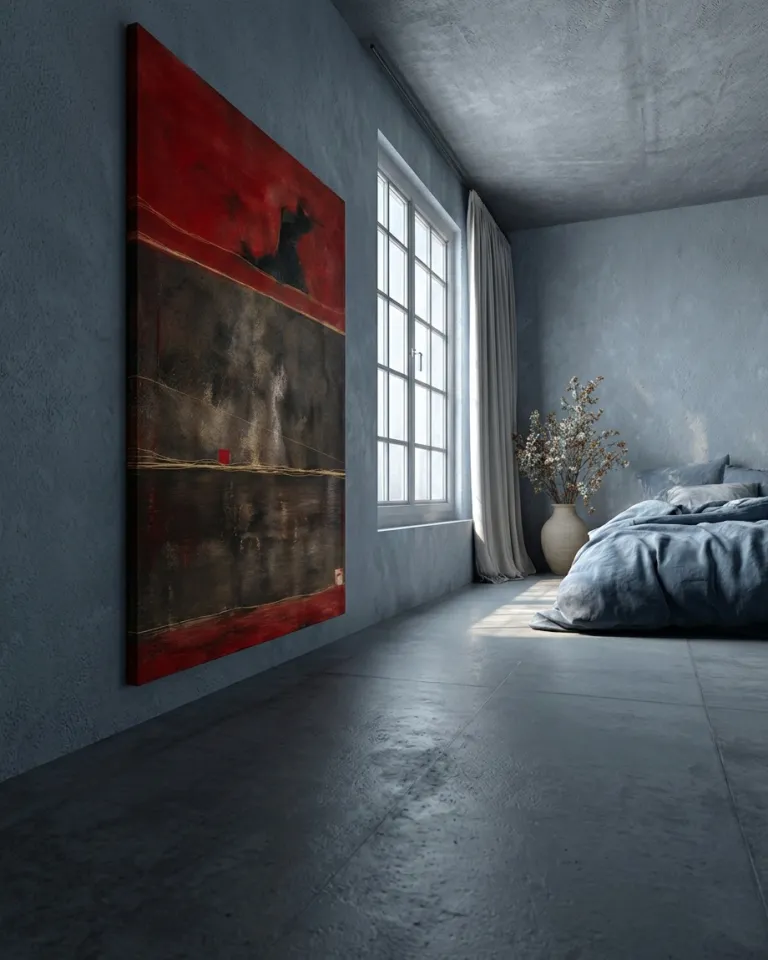
Structured in three large horizontal fields, the work presents a vibrant crimson red in its upper third, from which a rugged, dark silhouette rises like a monolith or a volcanic peak. The center of the canvas is dominated by an extensive textured gray zone, a plane of ash and charcoal crossed by a thin, oblique incised line that disobeys the straightness of the level. Right at the lower division, a tiny red block acts as a solitary sentinel on a thin horizontal line, visually balanced by a small pale square in the lower right corner, resting on the final strip of dark pigment. These incisions and spatial tesseræ demonstrate how emptiness and the containment of matter build a solid structure of relationships.
The Artist's Voice
I understand painting as that primal ground traversed with the body, where each color plane and each incision is the actual record of a transit. In this work, the crimson red and the gray density of the ash do not attempt to illustrate a catastrophe or a distant drama; they are the temperatures and the matter with which I measure my own presence against the immensity. In tracing that thin line that cuts the canvas and placing that tiny red block on the horizon, I ask myself how much space we really need to sustain ourselves, and whether a single point of resistance is enough to keep from losing our way in the midst of the unknown.