Context study / Un solo paso en la ceniza
Un solo paso en la ceniza — Context Study
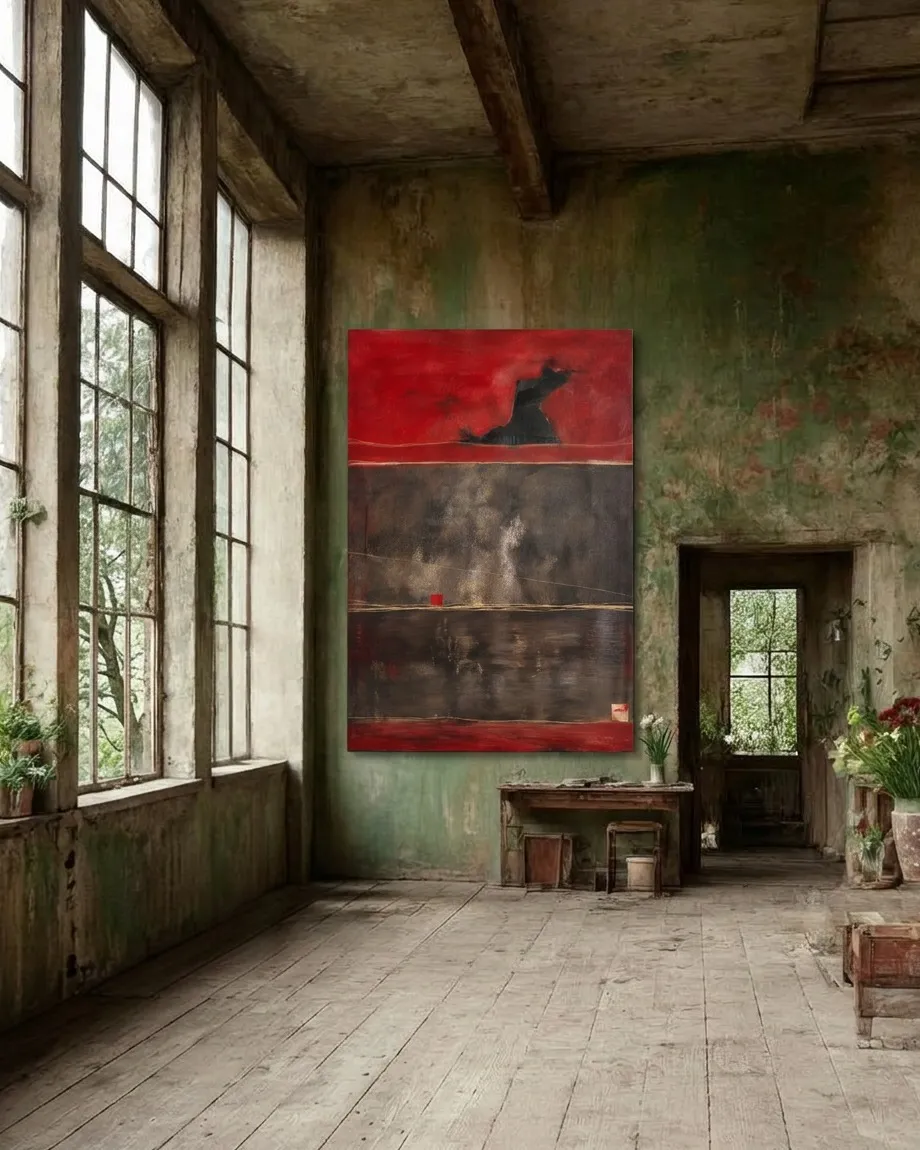
The eighty-by-one-hundred-and-twenty-centimeter surface of "Un solo paso in la ceniza" is structured around a severe division of strata organizing the pictorial matter into three large bands of an almost geological character. The upper third is dominated by a thick, dense crimson, upon which rests a monolithic, dark, and rough-edged silhouette that seems to press upon the lower plane with its mineral weight. Beneath this burning atmosphere unfolds a wide intermediate territory dominated by ashen grays, powdery textures, and glazes suggesting the cooling of an ancient combustion, which finally borders a dark, almost stagnant, and reflective lower band. It is precisely at the boundary of these zones where the concept of belonging is put into play, understood here not as a peaceful or organic rooting, but as a persistent tension of material forces. The small square red block, precisely situated on the incised horizontal line dividing the ash from the lower darkness, embodies this dispute: does this geometric fragment belong to the sky of fire from which it seems to originate, or is it hopelessly destined to dissolve into the lower blackness? The thin white and gold incisions crossing the canvas horizontally function as sutures or tactile scars attempting to order, contain, and hold those elements that threaten to be absorbed by the immensity of the plane.
When I face the canvas, my hand does not seek the complacency of ornament, but the insistence of the incision; through the accumulation of acrylic layers, successive oil glazes, and energetic scraping of the surface, I seek to establish a physical relationship with the material where cutting into the paint becomes an act of protection. The dark monolith rising in the upper band, as well as the small central red block and the white seal with crimson borders in the lower right corner, are not mere formal accidents, but are conceived as hermetic boxes—refuges built with pigment to guard a secret or a reservoir of silence against the intrusive gaze of the viewer. The refuge in my painting is not presented as monumental stone architecture, but as a trench of compact and scraped matter protecting the very vulnerability of the canvas and the experience deposited within it. In incising the crust of paint, I do not destroy, but rather delimit zones of shelter, small chromatic fortresses where the fragile can resist the wear of time and the weathering of open space.
A thin incised diagonal cuts through the field of grayish ash, emphasizing a declining trajectory that guides the gaze toward the lower zone, whose dark surface evokes the stillness of dense water or a polished slab in the shadow. In this transit toward the depths, the physics of trust manifests, which in this painting must not be understood as a rational certainty, but as a purely somatic acceptance of one's own weight and the gravity of the body. To trust here is equivalent to the audacity of taking that "single step" on unstable, scorched ground covered in cooled dust, assuming the risk that the support might yield under the sole of the foot. The work offers no simple footholds or immediate visual certainties; on the contrary, through its dry textures, material accidents, and wide chromatic silences, it demands a slow gaze from the viewer, stripped of the urgency to control or decipher the space, inviting them to sustain themselves on the uncertainty of the fall.
The title of this work, "Un solo paso en la ceniza", directly refers to my own experience of transit and the fatigue of the body when traveling long distances over gravel, where each step forward demands conscious effort and rigorous attention to the geology of the ground. From this walker's perspective, belonging is defined not by the possession of a stable dwelling or an immutable ground, but by the ephemeral, precarious, and rough trace we leave imprinted on the earth's surface as we move. The ash permeating the center of the painting is, ultimately, the physical residue of what once burned; painting on it is my way of inhabiting a desert of extinguished dust, assuming the finitude of our steps and the fragility of our presence before the immensity of the landscape. Each line scraped into the canvas is the testimony of that transit, an attempt to record the friction of the body with the material of the world without seeking to dominate it.
At the bottom end of the canvas, a horizontal band of red emerges once more as a shore or a retaining dike that halts the fall and delimits the composition. This final presence transforms the painting into a tactile membrane, a space of direct friction where the viewer's body collides with the physical consistency of the pigment and the roughness of the textures. It is in this strip where the concepts of belonging, protection, and trust unify and find their material synthesis: the work does not seek to resolve spatial tensions, nor does it pretend to offer a peaceful resolution to the transition between ash and darkness. On the contrary, it teaches us that the walker's true consistency lies not in reaching a summit or unveiling the enigma of the path, but in the ability to stand firm, with gravity and temperance, on the very edge of the unfinished.
- Original artwork
- Un solo paso en la ceniza
- Actual dimensions
- 31.5 × 47.2 in / 80 × 120 cm
- Presentation
- Digital contextual visualization
Context references
industrial decor with modern art paintings · abstract canvases in high ceiling living rooms · contemporary art contrast in old buildings · large format red and gray painting for living room
About this visualization
This visualization places the artwork within an architectural context to help collectors and viewers imagine its presence in a real space. It is an interpretive reference, not an exact reproduction: the original work remains the sole authority for scale, color, surface and material presence.