Context study / Un solo paso en la ceniza
Un solo paso en la ceniza — Context Study
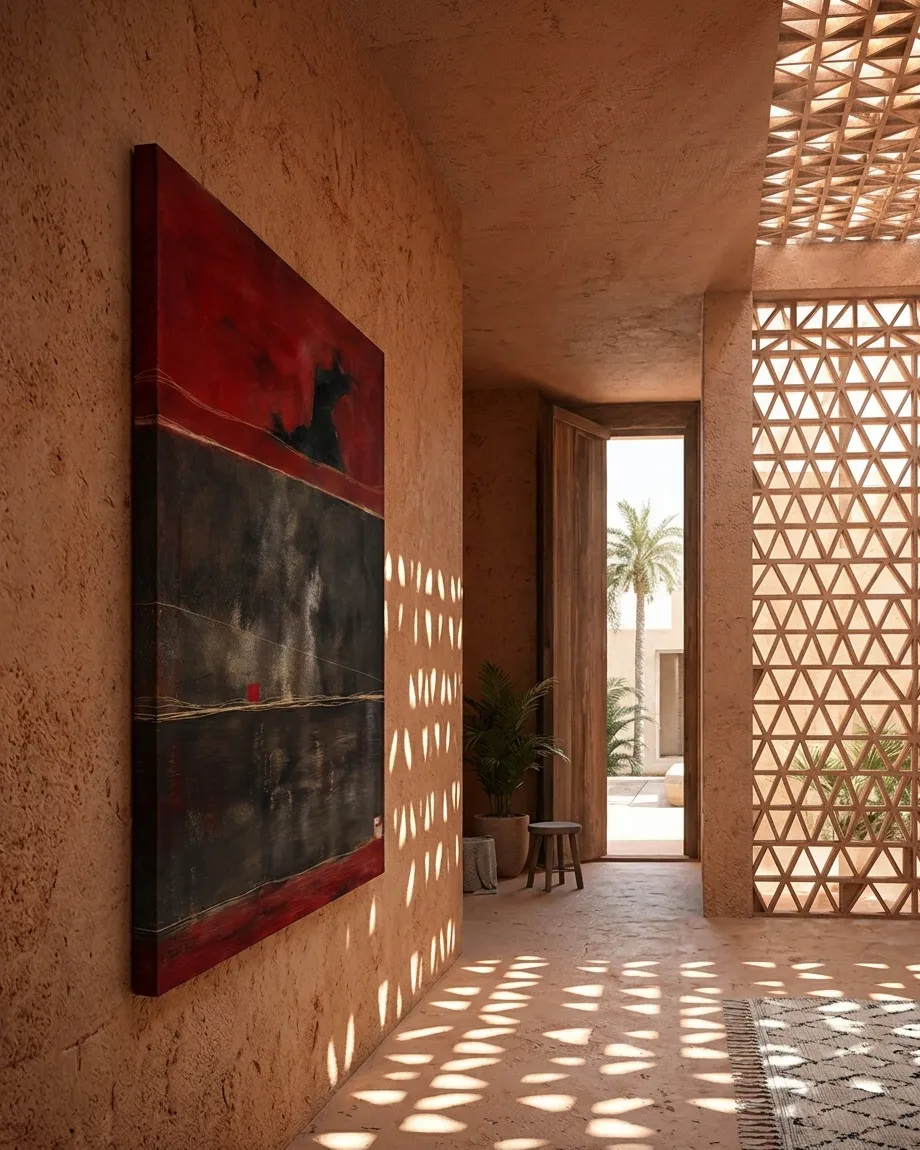
The surface of the work is structured around a severe horizontal division that compartments the canvas into three bands of contrasting chromatic densities, posing a true geography of catastrophe. The upper third is dominated by a violent crimson red over which emerges, suspended, a monolithic and dark mass that rises with the heaviness of dense smoke or a fragment of calcined charcoal; beneath this dense sky, a large central void of grayish tones emulates the tactile and powdery texture of ash, finally resting on a lower stratum of an almost liquid, abyssal black. To interrogate this rigorous stratification, it is inevitable to evoke the thought of G. I. Gurdjieff, a mystic and philosopher who thoroughly investigated the mechanical nature and lethargy of human consciousness, allowing us to decipher this tripartite composition not as a simple abstraction of nature, but as the ontological map of a "sleeping man" wandering automatically over the residues of his own history. In this cartography of slumber, the small red square holding onto the edge of the intermediate gray pit does not act as a mere decorative accent, but as a point of maximum material friction: a spark embodying the effort of a "self-remembering" against the immensity of forgetting and the inertia that assimilates everything.
When I face the canvas in the solitude of the studio, the title "Un solo paso en la ceniza" does not emerge as a literary whim, but as the decanting of a physical process in which I accumulate successive layers of acrylic and oil until forcing the material to reveal its internal resistance. The horizontal divisions that delimit these chromatic fields are not simple strokes added with a docile brush; they are true incisions in the matter, scars on the pictorial stratum that penetrate deeply into the surface to retain the implacable passage of the time of creation. By dragging the palette knife with force over the gray band, I want the friction to lift the superficial layer to unearth that dirty, veiled light pulsing underneath, so that the painting breathes its own destruction. The large dark monolith of the upper band was not planned; it appeared during the course of physical work as a necessity of blind weight, a shadow with a body claiming its own plane of gravity over the open wound of the crimson background.
The massive dark silhouette floating in the upper third of the composition immediately evokes the concept of the Shadow coined by Carl Gustav Jung, the celebrated Swiss psychiatrist who mapped the dimensions of the collective unconscious and archetypal structures. This shapeless, suspended presence seems to excavate Europe's geological memory, bringing to the surface both the primal fire of Paleolithic bonfires and the successive historical ashes that have covered Mediterranean soils. Confronting this element with Gurdjieff's thought generates a productive theoretical tension: while for Jung that suspended mass represents the collective Shadow that the subject must recognize and integrate to achieve wholeness, from a Gurdjieffian perspective it could be read as the colossal social and cosmic machinery that devours the individual's attention and keeps them captive. In front of this threatening block dominating the upper plane, the minuscule bicolor module located in the lower right corner functions as a rigorous spatial counterweight that disarticulates the symmetry of the collapse, forcing the viewer's eye to travel across the surface of the canvas in search of a precarious equilibrium.
For me, the creation of this painting is closely linked to my transit along the Andalusian coast, to the impact of Nerja's relentless light, and to the awareness that the Mediterranean is not just a landscape, but an immense cemetery of civilizations, broken ships, and promises reduced to dust. While painting this picture, I felt I was walking along a threshold where the outer landscape vanished completely, leaving bare only its essential skeleton: the horizon line, the border, and the calcined residue that remains when the light has been consumed. For this reason, I distrust closed psychological readings that attempt to domesticate painting; that small block I placed in the bottom corner is not a beacon of hope or a symbolic savior in the midst of a shipwreck, but simply a physical position, a body I decided to place at the extreme limit of the canvas to hold the gaze before everything plunges into the void.
In last analysis, the work places us at the very limit of representation and invites a phenomenological approach through the theses of Gaston Bachelard, the French philosopher who brilliantly analyzed the poetics of space and the imagination of fire, reminding us that ash is the witness of an extinguished vigor, a residue retaining the physical memory of the burning that originated it. This material melancholy contrasts directly with the philosophy of Osho, the mystic thinker who advocated absolute spontaneity and liberation from the bonds of the past, raising the question of whether this "step in the ash" represents a condemnation to repeat the traumas of history or if, on the contrary, it constitutes the only real ground where consciousness stripped of illusions can be refounded. In the end, the painting resists being closed off by verbal discourse; the violent vibration of red on the textured gray shows that the true secret of the work lies not in its possible meanings, but in the insurmountable physical distance that the artist has carved between its elements.
- Original artwork
- Un solo paso en la ceniza
- Actual dimensions
- 31.5 × 47.2 in / 80 × 120 cm
- Presentation
- Digital contextual visualization
Context references
modern rustic decor with abstract art · ideas for hanging large paintings in hallways · wabi sabi interior design with textured painting · contemporary art in earth and clay environments
About this visualization
This visualization places the artwork within an architectural context to help collectors and viewers imagine its presence in a real space. It is an interpretive reference, not an exact reproduction: the original work remains the sole authority for scale, color, surface and material presence.