Context study / Un solo paso en la ceniza
Maurizio Valch - Un solo paso en la ceniza | Minimalist Art
Movement I: The Gleaning Eye (The Tiny Periphery)
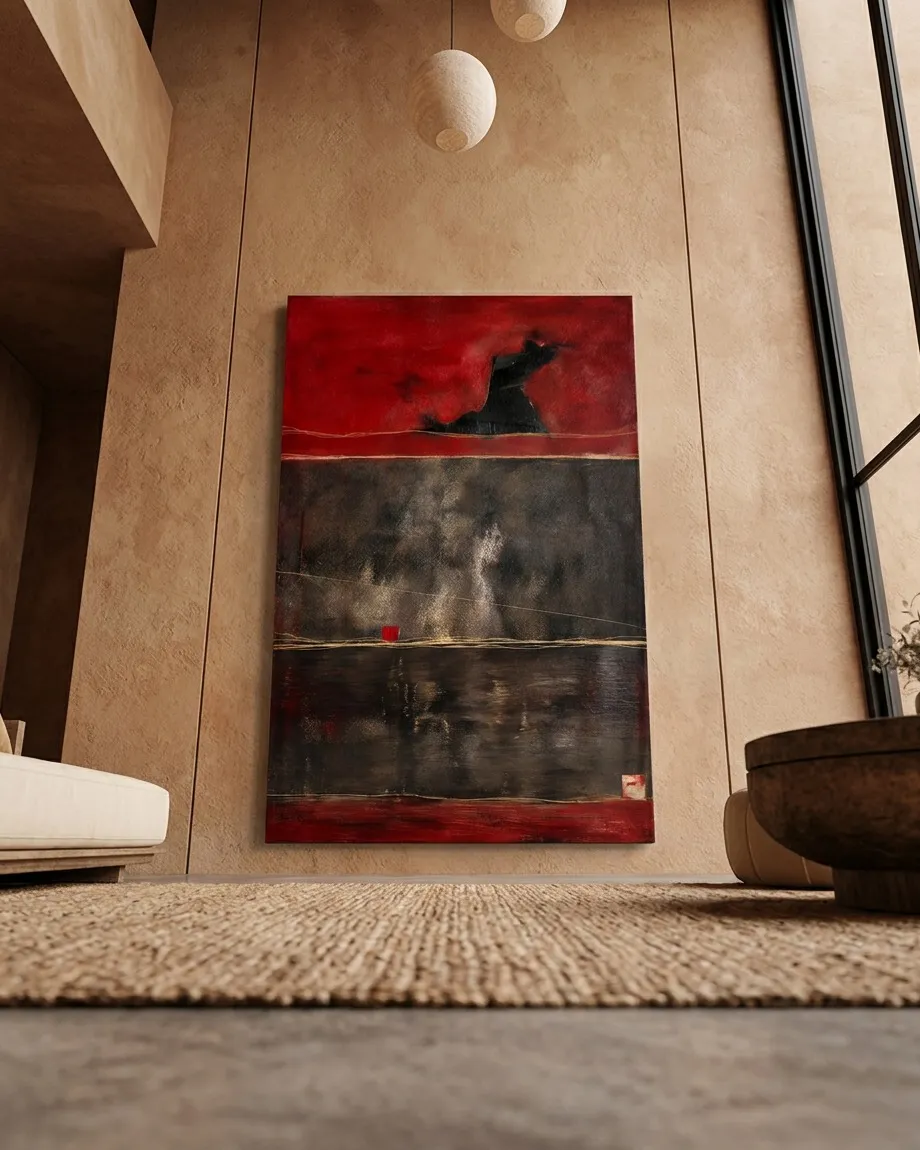
To enter the geography of "Un solo paso en la ceniza", one must train the eye to the scale of the minimal, where immensity is held up by details that seem accidental but actually act as gravitational counterweights. Agnès Varda, an untiring gleaner of what the world forgets by the roadside, bends down here to gather the remains of a matter that insists on not disappearing. With a gaze accustomed to gleaning the peripheral, the filmmaker draws our attention away from the great central storm and fixes it on the small geometric anchors: that tiny red cube resting on the golden thread and, further down, in the lower right corner, that white and red fragment resembling a wax seal or the final coordinate of a lost map.
Faced with the immensity of the dark void, the human eye experiences a sort of vertigo that forces it to seek refuge in these microstructures. They are not ornaments; they are buoys of sanity. Varda's lens would linger on the red cube like someone finding a cherry in a scorched orchard: a pocket of concentrated warmth, a point of resistance telling us that, even in the deepest desolation, a latent order exists. If these small blocks are the only reference points, where are they forcing us to walk? They force us to look closely, to understand that the scale of the work is not measured by its eighty centimeters of width, but by the infinite distance separating one point of support from another.
Faced with the density of that central plane, I remember doubting my own hands; I felt the material slipping away, and that in trying to fix the ash to the surface, I was only recording its dispersion. There is a point of friction where pigment ceases to obey the gesture and begins to demand its own weight, its own quiet gravity. I did not want to paint emptiness, but the tactile vibration left when everything else has been consumed, the almost imperceptible trace of a touch desperately searching for a boundary to hold onto.
Movement II: The Weight of Suspension (Matter and Consciousness)
In the center of the canvas, a large, hazy, textured mass imposes itself with the force of an event happening right now. Above it, an angular black silhouette ascends, cutting against a crimson sky as thick as stagnant blood. Virginia Woolf, a weaver of suspended moments who sought to capture the invisible pulse behind the passing of hours, holds her breath before this abyss of textures. For her, this large grey stain is not a representation of smoke, but a "moment of being": the visual record of consciousness folding in on itself, caught in an internal time that neither advances nor retreats.
What is the temperature of the ash in the center compared to the crimson sky crowning it? The upper red burns with a dry, suffocating heat, while the central mass feels cold, damp, like the residue of a fire put out by morning dew. Taking "a single step" in this territory is not about advancing physically; it is sinking one's foot into accumulated memory, a space where the past refuses to become oblivion and the future remains blocked by the density of the air. The black silhouette rising toward the red has no face and no clear direction: it is pure will to ascend amid absolute gravity.
When I hear this canvas described as a temporary suspension, or when I imagine Virginia's gaze resting on that hazy border, I understand a contradiction that inhabited me while I worked and that only now, contemplating the finished piece, I manage to decipher: I wanted to paint an absolute end, a stillness of ash and death, but the material itself sabotaged my intention, revealing that in every dark particle there is a latent pulse, a tremor refusing to be extinguished. The painting is not a point of arrival, but the threshold of an insistence.
Movement III: The Golden Cut (Gravity and Balance)
The canvas is traversed by fine horizontal lines that gleam with the muted luster of old gold. These lines act like the strings of a musical instrument subjected to extreme tension, or like political borders drawn across disputed territory. It is they that prevent the red abyss of the upper section from collapsing into the dark, incandescent depths of the bottom.
What sound does silence make when interrupted by a fine line of gold? It makes the sound of a clean fracture, of an imperceptible but definitive tear. These lines divide the space into three realms: the sky of fire, the purgatory of ash, and the lower plane, which behaves like a mirror of dark water or polished coal, reflecting a light of unknown origin.
The golden lines do not join the parts of the painting; rather, they maintain the exact distance so they do not destroy each other. It is a precarious balance, a non-aggression pact between light and shadow that keeps the viewer in a state of constant vigil. Ultimately, the work offers neither answers nor comfort; it leaves us there, foot suspended in mid-air, about to step onto the grey surface, forcing us to decide whether we can bear the weight of our own step.
- Original artwork
- Un solo paso en la ceniza
- Actual dimensions
- 31.5 × 47.2 in / 80 × 120 cm
- Presentation
- Digital contextual visualization
Context references
abstract paintings for modern living room · minimalist abstract painting · warm tone interior decoration · large format textured paintings · contemporary art for living room · maurizio valch situs · textured abstract canvases
About this visualization
This visualization places the artwork within an architectural context to help collectors and viewers imagine its presence in a real space. It is an interpretive reference, not an exact reproduction: the original work remains the sole authority for scale, color, surface and material presence.