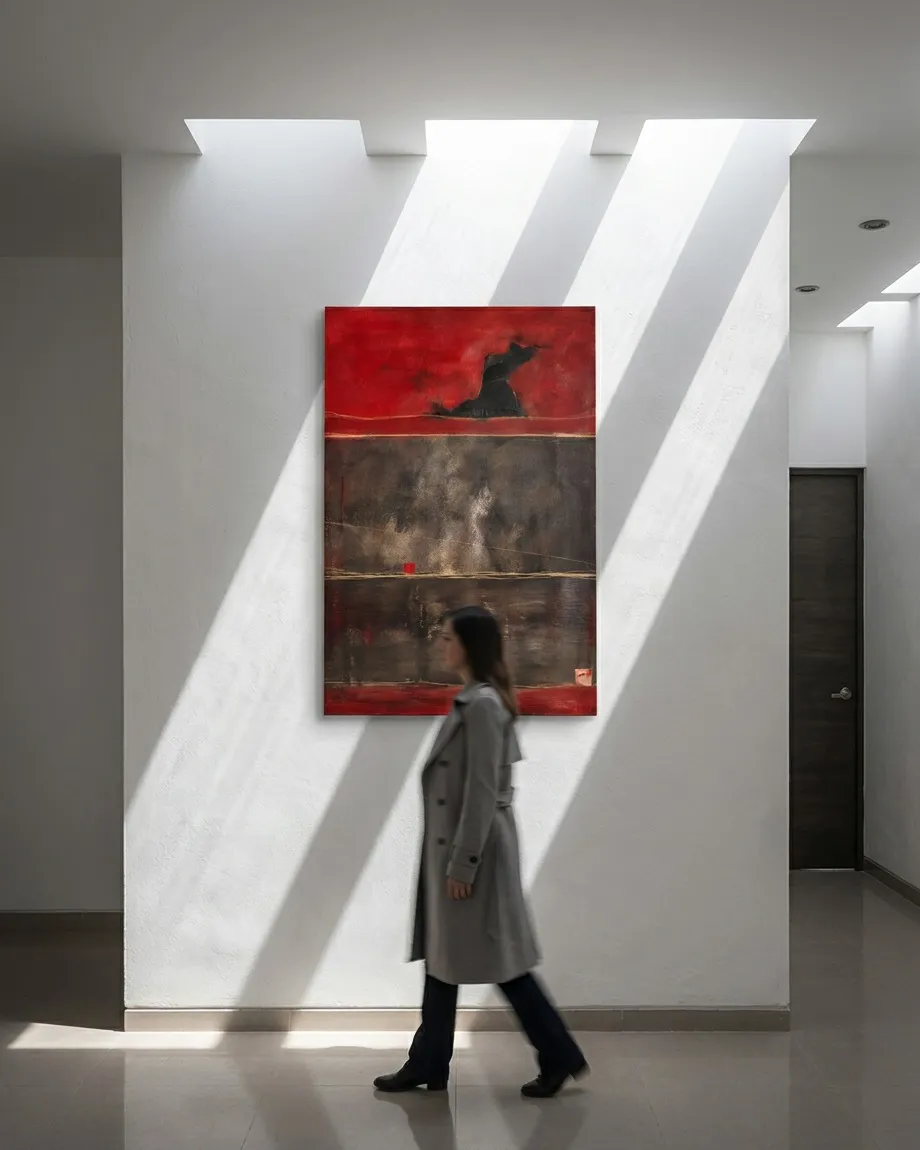
Context study / Un solo paso en la ceniza
Un solo paso en la ceniza | Painting for Entryway or Hallway
The surface of "Un solo paso en la ceniza" unfolds as a vertical geography of 80x120 cm divided into three large horizontal strata that hold the viewer’s perception in tension. In the upper band, a dense and glowing crimson red is interrupted by an angular, dark mass exerting downward pressure, while the wide central area opens like a greyish, burnt wasteland that emulates accumulated ash. This violent rupture of chromatic fields establishes a boundary that is as physical as it is psychic. Approached from the perspective of Carl Gustav Jung, the celebrated Swiss psychiatrist who explored the structure of the unconscious and the processes of spiritual transformation, this dark mass breaking into the crimson embodies the confrontation with the collective "Shadow"; it is a necessary descent into the nigredo of matter, where ash represents not inert waste, but the fertile and indispensable residue for psychic transmutation. However, this possibility of renewal is immediately questioned by the thought of G. I. Gurdjieff, the philosopher and spiritual teacher who denounced the sleep and automatism of human existence; from his view, this "step" over the residue of devastation critically questions whether we are witnessing a flash of authentic attention and "self-remembering" or if, on the contrary, we face another mechanical footprint marked by the inertia of the sleeping subject.
When I face the blank canvas, I want the painting to emerge from an accumulation of physical decisions and material sediment. In my working process for this piece, I have superimposed successive layers of acrylic and oil that I then subject to scraping and wearing down, forcing the support to reveal its own geological resistance. The fine horizontal and oblique lines crossing the central plane are not decorative additions or drawings superimposed on the finished surface; they are real wounds, direct incised lines that cut through the wet matter and leave a trace of the time of the stroke, a tactile mark of my own physical presence in the studio. Placing that small red block, suspended almost implausibly in the midst of the grey immensity, responds to my need to establish an anchor, a point of resistance that halts the dispersion of the plane and demands focused attention within the vastness of the ash.
Descending toward the lower third of the canvas, the composition transitions into a dark, almost liquid or reflective territory, resting on a final, thin red band. In the lower right corner, a small, pale quadrant of white and pinkish nuances interrupts this gloom, acting as a formal threshold or a subtle measure of scale against the density of the matter. If we recall the ideas of Gaston Bachelard, the French philosopher who analyzed the poetic relationship between the psyche and the spaces of matter or fire, we understand that these minimal, geometric elements act as genuine sanctuaries of shelter. For Bachelard, in the face of the threatening immensity of ash and void, the small quadrant functions as a miniature of order, a refuge or threshold where consciousness can shield itself and find a measure against external chaos. This modest geometry establishes constant friction between the imminence of falling into the lower reflective abyss and the possibility of an orderly ascent through the contemplation of the painting’s limits.
The title of the work, "Un solo paso en la ceniza", holds for me a truth that is both psychic and geological. When painting, I feel I am traversing an intermediate territory where form constantly threatens to dissolve into the dust that composes it; ash is the final record of what once burned, the materialized memory of a fire that is no longer there but insists on leaving its trace in the present. I try to sustain a constant tension between the desire to erect an ordered structure, delimited by my lines and quadrants, and the inevitable erosion of matter tending toward absolute dispersion. That "step" I name is a solitary and silent action, an attempt to tread firmly on shifting ground, knowing that each mark I leave on the painting is, at the same time, an act of formal affirmation and an acceptance of the inevitable dissolution of all things.
By integrating these perspectives, the painting does not leave us in a state of contemplative paralysis, but reveals itself as the beginning of an internal, unfinished cartography that demands the active participation of the observer. Any kind of mystical resolution or closed conclusion is avoided here; the work is offered as a surface of friction where the theory of the unconscious and the warnings of awakening dissolve before the raw, material presence of the paint. It is the physical incised traces on the canvas, the trace of scraped pigment, and the rough density of color that truly sustain the enigma of that "step", demonstrating that art does not illustrate predetermined concepts, but physically embodies the human attempt to trace a measure over the material void.
- Original artwork
- Un solo paso en la ceniza
- Actual dimensions
- 31.5 × 47.2 in / 80 × 120 cm
- Presentation
- Digital contextual visualization
Context references
80x120 paintings for hallways · minimalist decoration with abstract art · red and grey abstract painting with incised lines · contemporary art in modern gallery · abstract paintings for home entryways
About this visualization
This visualization places the artwork within an architectural context to help collectors and viewers imagine its presence in a real space. It is an interpretive reference, not an exact reproduction: the original work remains the sole authority for scale, color, surface and material presence.