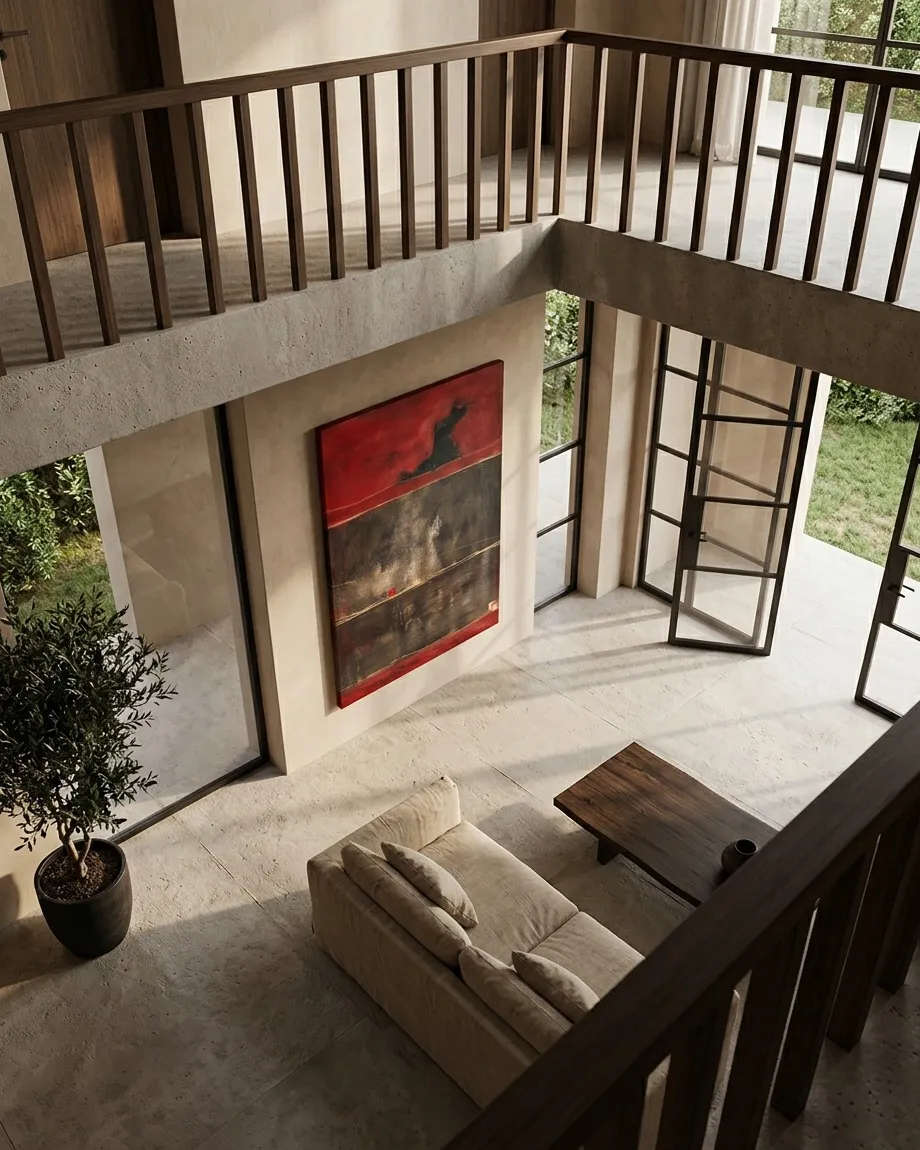
Context study / Un solo paso en la ceniza
Un solo paso en la ceniza - Maurizio Valch | Art Gallery
I. First Movement: The Stratum of the Fire (The Upper Red Band)
In the uppermost strip of the artwork, the space opens with a cry of dense pigment. It is an atmosphere of deep red, a chromatic wound that does not drip but suspends itself over the entirety of the canvas. In the midst of this thermal vibration, a dark, coarse, and suspended silhouette emerges, like a mass of charcoal or a petrified footprint defying the gravity of the abyss below.
To begin deciphering this presence, we encounter Johan Huizinga, a thinker who contemplates this canvas as a board of solemn forces where the human spirit demarcates its zones of truce. For him, this suspended silhouette is the first gesture of the rite: a foundational footprint that delimits the beginning of a sacred space. However, before him stands Alejandra Pizarnik, a poet who gazes into this painting looking for the reverse of the cry, the space where fire no longer burns but watches. Pizarnik shakes Huizinga’s playful interpretation and sees in that upper shadow a threatening presence: it is not a ritual trace ascending, but a silent weight that crushes, the mark of an exiled body that has left its final imprint just before falling into oblivion.
Does the body feel cold or heat when sliding its eyes along this upper band? Although the color evokes an active fire, the immobility of the black silhouette freezes the flames. It is an ancient, already petrified heat that questions us about the nature of its own origin.
The Process in Matter: The Artist Speaks
> "When confronting the material of this canvas, I remember the physical urgency of tracing that first border. I feared that the violent red at the top would end up devouring the dull gravity of the central black, so I carefully tensioned those golden filaments—threads that had to support the structure not only compositionally, but almost tectonically. I felt the painting vibrating in an unstable, almost dangerous way, until I understood that the artwork demanded a microscopic anchor: that small red square I placed intuitively to save the space from absolute collapse, a tiny but definitive visual counterweight."
II. Second Movement: The Tectonic Trench (The Great Central Grey and Black Void)
Below the igneous border opens the great void of ash. A textured band of mineral greys and deep blacks, evoking a geological trench or the residue of absolute combustion. If the upper band is fire, the center is its physical memory: the already cooled body of the disaster. What temperature does this central ash have compared to the fire above? Looking closely, the surface seems to emit a sharp cold, the ice that ensues when fire has exhausted all its fuel.
Crossing this void from side to side, two golden filaments act as subtle threads of tension. Huizinga observes these lines and smiles: to him, they are the borders of the "magic circle," the chalk lines that define the playground of art, where the laws of reality are suspended to give way to the order of representation. Pizarnik, however, rejects the idea of a protective game. For her, those golden lines are insurmountable borders, exposed scars on the skin of the canvas, or the remains of a stringed instrument whose music has been forcibly silenced.
If these golden lines were real strings of a forgotten instrument, what sound would they make if the wind of the ash made them vibrate? It would be a sharp, metallic, and solitary hum, the last note of a language dying out in the middle of the grey steppe.
III. Third Movement: The Microclimate of the Witness (The Small Red Square and the White Redoubt)
It is in the lower half of the work where the drama of scale is resolved. Just above one of the horizon lines, a small red square floats off-center in the grey immensity. Further down, almost at the edge of the abyss, in the bottom right corner, an imperceptible white flash exerts a silent gravitational pull.
This is where the clash between the historian and the poet reaches its peak dialectical tension. For Huizinga, that tiny red square is a forgotten piece on the board, a mark of order showing that the game of meaning is still possible, a witness that has survived the dissolution of forms. Pizarnik, moved by the extreme orphanhood of the figure, opposes with a whisper: that square is not a game piece, but the last drop of blood from a poem that could not be written, the minimal remnant of a consciousness refusing to be assimilated by the ash-black.
What physical law keeps the small red square floating exactly there without falling to the bottom of the grey abyss? It is not the gravity of matter, but the poetic tension of space. If it moved a millimeter, the entire painting would lose its center and collapse to the left. This microclimate of minimal weights sustains the entire canvas, converting the immensity of the void into a habitable territory thanks to the scale of the witness.
Reflection on the Limit: The Artist Speaks
> "The title of the painting, 'Un solo paso en la ceniza', resonates within me like an unresolved inheritance. That dark, diffuse silhouette inhabiting the upper band remains, even to my own eyes, an indecipherable mystery; I perceive it as a misstep I took myself on the wet canvas and have now left abandoned for the spectator to inhabit. There is a portion of this painting that stubbornly refuses to be explained by my hands, a zone of shadow that resists my own will and only finds its true meaning when another gaze travels across it."
Epilogue: The Memory of the Residue
As we move away from the painting, the tension between the horizontal bands unifies into a single physical certainty: the painting functions as a seismograph of a sacred loss.
What is it that the painting remembers and that we, looking at it, have forgotten? Perhaps the artwork is the only space we have left to take that suspended step, the only board where destruction and beauty are allowed to coexist under the watchful gaze of a golden sliver. Before "Un solo paso in la ceniza", the spectator is not a mere observer; they are the silent walker who agrees to traverse the very border of what has been extinguished.
- Original artwork
- Un solo paso en la ceniza
- Actual dimensions
- 31.5 × 47.2 in / 80 × 120 cm
- Presentation
- Digital contextual visualization
Context references
large paintings for double height living room · contemporary abstract art by Maurizio Valch · minimalist abstract painting decor · crimson red and textured black painting · artworks from the limina series
About this visualization
This visualization places the artwork within an architectural context to help collectors and viewers imagine its presence in a real space. It is an interpretive reference, not an exact reproduction: the original work remains the sole authority for scale, color, surface and material presence.