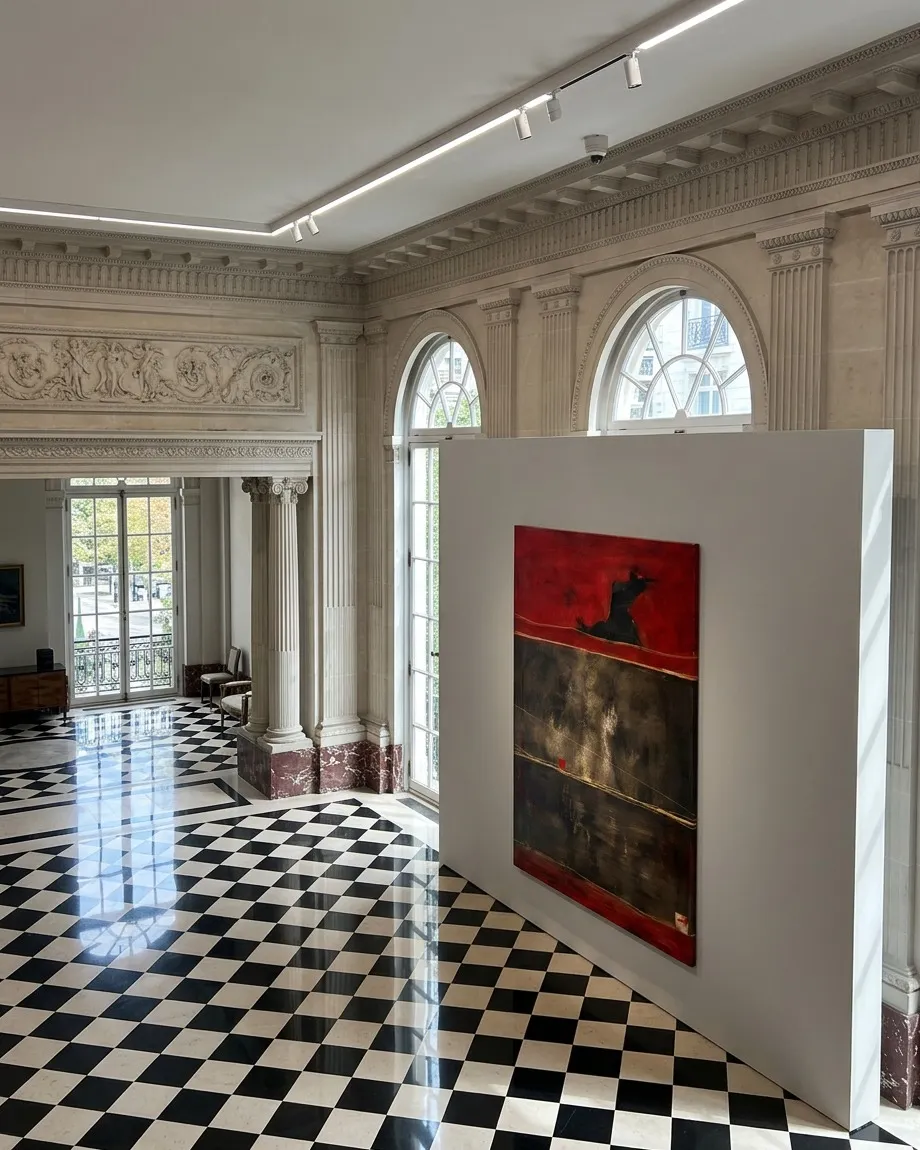
Context study / Un solo paso en la ceniza
Un solo paso en la ceniza | Maurizio Valch | Abstract Painting
The surface of the artwork is structured through a tripartite division that distributes the tensions of the pigment and the gravity of the plane. In the upper third, a field of dense, opaque crimson red is interrupted by an angular black mass with abrupt edges, which emerges from the border of the first strip like a mineral growth or a ruined architecture. This upper zone is separated from the central body by a horizontal incision, a thin golden line that seems to have been opened directly on the material to contain the overflow of color. The central space of the painting unfolds as a vast field of grey, brown, and blackish sedimentation, where oil and acrylic paint have been scraped, superimposed, and worked to suggest the vibration of calcined matter, accumulated dust, and the texture of residue. Finally, at the base of the canvas, a new horizontal boundary gives way to an even darker register, where in the bottom right corner rests a tiny red block, an isolated point of heat acting as a visual and formal counterweight to the immensity of the ashen void preceding it.
I work from the physical resistance of the material, understanding that the canvas is not a passive support for representation, but a wall where oil and acrylic fight a battle of densities. By scraping the layers of paint and forcing the superimposition of grey over black, I aim for the texture to acquire the real roughness of scorched earth, a territory where the palette knife leaves the trace of its own weight. The golden incisions crossing the composition are not simple dividing lines; they are precise wounds I open in the pictorial surface to establish artificial horizons of containment, borders that force the blocks of color to halt and accumulate at the edges. By placing that tiny red block at the bottom, I seek to suspend the inertia of the grey paint: it is not an accident, but a thoughtful decision, a point of extreme tension placed on the ash plane to force the eye to stop, to register a minimal but resolute presence interrupting the monotony of material wear.
This friction between the lethargy of the grey plane and the irruption of the small red block allows a direct parallel with the thought of George Gurdjieff. This thinker investigated the mechanisms of mental inertia and the possibility of awakening through a deliberate effort of attention. In this light, the large central ashen strip functions as the visual representation of daily automatism, that state of waking sleep in which human existence takes place, while the tiny red dot embodies the force of "self-remembering," that moment of minimal but radical lucidity that breaks the mechanical repetition of the environment. Likewise, the transition between the violent fire of the upper quadrant and the coldness of the middle zone evokes the insights of Gaston Bachelard. This author analyzed how material elements awaken deeply rooted images in the human imagination. Bachelardian ash is not presented here as mere sterile residue or the absolute annihilation of fire, but as the material archive of combustion, a substance that latently preserves the heat of the original fire and acts as a shelter of memory where past fire still vibrates under the appearance of thermal death.
I feel the passage of time not as a linear succession, but as the accumulation of layers of memory deposited on the earth, an experience closely linked to Mediterranean landscapes, where ruins and scorched fields reveal the persistence of the past under layers of dust and oblivion. I do not paint to illustrate psychological concepts or to translate philosophical theories into color; my practice consists of raising an autonomous territory where form simply appears and imposes itself with the force of a physical fact. The imposing dark mass rising in the upper third of the composition does not respond to a prior symbolic planning, but emerged during the process of pigment accumulation, like a presence demanding its own geological space on the red plain. That black form remains there, suspended between the burning sky and the ashen ground, like an archaic monument that needs no explanatory justification to hold its weight before the gaze.
Standing before the 120-centimeter height of the artwork, the viewer experiences a physical confrontation where their own bodily scale is questioned by the division of the canvas. The abrupt black silhouette interrupting the upper crimson field can be interpreted from the perspective of Carl Gustav Jung. This Swiss psychiatrist mapped the territories of the collective unconscious and the hidden forces that shape our perception of the world. The dark mass operates as a materialization of the archetypal Shadow, that unintegrated psychic structure emerging unexpectedly on the horizon of consciousness, reminding us of the existence of a primitive and untamed substrate underlying any appearance of order. The "single step" referenced in the title thus becomes a measure of real and phenomenological movement for whoever contemplates the painting: a physical step that pulls the body out of its own inertia and places it at the threshold of the ash, forcing it to recognize the fragility of its presence in front of the density of a territory that has ceased to burn but still retains the vibration of fire.
- Original artwork
- Un solo paso en la ceniza
- Actual dimensions
- 31.5 × 47.2 in / 80 × 120 cm
- Presentation
- Digital contextual visualization
Context references
large abstract paintings for living room · contemporary red abstract painting · wall art in classic living rooms · Maurizio Valch painter · textured paintings with relief
About this visualization
This visualization places the artwork within an architectural context to help collectors and viewers imagine its presence in a real space. It is an interpretive reference, not an exact reproduction: the original work remains the sole authority for scale, color, surface and material presence.