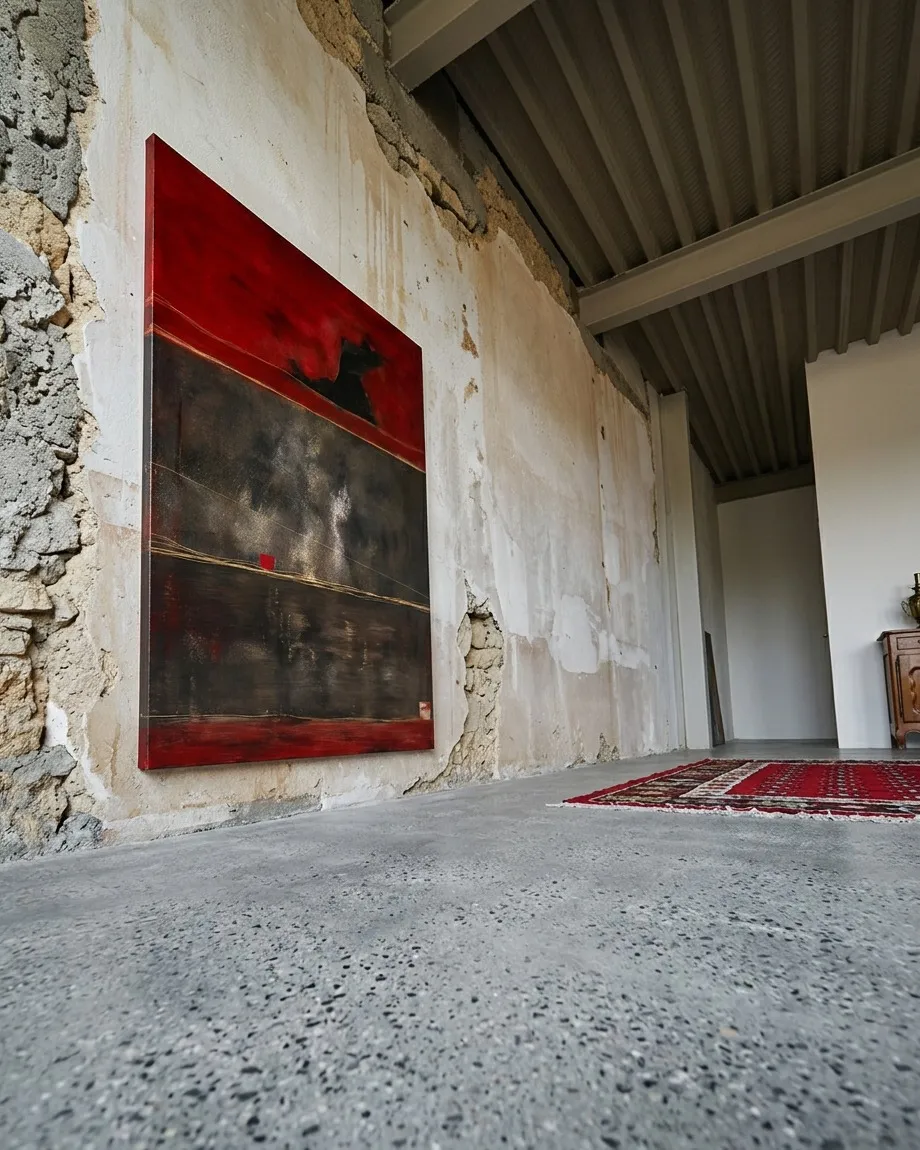
Context study / Un solo paso en la ceniza
Un solo paso en la ceniza - Maurizio Valch | Brutalist Painting
The roughness of the chipped wall, where brick and broken plaster show their inner layers beneath the steel ceiling beams, strips Un solo paso en la ceniza of any suspicion of ornament. Hanging the large canvas of the SITUS series in this industrial, exposed environment reveals the painting’s true nature: it is not the illustration of a state of mind, but a physical body retaining a specific vibration. The mass of dark grey and charcoal dominating the center of the composition does not narrate a loss or describe mourning; it simply contains them in its granular density, in the weight with which it settles over the last red strip. Here, emotion is presented all at once, bypassing the detour of language, offering itself to the viewer’s body with the same silent and resolute presence as the concrete floor on which it stands.
When I spread the grey pigment on the canvas, I am not thinking of an abstract melancholy or trying to explain what it means to be alone on an empty plain. I work with the temperature of the matter, with the resistance of the oil paint opposing the palette knife, looking for the exact point where color ceases to be an optical resource to become a pressure in the chest. The crimson of the upper third and the ash of the center are records of a transit my body recognizes long before my mind tries to give it a name. In tracing that fine incised line cutting the surface, I am not drawing a path on a map; I am opening a physical crack in the painting so that the silence I carry inside finds a place to hold itself.
This rejection of anecdote aligns the artwork with the compact masses of Nicolas de Staël, where space is organized through blocks of color sustaining a purely pictorial gravity. However, on Valch’s canvas, that density is interrupted by a minimal but decisive event: a tiny red block suspended over an unstable coordinate. The emotional tension of the painting does not arise from a represented conflict, but from this radical asymmetry between the immensity of the ashen plane and the fragility of the small sentinel resisting at its edge. There is no drama to decipher because there is no story preceding the painting; the vibration emerges from the pure relation of scale, from the contrast between the abyss of the background and the stubborn persistence of that single point of resistance.
I often find myself falling into the temptation of constructing a theory to justify why that small red square must go exactly there and not a few centimeters to the left. But I know that as soon as thought takes control and begins to manufacture a psychological explanation about control or vulnerability, the real event of the painting disappears under the weight of interpretation. That red block is a fact, a mark of heat on the cold surface, as real and devoid of discourse as the food I prepare for my dogs in the workshop or the fatigue in my legs after hours of walking. Painting is, at its heart, an effort to silence that inner noise, to reach a state where the hand can act cleanly, without the obligation to prove anything to an invisible court.
Ultimately, contemplating this work in the twilight of the brutalist space brings us back to the wisdom of insecurity spoken of by Alan Watts: experience is not divided between the subject who looks and the object looked at. The canvas is not a mirror of the artist’s soul nor an enigma for the visitor’s intellect, but a tactile shore where matter and gaze rub against each other. The thread of tension crossing the ash remains open, suspended on a slope that disobeys the law of the level. There is no possible conclusion at the foot of this wall of pigment; there remains only the silent presence of the work which, by refusing to narrate its own wound, offers itself as a territory free of explanations where emotion simply happens.
- Original artwork
- Un solo paso en la ceniza
- Actual dimensions
- 31.5 × 47.2 in / 80 × 120 cm
- Presentation
- Digital contextual visualization
Context references
brutalist style paintings · industrial abstract art · loft decor textured painting · grey and red textured painting · paintings by Maurizio Valch
About this visualization
This visualization places the artwork within an architectural context to help collectors and viewers imagine its presence in a real space. It is an interpretive reference, not an exact reproduction: the original work remains the sole authority for scale, color, surface and material presence.