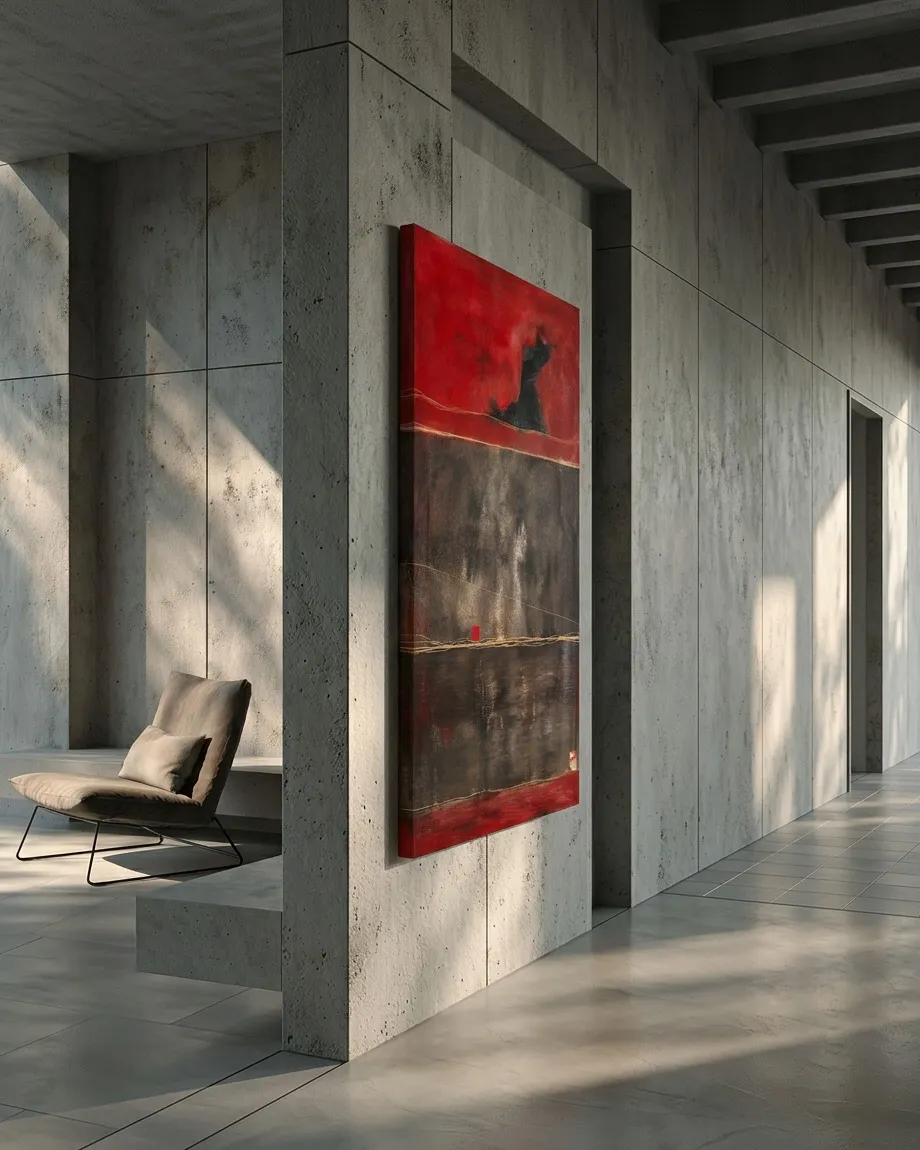
Context study / Un solo paso en la ceniza
Maurizio Valch | Un solo paso en la ceniza – Abstract Painting
First Movement: The Upper Red Band (The Fire / The Origin)
One’s gaze first stumbles upon height. Along the painting’s cornice, a dense, almost heraldic and carnal red supports a nocturnal accumulation—a dark, vertical mass that challenges the format’s horizontality. Is this dark mass something ascending like a totem of thick smoke, or is it an open wound draining its substance into the great void below? Faced with this enigma, the painting forces us to summon a centuries-old dialogue. Here, two opposing sensibilities collide: that of Antoni Tàpies, an artist who understood painting as a material battlefield where textures, surface wounds, and dust contain a silent, earthly spirituality; and that of Plato, a philosopher who invited us to doubt the shadows projected on a cave wall and seek the original light behind appearances.
Where Plato’s idealist gaze would suspect this black stain of being a double illusion—a shadow trapped within the cave of the canvas—the tactile vibration that fascinated Tàpies claims the physical wound as the only possible truth. What exists is matter that weighs, that collapses or stands with geological gravity. Just at the threshold where this upper fire cools, a disarming, almost naive vibration emerges: a series of subtle gold lines slicing through the canvas. Far from the solemnity of cosmic drama, a child might see in this boundary the delicate trace of a golden insect that patiently crossed the painting from side to side, oblivious to the catastrophe in the background, defining a playground upon the dust. Who actually strung these thin golden threads that seem to hold the weight of the red band, preventing it from collapsing into the central void? On that physical frontier, the fire goes out and gives way to suspension.
Second Movement: The Great Central Gray Void (The Ash / The Mist)
Descending further, the painting sheds its weight. We enter a territory of cold temperature, a plain where pigment turns to mist and matter presents itself as residue. It is the realm of ash. Here, suspended in an undecipherable exposure to the elements, floats a small, off-center red dot—a minimal impact of color breaking the monotony of the gray.
> The gray took over the canvas without asking permission. It began as a timid wash but soon became a dense atmosphere that devoured perspective and air. While working in that mist, this small red dot appeared almost by accident, like a spasm of the hand, an involuntary respiratory beat that I did not plan and that, even today, I resist fully understanding. It is an intruder claiming its right to exist in the middle of nothingness, a spark refusing to be buried by the surrounding ash.
What does Tàpies’s material gaze see in this rough, dusty texture of ash that Plato’s idealist gaze would reject as a simple lie of the senses? For the philosopher, this gray void is non-being, the absence of the pure idea; for the painter of matter, it is the place of maximum revelation, where the residue of what once burned confesses its most honest nature. In the silence of this void, the red dot is neither a traffic sign nor a symbol of passion; it is a minimal biological pulse, the last remaining warmth surviving in a landscape that has already renounced eloquence.
Third Movement: The Lower Dark Reflection (The Water / The Abyss)
Finally, gravity pulls the gaze toward the lower stratum. Here, the gray dissolves into fluid, damp, and oily blacks, suggesting the surface of a stagnant lake or a nocturnal mirror. It is an abyss that duplicates the original upper fire, but in an inverted, cold manner. In the bottom-right corner, almost at the edge of the frame, a small, perfectly defined bicolor square of white and red stands out. If this detail is the "single step" referenced in the title, what exactly burned before we arrived to look?
> Contemplating the work now, with the distance given by time and the already dry pigment, I discover a strange paradox. The painting, as it cooled and structured itself under the rigidity of those golden horizon lines, has become an alien territory. It no longer belongs to me. It seems to look at me from its silence, knowing something about myself—a limit, a wound, or a truce—that I am still unable to formulate in words. It has become a mirror returning an image clearer than my own memory.
The painting offers no way out. In the meeting between the watery, oily base and the golden boundaries containing it, a tension remains suspended and unresolved. There is no redemption in the ash, nor any definitive explanation for that single step peeking from the corner. We remain on the threshold, with the strange certainty that beneath the apparent stillness of the surface, matter continues to breathe in the darkness of the room.
- Original artwork
- Un solo paso en la ceniza
- Actual dimensions
- 31.5 × 47.2 in / 80 × 120 cm
- Presentation
- Digital contextual visualization
Context references
red and gray ash abstract painting · charcoal and gold textured painting · contemporary art inspired by tapies · large vertical brutalist painting for hallway · minimalist vertical abstract painting · architectural design wall art
About this visualization
This visualization places the artwork within an architectural context to help collectors and viewers imagine its presence in a real space. It is an interpretive reference, not an exact reproduction: the original work remains the sole authority for scale, color, surface and material presence.