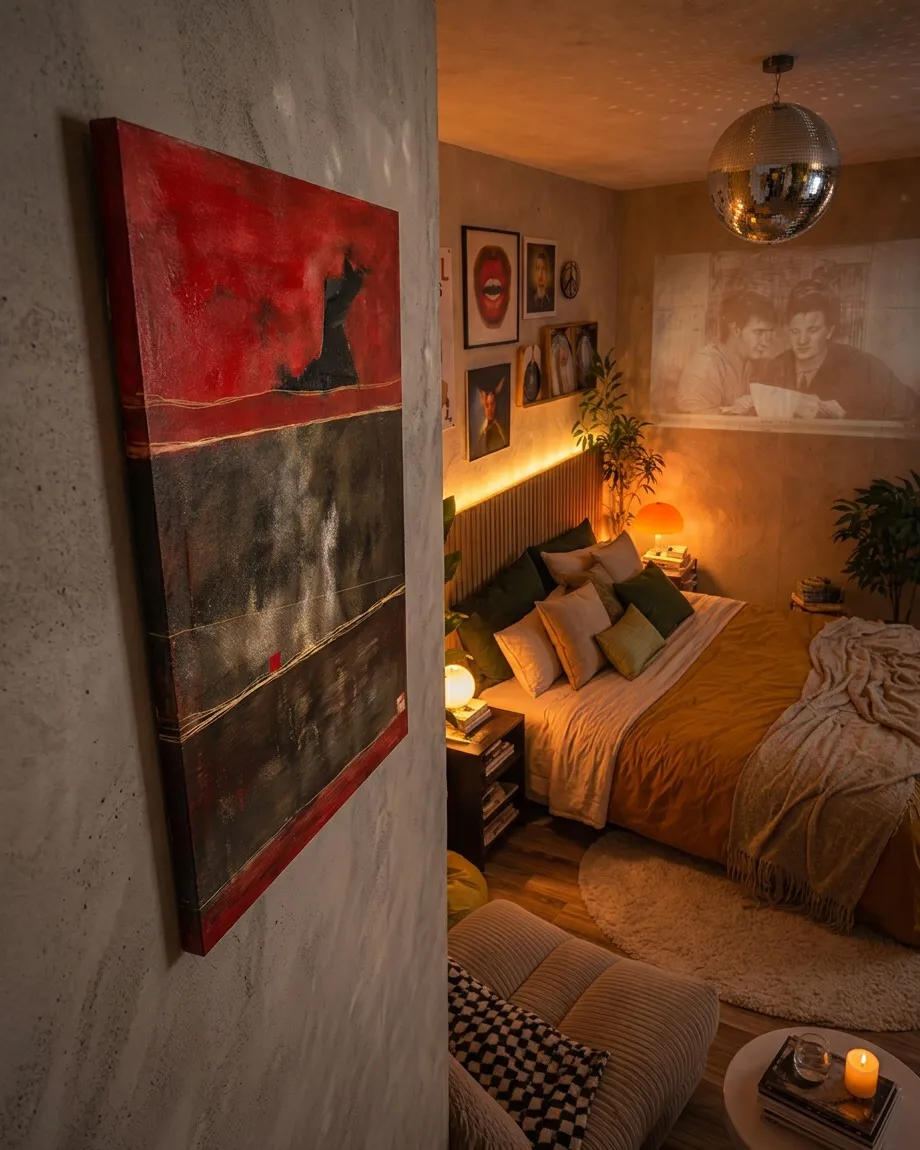
Context study / Un solo paso en la ceniza
Artwork 'Un solo paso en la ceniza' – Maurizio Valch | LIMINA Series
"Un solo paso en la ceniza" unfolds before the gaze as a topography of geological and chromatic tensions contained within a vertical format of 80 by 120 centimeters. In the upper third, a glowing crimson red color plane burns with the mute violence of a latent fire, crowned by a dense, angular black silhouette that rises like a charred monolith or the ruin of a structure consumed by fire. Below this crown of fire, the painting plunges into an immense central void of ashen and grayish tones, a textured territory evoking the physical accumulation of soot and charcoal dust. This vast surface does not represent destruction or nothingness, but pure permanence: ash here is understood as the indestructible residue, the definitive mineral sediment that survives combustion and bears witness to the passage of time. Two horizontal lines, golden incisions scratching the surface from end to end, act as geographical boundaries that order and contain this geological gravity, preventing the weight of the gray from collapsing upon itself and outlining the sedimentary layers of the painting.
When I face the wet matter on the canvas, I relive the physical rigor of my long solitary walks through desert paths, where each step is a negotiation with immensity and silence. Holding the metal stylus and firmly scraping the accumulated layers of oil to open those thin golden incisions, I feel I am tracing a path through the hostility of the canvas, revealing the luminous substrate hidden beneath the paint's density. It is in this physical gesture that exposure is embodied: that naked solitude of the traveler I have experienced after covering thousands of kilometers in the open, stripped of artifice and exposed to the immensity of the landscape. This exposure is not a weakness to me, but the brutal honesty of the resisting body; a human condition I have condensed into that tiny crimson block resting solitarily on one of the thin golden lines, suspended in the middle of nothingness like a traveler who has decided to stop and sustain their presence against the gray abyss.
The scale of the work alters drastically as the gaze descends toward the lower band, where a formal anomaly of great poetic power manifests. On the left, the tiny red sentinel remains motionless on its golden line, defying the ashen immensity; meanwhile, in the bottom-right corner, a discreet bicolor quadrant—divided into white and red—settles on the very edge of the support, like a visual anchor or a cadastral mark in an unpopulated territory. These two microscopic presences directly confront the immense atmospheric pressure of the upper dark mass and the surrounding gray void. Here, the concept of exposure undergoes a radical transformation: it sheds its sense of helplessness or vulnerability to become an active force of silent resistance. Far from letting themselves be devoured by the gravity of the soot or the threat of the black monolith, these small chromatic signs uphold the overall balance of the painting, proving that the minute possesses the strength necessary to contain and counteract the monumentality of disaster.
In my painting practice, which many classify as brutalist and restrained, wonder is not revealed through a loud, mystical, or spiritual awe, but as the purely physical miracle of material persistence. I am amazed by the fact that a vibration of color, however slight, or a thin wounded line on the canvas manages to hold, beat, and breathe under the weight of the soot and the implacable accumulation of the layers of oil and binder that I apply with the palette knife. My relationship with matter is intimate and tactile; I mix dust with the medium, searching for a density that records the memory of each tool stroke, of each physical friction. The canvas ends up behaving like a sensitive skin retaining the traces of its own healing process, where wonder lies precisely in that ability of the painting to heal its surface wounds without hiding them, allowing the background light to emerge through the clean cuts of the metal.
Contemplating "Un solo paso en la ceniza" in all its physical magnitude, it becomes clear that the title of the work is not a literary metaphor, but the exact threshold where the conceptual constellation unifies and reconciles with matter. The painting reveals itself as the stage of a tense yet harmonious encounter: the exposure of the tiny red signs, unprotected against the void, coexists with the unalterable permanence of the ashen textures that evoke a mineral and eternal time. From this forced coexistence emerges the discreet wonder of Maurizio Valch’s painting, a visual event that does not seek to comfort the viewer, but to place them before the rigor of a cracked horizon. Stepping back from the canvas, we do not find a resolution or a comforting answer; instead, we remain inhabiting the thermal vibration of that wounded landscape, where the red color continues to burn slowly beneath the indestructible residue of the fire.
- Original artwork
- Un solo paso en la ceniza
- Actual dimensions
- 31.5 × 47.2 in / 80 × 120 cm
- Presentation
- Digital contextual visualization
Context references
abstract painting by maurizio valch · limina series artwork · abstract art with incised gold lines · minimalist red and black painting with relief · buy original contemporary abstract painting
About this visualization
This visualization places the artwork within an architectural context to help collectors and viewers imagine its presence in a real space. It is an interpretive reference, not an exact reproduction: the original work remains the sole authority for scale, color, surface and material presence.