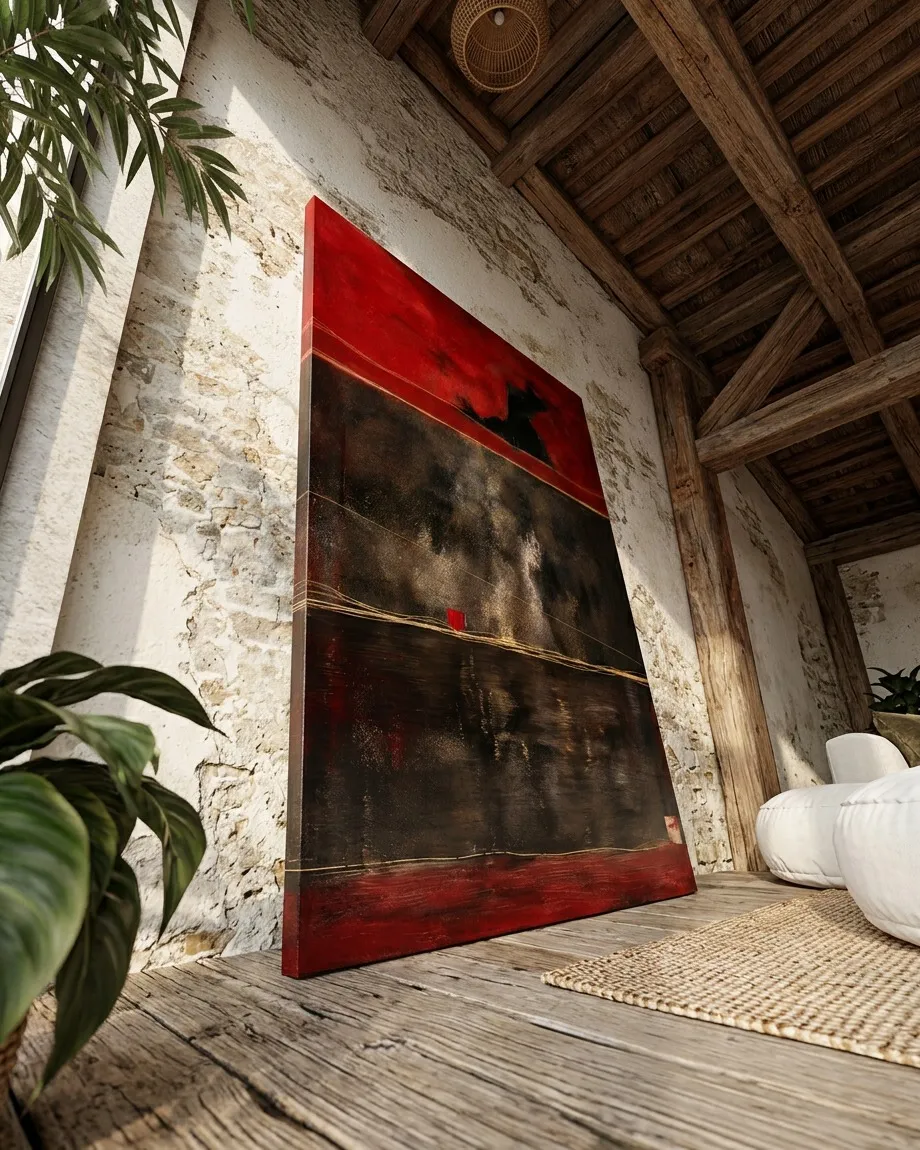
Context study / Un solo paso en la ceniza
Un solo paso en la ceniza | Maurizio Valch | Rustic Decor
In "Un solo paso en la ceniza", the pictorial surface is organized through a severe tension of strata where two bands of a dense, boiling crimson red delimit a vast central field of dark grey, almost black, whose rough texture evokes the sediment of soot and scorched earth. This intermediate space does not operate as an inert hollow or a void of representation, but as the material testimony of a slow cooling, a geography that has abandoned its igneous violence to settle into the gravity of the residue. The warmth appears here not as the agitation of an active flame, but in the form of a latent temperature, a fossil radiation that survives combustion and pulses from the depths of the matter. Faced with this transition from the chromatic vibration of the extremes to the muted silence of the ash, the viewer is called to practice a visual listening—a suspended attention capable of perceiving the quiet crackle of organic binders contracting and the weight of a support that has halted its burning to become a geological layer.
When confronting this eighty by one hundred and twenty centimeter canvas, I understand that working with oil and acrylic in this piece is not about accumulating layers of representation, but about practicing a rigorous exercise of abandonment. Creating this piece has demanded of me a conscious detachment from the sovereignty of the stroke, a deliberate renunciation of the control and tyranny sometimes imposed by the verticality of the easel. Using a palette knife and direct scraping, I have stripped away wet matter, allowing the raw texture of the canvas weave to assert itself. Taking this "single step" upon the ashen surface means accepting that the painting must emancipate itself from my hand; leaving it to stand on its own, cold to the touch but internally charged with the warmth accumulated during the hours of physical effort that brought it to life.
Close scrutiny of the piece reveals minor accidents punctuating the seemingly desolate immensity: thin, ochre incised lines that cross the plane like taut strings or boundary lines, a tiny red cube suspended in the middle horizon, and a small bicolor square standing isolated in the lower right corner. These discreet signs act as sentinels of a territory that resists the homogenization of the void. These incised lines function as scores for a deep listening, linear traces that record silent frequencies to ward off external noise. Meanwhile, the minuscule crimson block condenses the warmth that has been banished from the vast field of ash, rising as a coordinate of tactile resistance that refuses to dissolve into the absolute detachment of abandonment.
When applying the dark zones of this surface, I seek the same self-possession I experience during my long walks along barren, vegetation-free paths, where the weight of gravel under my boots and accumulated fatigue eventually quiet the noise of the mind. There is a direct relationship between exhausting walks and the act of covering the canvas: both demand a pure bodily listening, a state of attention where the observer and the observed ultimately merge into the same step. Painting this ash is, for me, a way of entering the sobriety of an empty room at the end of the day; a space of absolute abandonment where keeping up an identity is no longer necessary, and where the only real belonging is the residual warmth of one's own breath pulsing gently in the half-light.
Finally, "Un solo paso en la ceniza" eludes any tragic reading to propose, instead, the possibility of a transit freed from maps. The large, dark, monolithic silhouette that emerges in the upper crimson band resembles a stranded keel or a body that has decided to halt its march to become pure permanence. The painting thus places us on a tactile shore, a zone of friction where the warmth evoking origin, the abandonment of utilitarian haste, and the listening to the empty interval reveal themselves as one and the same. Far from offering decorative solutions or dogmatic answers, Maurizio Valch's work delivers a rugged, honest surface—a threshold where the gaze can stumble, shed its theories, and simply remain before the open horizon.
- Original artwork
- Un solo paso en la ceniza
- Actual dimensions
- 31.5 × 47.2 in / 80 × 120 cm
- Presentation
- Digital contextual visualization
Context references
paintings leaning on the floor decor · modern rustic living room decor · warm rustic abstract painting · large warm and dark tone paintings · situs collection by maurizio valch
About this visualization
This visualization places the artwork within an architectural context to help collectors and viewers imagine its presence in a real space. It is an interpretive reference, not an exact reproduction: the original work remains the sole authority for scale, color, surface and material presence.