
Published work / LIMINA
CLATHRI
From the LIMINA series
- Size
- 31.5 × 47.2 in / 80 × 120 cm
- Series
-
LIMINA
 Painting series
LIMINA
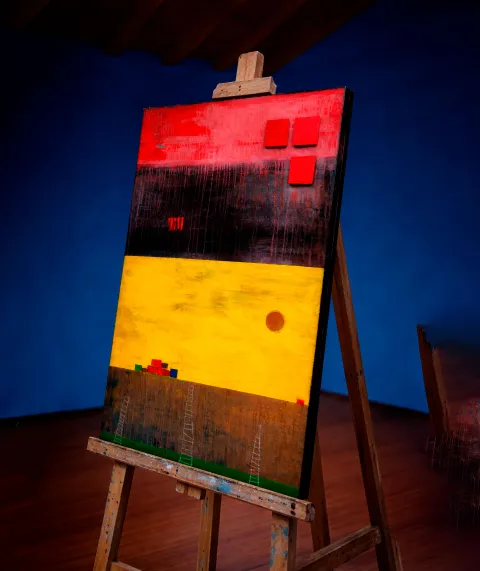
In LIMINA, Maurizio Valch constructs territories of transit through superimposed planes, contained horizons, unstable enclosures, and suspended forms. The painting sustains an elemental architecture while seepage, drips, and incisions introduce a mobility that prevents any definitive orientation. View series
Painting series
LIMINA
In LIMINA, Maurizio Valch constructs territories of transit through superimposed planes, contained horizons, unstable enclosures, and suspended forms. The painting sustains an elemental architecture while seepage, drips, and incisions introduce a mobility that prevents any definitive orientation. View series
- Context studies
- 10
Conceptual Note
Movement I: The Lower Plane (The Wired Night)
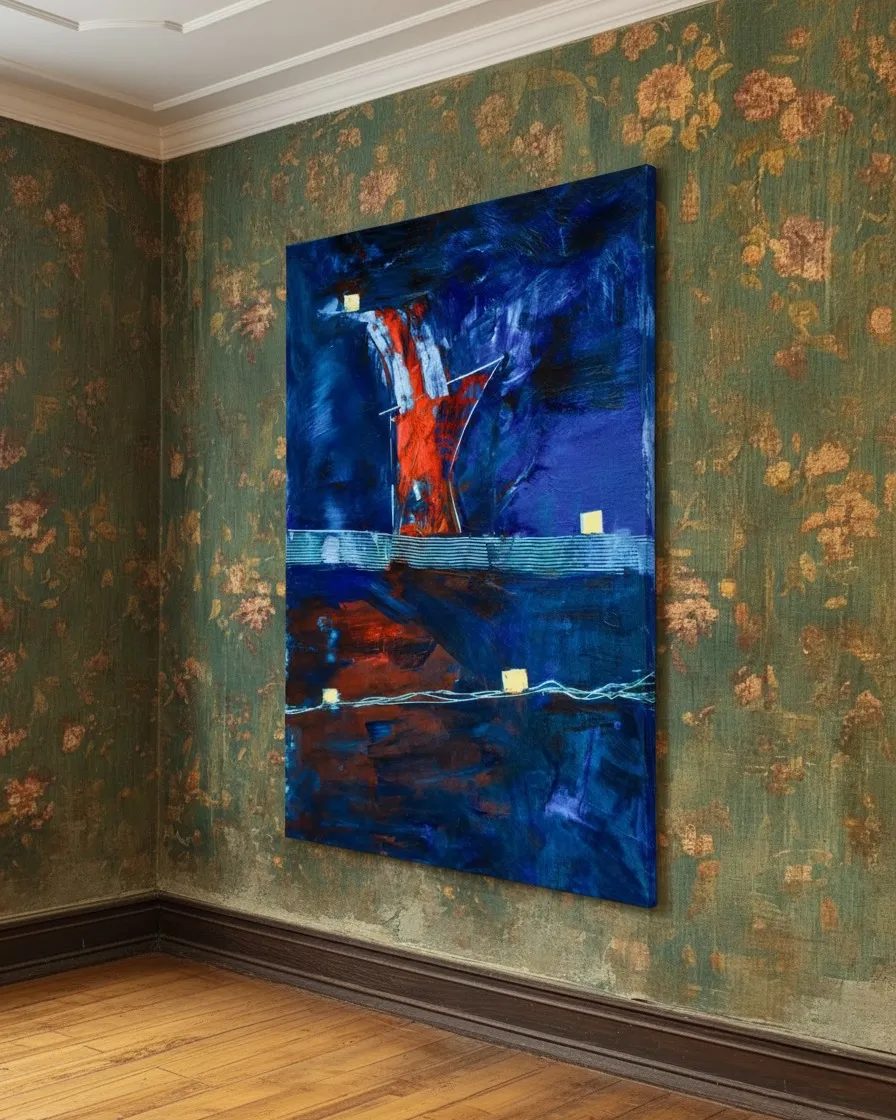
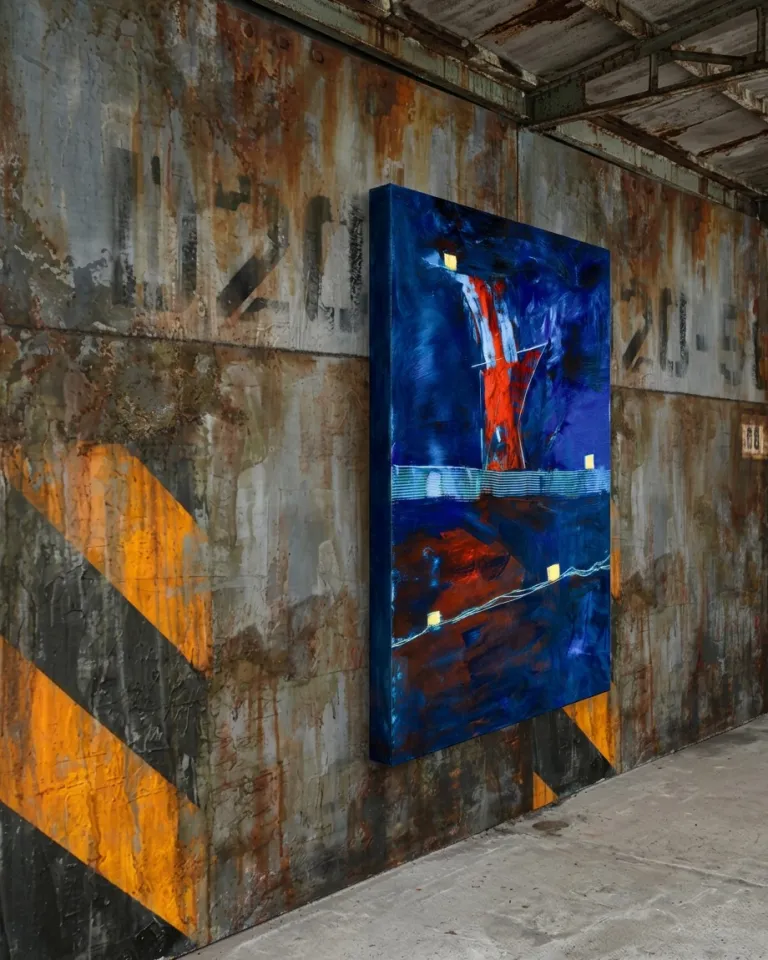
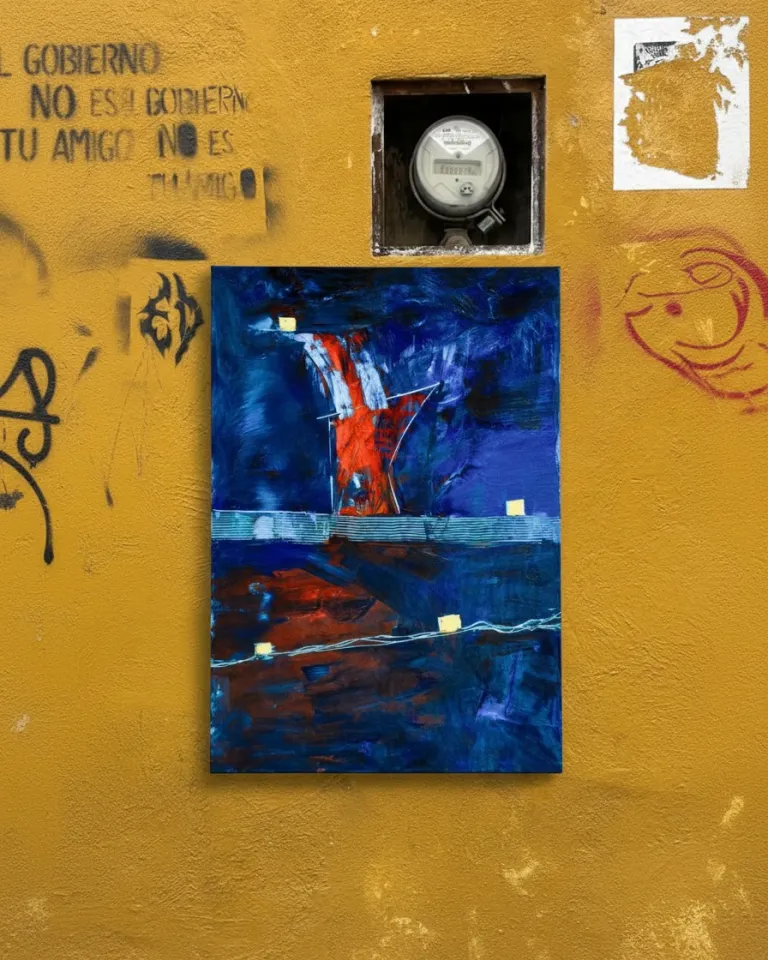
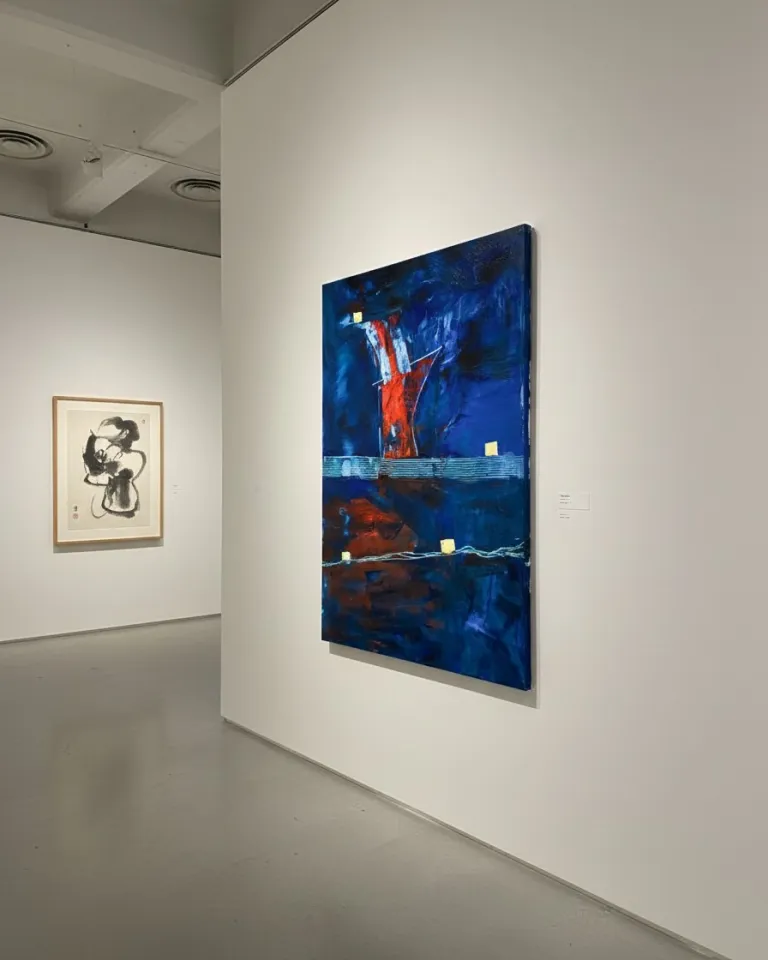
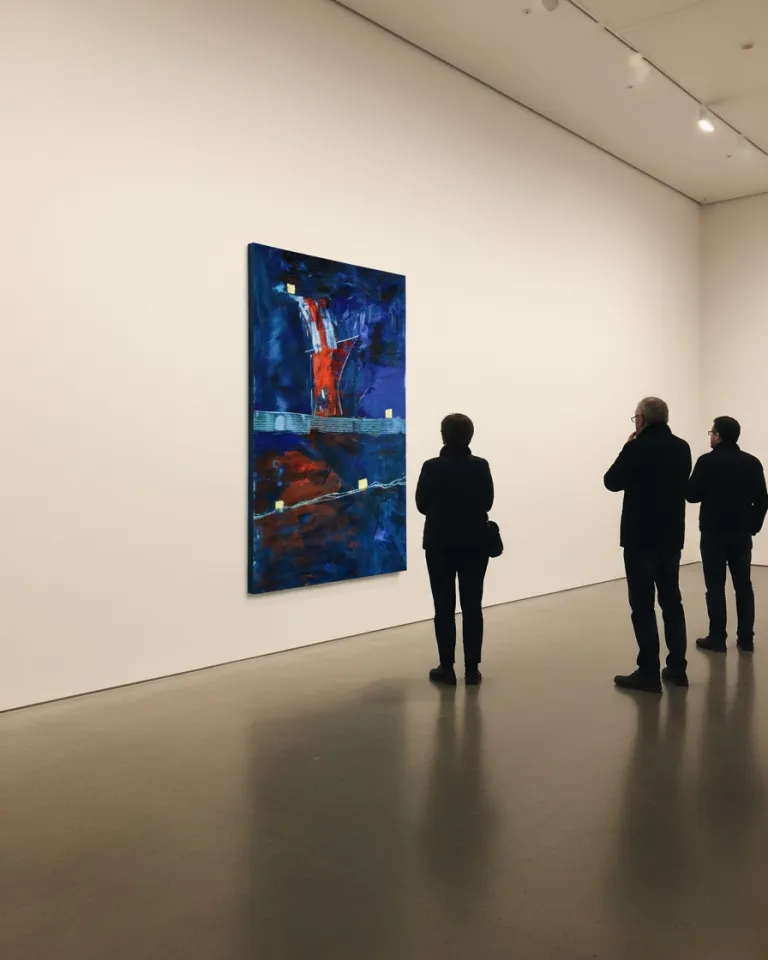
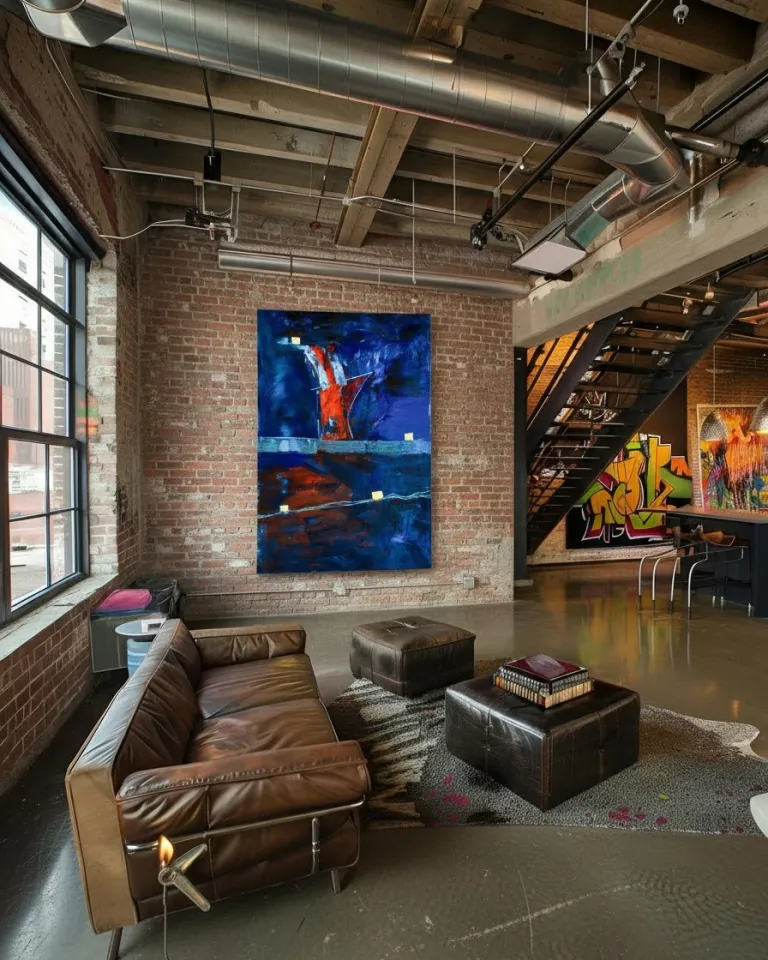
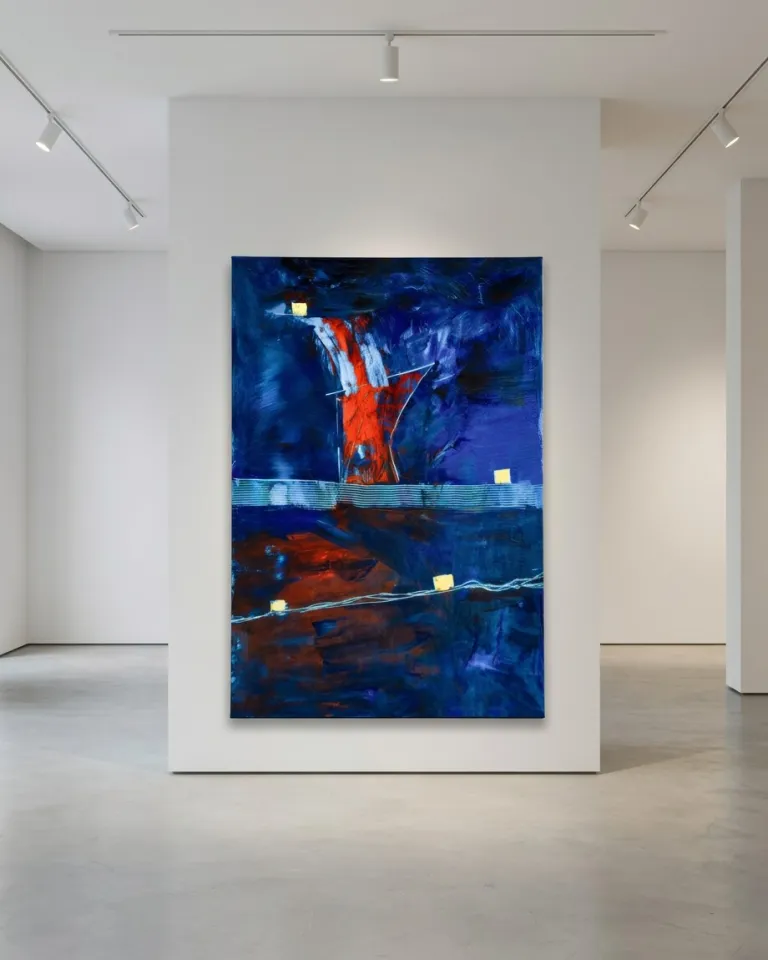
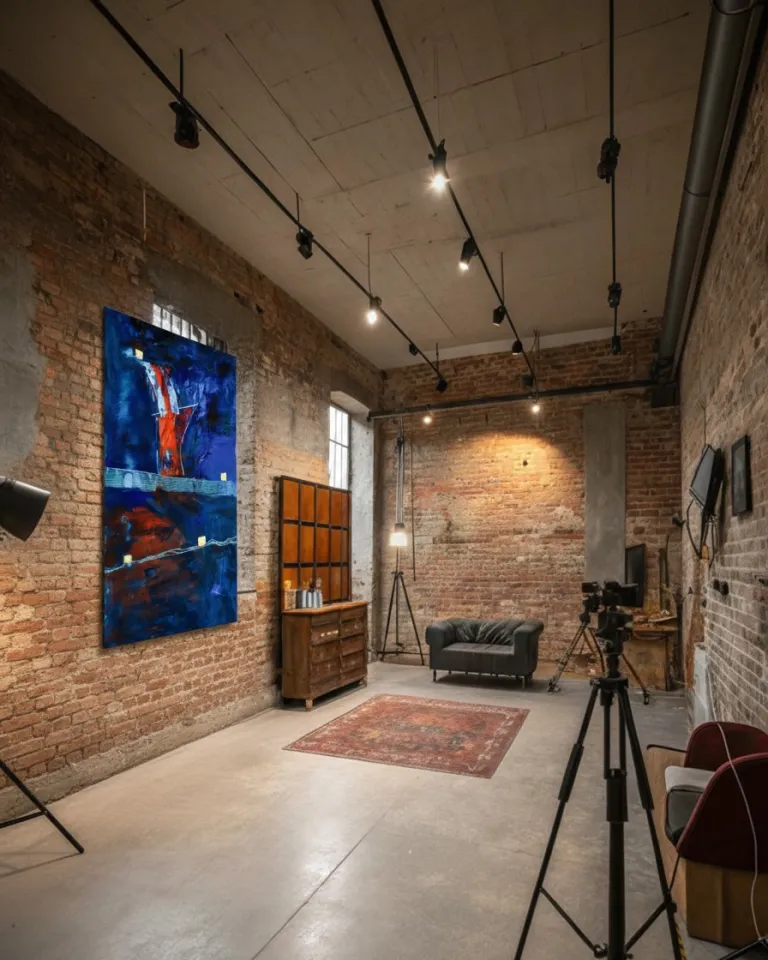
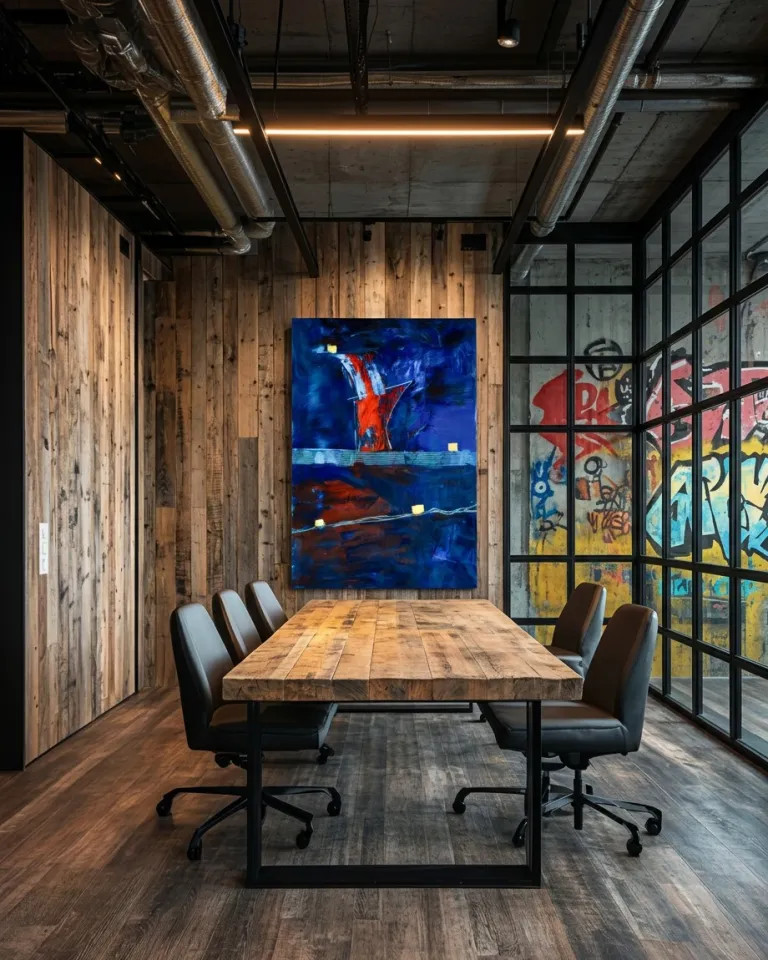
In front of the 120-centimeter height of CLATHRI, the viewer's body does not adopt a posture of passive contemplation; it stands before a vertical abyss that presses against the chest. At the base of the work, where the tones thicken into an amalgam of Prussian blue and burnt sienna, the matter seems to emit a low hum. An erratic white wire of light crosses this twilight, threading three yellow squares that float like magnetic buoys or terminals of a submerged circuit.
Johan Huizinga teaches us that play requires a bounded space, a "magic circle" where the laws of daily life are suspended so that a new order of possibilities may flourish. For the historian, this lower plane is a latent game board, a territory where the coordinates of yellow light establish the rules of a secret match. How does the friction of that white wire sound against the rough background of the painting? It is not a clean sound; it is the static of a high-voltage cable brushing damp sand beneath a dark ocean. The game here is dangerous: if one of these yellow squares were a switch that, upon being turned off, erased the blue of the canvas, we would be left alone with the blind weight of terrestrial matter.
"I remember the instant when the brush, loaded with cobalt blue and burnt sienna, sought to graze the canvas, feeling the tremor in my own wrist as I traced that white cable cutting through the twilight. I was not looking for a perfect line, but rather to record the electrical pulse of a physical doubt: the suspicion that the matter accumulated at the lower edge is not static, but a current breathing in the darkness of the studio."
Movement II: The Clathri Barrier (The Chalk Lines)
Right at the middle of the vertical, the painting is slashed by a score of thin, pale horizontal lines. It is the grid, the clathri that gives the work its title, a structure that seems to float over the painting without ever fully merging with it.
Alejandra Pizarnik peers into this grid with the certainty that silence is not the absence of sound, but a cage of fine lines that barely protects us from the beasts inhabiting the night of language. While Huizinga sees in this grid the sacred limit that orders chaos and establishes ritual, Pizarnik perceives an irreparable wound, a chalk screen separating dark childhood from maturity in flames. Here, intelligences collide in a silent tension: for the former, the barrier is the guarantee of order; for the latter, it is the closure that condemns us to look at the fire from exile. This horizontal grid raises an uncomfortable suspicion: is it a shield to prevent the abyss below from contaminating the sky, or is it a cage retaining something too violent in the upper half? The viewer remains trapped in the center, suspended in the blank space between two realms that refuse to touch.
Movement III: The Tower of Fire and the Celestial Escape
Above the custom-house of the clathri, the painting breaks loose. A structure at once architectural and organic, painted in a searing vermilion red and electric oranges, rises toward the firmament of the canvas. Around it, the blue is no longer the dense soup of the lower plane, but a swift night wind, charged with gestural strokes.
"I look now at the violence of that red tower and realize, with a certain anxiety, that it has slipped from my hands; while my guests discuss whether the white lines contain the danger or if they are a game board, I understand that the painting has made an autonomous decision that I still cannot decipher, because that central fire does not attempt to escape the grid, but uses it as a pedestal to avoid sinking into the gravity of the earth."
What is the red structure afraid of, stretching with such urgency toward the upper left corner? In that zone, a single yellow square, identical to those below but now isolated and devoid of wires, waits in silence. Perhaps that tower of fire is not a warning beacon or a pyre of destruction, but a wounded creature trying to reach the last redoubt of pure light before the blue night completely devours the space. In the end, CLATHRI offers no resolution: it leaves us standing before its 120 centimeters of vertical tension, contemplating how the fire feeds on a grid that we ourselves, out of our need to bring order to the world, have drawn.