Context study / CLATHRI
Maurizio Valch - CLATHRI in Industrial Studio | Abstract Painting
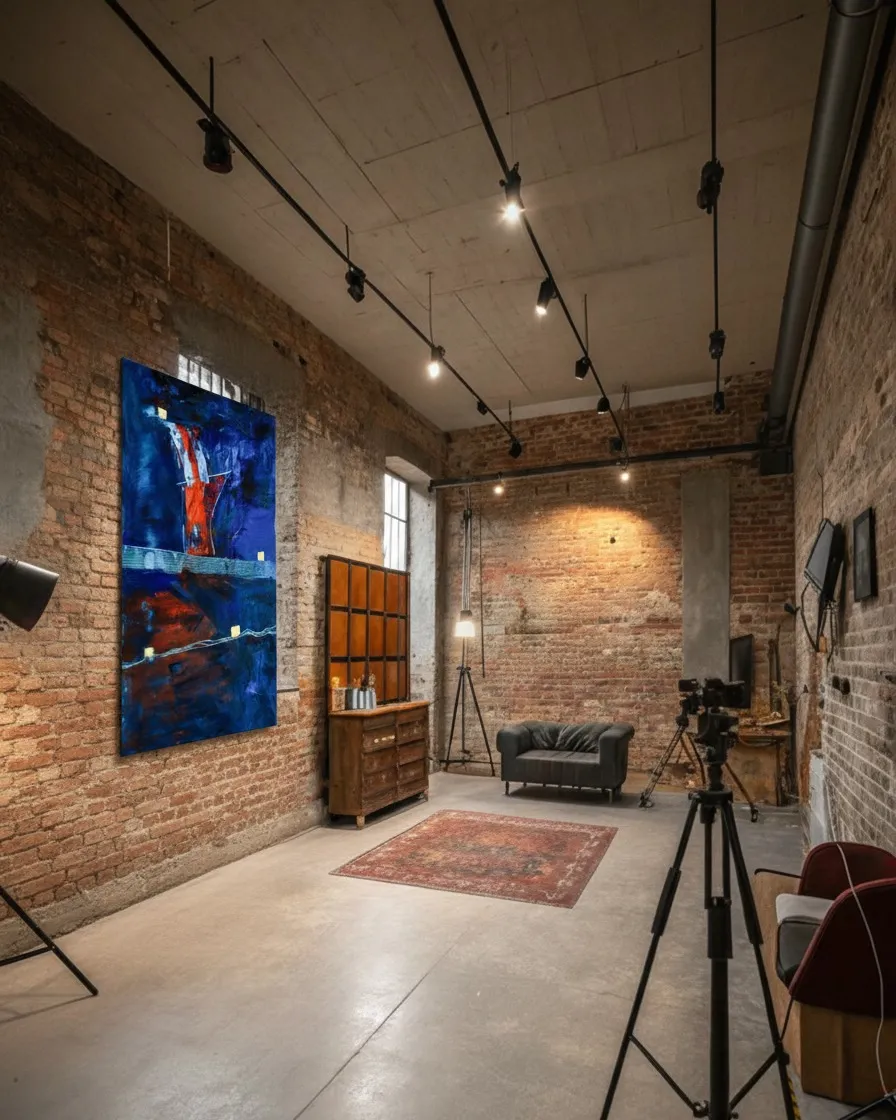
The rough brick of this industrial workshop does not function as a neutral background, but as the physical extension of a surface that has renounced representation. By hanging CLATHRI in this atmosphere of tools, concrete, and exposed wires, the painting reveals its true nature: it is not the illustration of a journey, but the sediment of a geography that has ceased to be external. The 120 centimeters of verticality impose a rigorous order contrasting with the messy texture of the wall, suggesting that a painter's autobiography is not written by accumulating anecdotes, but by delimiting the space where memory still exerts pressure. The blue abyss of the lower plane, dense and loaded with sienna, does not describe an actual night, but the weight of a time that has become body.
I remember the physical fatigue of walking for hours under a sky that offered no answers, crossing administrative boundaries that by the next morning made no sense. In the painting, this disorientation does not appear as a navigable map, but as the need to drive three yellow points into the mud of the base and join them with a white, trembling line. I was not trying to narrate my returns or lost luggage; I wanted to record the vibration of an insistence, the moment when constant movement stops and forces one to look at what remains when you are no longer heading anywhere.
The central grid, that custom-house of thin pale lines from which the work takes its title, acts as the structure of a mind needing to watch its own noise. Here, the formal collision between the submerged base and the red tower of the upper plane is not resolved through a narrative of overcoming; the barrier simply coexists with the fracture. This chalk geometry evokes the tension of the boundary, a tactile shore where the thought's need for control clashes with the indomitable matter pulsing on both sides. The artist's life appears stripped of recognizable dates or faces, codified in the resistance of a grid trying, without success, to contain the fire breaking out above it.
For years, I believed that my work consisted of erecting towers of fire, of turning every crisis or move into a great exploit to justify the effort of starting over. Looking today at that violent vermilion seeking the upper left corner of the canvas, I realize that this heroic character has finally become trapped in its own slope. That yellow square, isolated in the blue corner, is not a port of arrival or a mystical revelation; it is just a clean fact, a point of light that no longer needs a complete theory of who I am to hold its place in space.
Faced with the work, the presence of the tripod and the directed light in the dimness of the studio return us to the scale of the witness. The painting does not offer itself as a closed spectacle, but as a threshold assuming the irregularities of the environment and of the light grazing it. In the end, the incisions and chromatic blocks of CLATHRI do not translate into an intimate diary; they remain as physical traces of a transit that has renounced explanation. The viewer observing the painting from the cold concrete of the workshop does not decipher a confession, but peers into the crust of a territory that still breathes under its own cuts.
- Original artwork
- CLATHRI
- Actual dimensions
- 31.5 × 47.2 in / 80 × 120 cm
- Presentation
- Digital contextual visualization
Context references
abstract painting in studio · large paintings for industrial loft · contemporary art on brick wall · decorating industrial studio with art · maurizio valch clathri industrial
About this visualization
This visualization places the artwork within an architectural context to help collectors and viewers imagine its presence in a real space. It is an interpretive reference, not an exact reproduction: the original work remains the sole authority for scale, color, surface and material presence.