Context study / CLATHRI
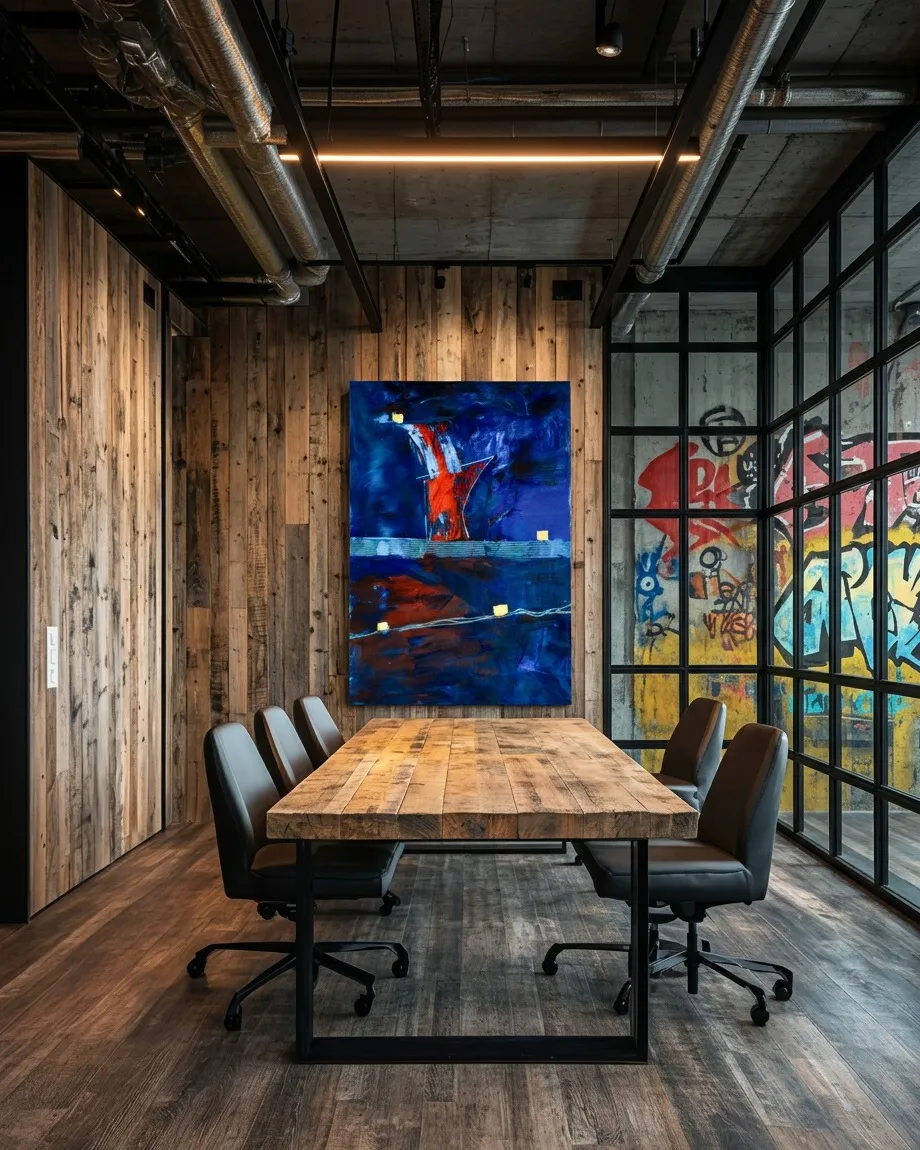
CLATHRI abstract painting in rustic industrial meeting room
The visual geography of the painting presents a stage of containment and vertical escape, where the canvas becomes a theater of opposing forces. An abyss of indigo blue and shadowy depths is slashed in its center by an organic-looking, fiery red vertical structure, which seems suspended or imprisoned by thin incised white lines. This igneous core is interrupted and conditioned by a horizontal band of very fine parallel lines that cuts across the composition like an electromagnetic grid, a sieve, or a frequency boundary separating the upper and lower planes. Four mysterious yellow quadrants, dense and luminous, are distributed across the surface like anchors or spatial coordinates, interconnected in the lower area by a double wavy line that introduces a dynamic vibration into the terrestrial base. A severe friction is thus generated between the rigidity of the enclosing structure and the raw energy pulsing at the center of the matter.
I do not paint to illustrate an idea, but to excavate the matter and find its physical resistance on the canvas. By applying impastos of blue and then vigorously scraping them away, I want the painting to acquire the weight of a wall or an ancient sediment, where the surface reveals its hidden layers. The incised lines and incised traces that traverse the plane are not mere drawing marks, but wounds inflicted directly onto the wet oil, channels dug to drain the light or to set a physical limit to the expansion of color. Each incision with the palette knife or the stylus is a way of forcing the matter to take a stand, of drawing an impassable border between the fire of the center and the surrounding night, turning the canvas into a record of tensions accumulated during the execution process.
This formal confrontation acquires a more complex dimension when analyzing the horizontal grid as a symbol of the automatism imposed on existence. To this end, it is necessary to turn to the ideas of George Gurdjieff, whose doctrine on the mechanical nature of human beings posits that we live asleep within a prison of habits and conditioned perceptions that prevent us from experiencing actual reality. The gridded strip acts as that rationalizing sieve of civilization, a structure that seeks to domesticate the brute force of territory and life. In contrast to this limiting rigidity, the thought of Osho, who advocated for the liberation of desire, spontaneity, and the body's internal fire against the repressive dogmas of society, allows us to interpret the red core as an indomitable impulse resisting mental gridding. Likewise, the gold coordinates find their meaning in the theory of Carl Gustav Jung, pioneer of analytical psychology, who proposed the process of individuation as the path to unify the conscious and unconscious aspects of the psyche, suggesting that these four yellow points operate as minimal mandalas of orientation in the midst of the work's Dionysian storm.
Beyond philosophical and psychological interpretations, my gaze feeds on a more elemental memory linked to geography and territory. When placing those yellow quadrants on the canvas, I think of the Mediterranean not as a luminous postcard, but as a space of nocturnal transits and isolated lighthouses blinking in the darkness before an impenetrable sea. The wavy lines and the containment structures of the work evoke ancient fishing corrals, trawling nets, and archaic stone and wood constructions that have withstood the passage of time on the coasts. In the studio, during the creative process, I seek to capture that dense silence of material waiting, where forms do not shout but bide their time under a zenithal light, suspended in a non-chronological time that belongs as much to the past as to the future.
By integrating the physicality of the pictorial process with these conceptual readings, the canvas reveals itself as an unresolved battlefield where the viewer is confronted by the vibration of the pigments. The yellow coordinates hold the composition in a precarious balance, forcing the eye to traverse the distances separating the celestial plane from the terrestrial one through the grid. The work does not offer comforting resolutions, but suspends the conflict within the space of representation. Thus, the destiny of that red core remains in a constant paradox: we do not know if the containment structure will finally succeed in suffocating and domesticating its organic energy, or if, on the contrary, the civilizing grid is about to be burned away by the unbearable heat of that internal fire.
- Original artwork
- CLATHRI
- Actual dimensions
- 31.5 × 47.2 in / 80 × 120 cm
- Presentation
- Digital contextual visualization
Context references
meeting room decor with art · rustic industrial design ideas · paintings for wood walls · contemporary art luxury offices
About this visualization
This visualization places the artwork within an architectural context to help collectors and viewers imagine its presence in a real space. It is an interpretive reference, not an exact reproduction: the original work remains the sole authority for scale, color, surface and material presence.