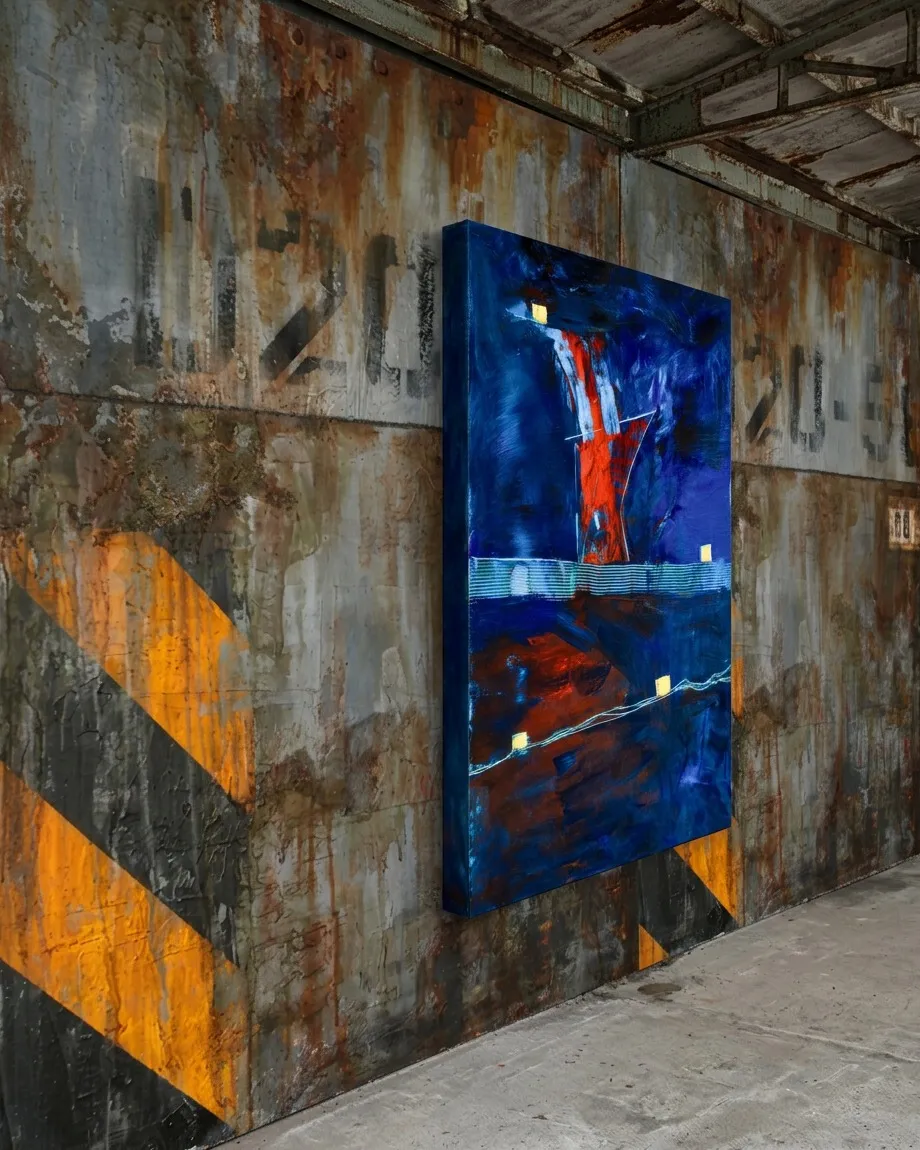
Context study / CLATHRI
CLATHRI Abstract Painting on Industrial Wall | Maurizio Valch
Coordinate I: The High Point (The Upper Left Yellow Square)
In the upper quadrant of the canvas, suspended in an atmosphere of nocturnal blue that seems to vibrate with the density of wet cobalt, floats a small yellow square. It is not an accident of light; it is an orientation buoy, a minimal coordinate claiming its right to exist against the disorder of the surrounding brushstrokes. Here we meet Immanuel Kant, a thinker obsessed with drawing the boundaries of human reason to save us from losing ourselves in the fog of the unknowable.
For the Kantian gaze, this first luminous point functions as a category of understanding: a desperate attempt by the eye to order the chaos of the pictorial night. Kant observes the canvas and recognizes in that small yellow point the sacred limit of our perception. Beyond this solitary beacon, the blue retreats into itself, reminding us that there are areas of reality—the noumenon, the thing-in-itself—that escape our conceptual networks. The square does not illuminate the entire painting; it barely self-illuminates, marking the exact point where the conscious mind decides to stop before being devoured by the immensity of the abyss.
First Interval: The Voice of Maurizio Valch
I remember the weight of the oil on the palette knife that afternoon; the blue did not want to be a background, it wanted to be a body, a dense mass threatening to swallow any attempt at drawing. When the central red structure began to emerge, it did so not as a planned figure, but as a physical need for support, a rib or a scaffold I myself did not know how to hold. I felt a strange urgency to shore up the canvas before the gravity of the color itself collapsed everything, letting that column of cold fire break through the dark tide.
Coordinate II: The Red Scaffold and the Horizontal Grate (The Threshold)
Descending the vertical axis of the canvas, we collide with the violent irruption of the red structure, imprisoned and yet sustained by a grate of parallel horizontal lines. At this point of friction, Paul Celan enters, the poet who sought words in the ashes of silence and understood that language only survives when it allows itself to be wounded.
For Celan, this horizontal grate is not a simple geometric device, but his Gitter (the grid, the cell lattice), the painful filter through which the voice must modulate itself to avoid becoming a scream. A mute but tense dialogue then occurs with the rigidity of Kant. While the philosopher seeks the law to pacify space, the poet hears the creaking of the red scaffold: a wounded throat attempting to pronounce a broken word through the horizontal bars. The color vibrates with the urgency of organic matter, but the grate—those rhythmic, cold traces—fragments it, forcing us to perceive the painting not as a harmonious totality, but as a stammer, an attempt at communication that resists closure.
Coordinate III: The Middle Horizon (The Yellow Square on the Right)
Shifting our gaze to the far right, just at the boundary where the grate of frequencies seems to fade into the gloom, we find the second yellow square. Here, the scale of intellectual analysis collapses, demanding a microscopic, almost childlike approach.
Stripped of absolute pretensions, this luminous point reveals itself as a frightened sentinel at the edge of the map. Is that small yellow square cold, suspended over the last line of the grate just before the blue becomes fathomless? Seen through the eyes of a child, it is neither a philosophical category nor a poetic symbol; it is a firefly that has decided to perch on the ledge of the painting to watch the border. Its isolation questions us directly: is it the sole witness to what happens behind the blue, or is it the last light left on before the winter of painting covers everything?
Second Interval: The Voice of Maurizio Valch
It feels strange to hear talk of Kantian limits or Celan's fractures regarding these traces. While dragging the brush, I only thought about the resistance of the material, how the yellow had to maintain its purity without being soiled by the surrounding blue. However, now that I observe the painting from the distance of years, I recognize an uncomfortable truth: the painting knew more about me than I did about it. Those yellow squares, which in my studio seemed like simple compositional decisions, are actually breathing holes; small confinements of light I opened without knowing I was protecting myself from my own darkness.
Coordinate IV: The Abyss and the Current (The Two Lower Squares)
The journey concludes at the base of the canvas, in the territory where the blue thickens almost to black and the ocher tones simulate a submerged land. Here, the architectural rigidity of the upper grate dissolves entirely, replaced by a wavy white line that trembles from one end to the other, threading the last two yellow squares.
The entire conceptual scaffolding of Kant and Celan crumbles before this underground current. The gaze no longer thinks; it feels. It is the vibration of a copper wire underwater, a low-intensity electrical current dragging the viewer's feet toward the depths. The two lower squares no longer support the space; they float adrift, swept away by the tide of a blue that weighs like the deep ocean. The temperature of the canvas drops drastically in this lower zone, leaving us with a physical uncertainty: the suspicion that the painting does not end where the stretcher frame stops, but continues to flow invisibly beneath the floor we stand on.
- Original artwork
- CLATHRI
- Actual dimensions
- 31.5 × 47.2 in / 80 × 120 cm
- Presentation
- Digital contextual visualization
Context references
brutalist style art · industrial loft decor · modern abstract paintings · rusted metal wall art · blue and red abstract painting
About this visualization
This visualization places the artwork within an architectural context to help collectors and viewers imagine its presence in a real space. It is an interpretive reference, not an exact reproduction: the original work remains the sole authority for scale, color, surface and material presence.