Context study / CLATHRI
CLATHRI Abstract Painting in Classical Decor | Maurizio Valch
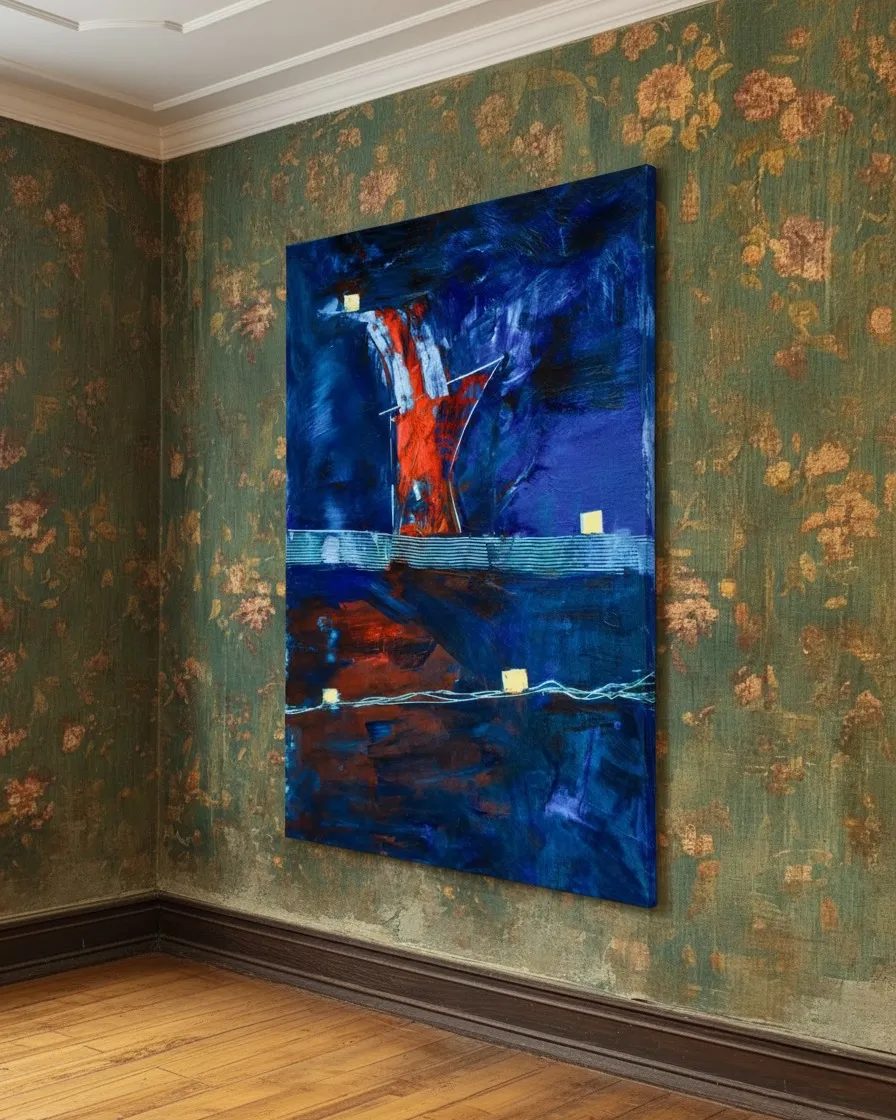
The work welcomes us with an atmosphere of deep gravity where color is not mere ornament, but pure psychological energy in conflict. On Maurizio Valch's canvas, an abyss of indigo and cobalt blue seems to devour everything, establishing an almost nocturnal space of containment over which an imposing vertical structure of fiery red emerges with contained violence, crowned by a subtle white arch. This chromatic irruption is crossed and divided by a horizontal grid of incised white lines that directly recalls the Latin term clathri, a word used in classical antiquity to designate the grates or lattices that protected sacred spaces or confined the untamed. Observing this grid, it is impossible not to think of the ideas of G. I. Gurdjieff, the Armenian mystic who described how human beings live imprisoned by their own automatisms, inhabiting a purely mechanical existence alienated from their true essence. The painting questions us precisely on this threshold: is this white grid the representation of a mental prison self-inflicted by our routines, or is it, on the contrary, the indispensable tectonic structure preventing the sacred fire of consciousness from dissipating into the immensity of the void?
The act of painting is a physical battle, a process of excavation where the palette knife acts as a chisel wounding the material. The white lines forming the central grid are not strokes superimposed on the blue, but real scars—deep incisions carved directly into the successive layers of acrylic and oil, seeking to unearth the latent light residing in the background. The large red block rising in the center represents a geological force, an indomitable magma of experience resisting suffocation by the geometries of reason. By placing those small blocks of yellow and golden light at strategic points of the composition, coordinates of salvation are established amid the visual chaos. They function as beacons of attention and luminous anchors deliberately introduced to arrest the viewer's gaze, offering a lighthouse of stillness amid the friction between the unleashed force of color and the rigor of the line.
This formal tension between the red mass and the grid that sections it raises an inescapable philosophical conflict between structured control and the absolute freedom of the self. If we analyze the work through the perspective of Osho, the Indian philosopher and mystic who advocated for the liberation of life flow against the repressive structures of society, the white grid reveals itself as a system of repressive domestication fragmenting the instinctive and passionate current of life represented by the red. However, when counterposing this view with the thought of Carl Gustav Jung, the celebrated Swiss psychiatrist who proposed the concept of the individuation process, the geometric structure acquires an integrating and necessary value. From this analytical approach, the small yellow squares floating in space are not fortuitous decorative elements, but "self-points," minimalist mandalas acting as beacons of conscious awareness, awakening the observer from the hypnosis of the dark background and allowing them to integrate their own shadows.
The memory of territory and the original meaning of words play a fundamental role, connecting directly with series that have marked Valch's career, such as STRATA or LIMINA. In the privacy of the studio, the eighty by one hundred and twenty centimeter support transforms into a sensitive skin or an ancient wall preserving the marks of time, friction, and the resistance of materials. There is no intention to literally illustrate any preconceived psychological theory or expose personal dramas; the true aim is to record as honestly as possible the exact instant in which a form decides not to submit to the space surrounding it, asserting its right to exist and shine with its own light despite the imposed limits.
Stepping back to contemplate the work in its entirety, we discover the delicacy of its peripheral details, like that wavy line at the bottom of the canvas resembling a seismic horizon, an electrogram of the soul, or a high-tension wire on which two of the golden beacons rest suspended. This subtle vibration returns us to the reality of our own present, turning the contemplation of this painting into an active, transformative experience. To look at this painting today is to accept a direct invitation to awaken our inner attention, to courageously recognize the invisible bars that limit us, and to value that inextinguishable fire that, despite the structures attempting to compartmentalize it, continues to beat with indomitable force at the center of creation.
- Original artwork
- CLATHRI
- Actual dimensions
- 31.5 × 47.2 in / 80 × 120 cm
- Presentation
- Digital contextual visualization
Context references
paintings for wallpapered walls · vintage living room decor · minimalist abstract painting · classic interior design ideas · contemporary art for home
About this visualization
This visualization places the artwork within an architectural context to help collectors and viewers imagine its presence in a real space. It is an interpretive reference, not an exact reproduction: the original work remains the sole authority for scale, color, surface and material presence.