Context study / CLATHRI
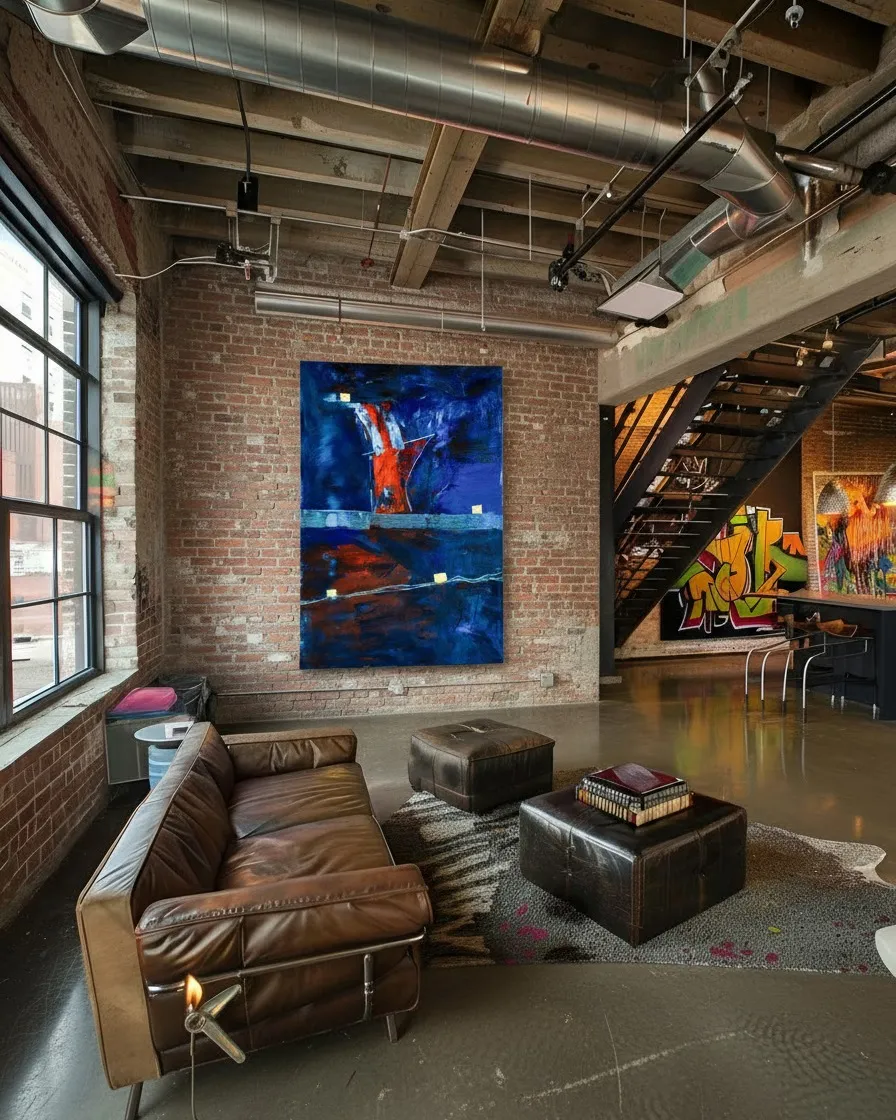
Maurizio Valch - CLATHRI in Urban Loft | Interior Design
The surface of CLATHRI presents itself as a field of geographical tensions where pictorial matter is subjected to a strict visual toll. A horizontal band, defined by a series of longitudinal incisions slicing through the plane, functions as a boundary or grid (clathri) that interrupts the violent ascent of an organic, reddish mass. This vertical structure, evoking both a primitive column and an exposed artery, struggles to emerge amidst an atmosphere of dense, nocturnal blues, forced to negotiate its passage through that geometric grid. Contemplating this friction between the almost mechanical regularity of the incision and the untamed thrust of the crimson core, it becomes inevitable to summon the ideas of G. I. Gurdjieff, the influential Armenian mystic who relentlessly analyzed the automatism of the human being and the difficulty of authentic awakening. In this light, one wonders if the incised grid on the canvas represents the repressive armor of a civilization bent on domesticating and numbing the vital impulse, or if, on the contrary, it constitutes the rigorous and essential structural scaffolding preventing individual consciousness from ultimately dissolving into the chaotic void of the surrounding blue.
When confronting the surface of this canvas, my intention was not to trace a descriptive drawing, but to commit an incision that would act simultaneously as a wound and as a territorial ordering of matter. Feeling the physical resistance of oil and acrylic under the palette knife forced me to confront the density of the support; each horizontal groove is the result of a hand-to-hand struggle with the wet pigment, an indentation that fractures the space to compel the dark blue to dialogue with the central red's vertical explosion. In this process of subtraction and addition, the small yellow quadrangular blocks were not born from a preconceived symbolic plan, but emerged spontaneously upon the canvas like light buoys or silent witnesses; they are position markers that I introduced to measure the physical distance between the background and the surface, luminous anchor points holding the gaze against the abyss of the pictorial night.
Focusing attention on the upper half of the painting, the red mass seems to fight a silent battle to overflow its own physical boundaries, standing out against the depth of the dark blue in a struggle that exceeds mere formal abstraction. This conflict can be read in terms of Carl Gustav Jung, the pioneering Swiss psychiatrist who formulated the theory of archetypes and the collective unconscious, who would see in this igneous core the irruption of the Shadow or of a primordial dynamism that the conscious mind, represented by the ordering grid of civilization, attempts to contain and codify to prevent its overflow. However, this analytical framework acquires a different dimension when contrasted with the philosophy of Osho, the Indian thinker and mystic who advocated radically for individual freedom and spontaneity against the repression of moral institutions. The visual clash of the work thus poses an open dilemma: is that red column the desire and untamed life that the restrictive structure of the grid seeks to imprison under an imposed discipline, or does it represent a necessary rite of passage in which the original energy of the territory finds its temple and its formal containment?
My painting draws directly from the geological and cultural memory of the Mediterranean territory, from that constant transit between the ruins of past civilizations and the physical harshness of the Andalusian coast that has defined my visual and vital experience. For me, conceiving this work meant positioning myself on the blurred boundary between the dream, that Mare Somniorum of lunar geography, and the material solidity of the ground we walk on daily. I do not intend to illustrate an archaeological concept or recreate a classical mythology in an illustrative way; I want the painting to function in itself as a stratigraphy where time has sedimented layer upon layer. Painting, in this sense, becomes an exercise in tactile excavation, a way to scrape the matter and discover what ancestral structures continue to support our fears and our pockets of freedom beneath the immensity of the night.
Withdrawing the gaze toward the subtler elements of the composition, the central drama of the work seems to dissolve into smaller-scale details of great structural relevance, such as the sinuous, whitish lines traversing the lower base or the discrete golden blocks fixing the visual weights of the canvas. The dark environment enveloping the scene forces us to distance ourselves from the psychological and mystical readings previously set forth, returning us to the pure reality of paint. Thus arises a final question that suspends any definitive conclusion: what if that incised grid is not the symbol of a moral prison nor the scaffold of consciousness, but simply an interval of material truce, a neutral space where pigment rests and stabilizes before beginning its inevitable process of physical transformation?
- Original artwork
- CLATHRI
- Actual dimensions
- 31.5 × 47.2 in / 80 × 120 cm
- Presentation
- Digital contextual visualization
Context references
paintings for designer loft · industrial living room abstract art · decorating tall walls with abstract art · maurizio valch limina loft · leather sofa modern art living room
About this visualization
This visualization places the artwork within an architectural context to help collectors and viewers imagine its presence in a real space. It is an interpretive reference, not an exact reproduction: the original work remains the sole authority for scale, color, surface and material presence.