Context study / CLATHRI
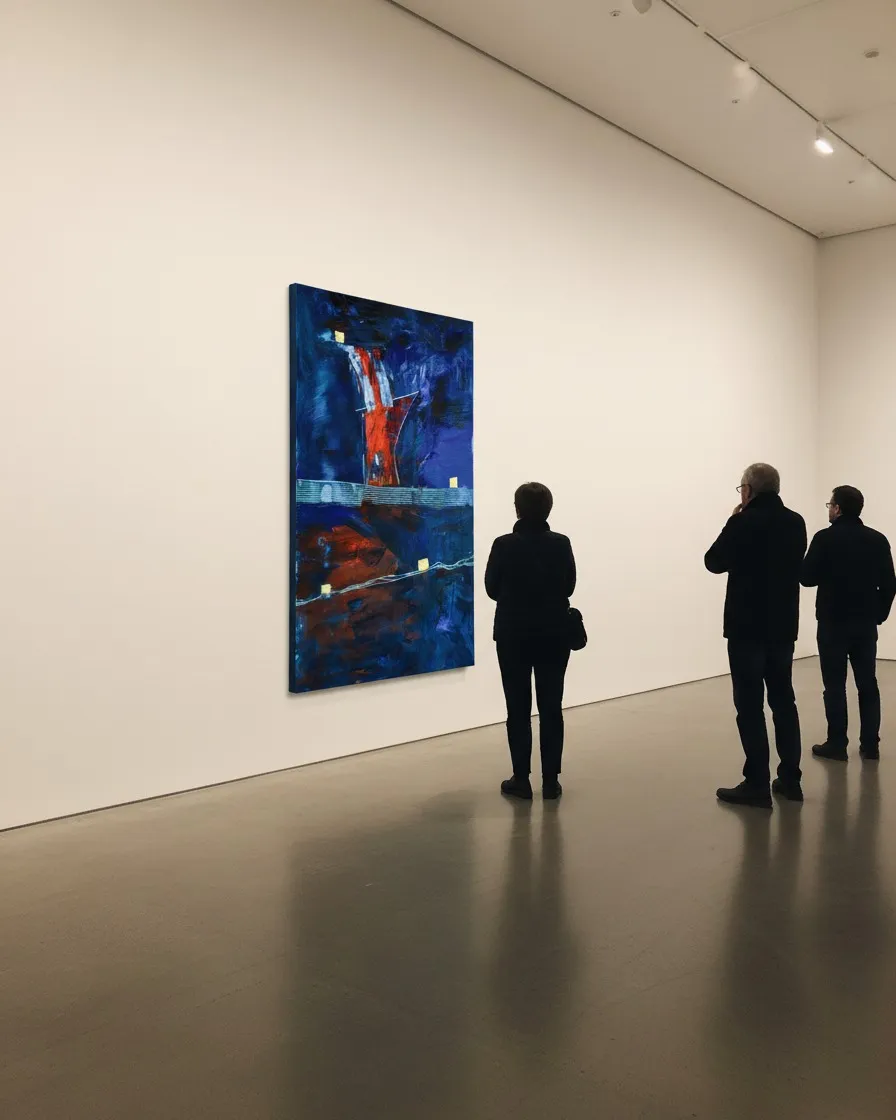
Maurizio Valch - CLATHRI in Exhibition with Viewers
Three human figures stand motionless, their backs turned, measuring with the gravity of their own bodies the 120 centimeters of verticality of CLATHRI. In the coldness of the exhibition room, surrounded by white walls that isolate the noise of the world, the painting does not present itself as a window to look through to decipher a story, but as a block of psychophysical pressure impacting the observer's chest directly. There is no chronicle of the wound here, nor an illustration of fear, nor a travel diary for the spectator to read from left to right. The work operates by accumulation and discharge: the Prussian blue absorbs the light of the room to transform it into a dull weight, while the eruption of the upper vermilion operates like a cry frozen before modulating its first word.
When I hold the brush in front of a canvas of these dimensions, my endeavor is not to explain to anyone what it means to be suspended in the middle of the night, but to transfer that same temperature to the matter. Color is not a psychological code; it is a physical force that pushes, suffocates, or opens spaces to breathe. I know there is a temptation to search in the red tower or the white wire for an allegory about pain or resistance, but for me, painting ends precisely where the need to justify it with a narrative begins. Scraping the lines of the clathri onto the still wet oil, I was not drawing the bars of a moral cell, but registering the precise instant when the acceleration of my own pulse needed to find a limit, a tactile border to halt the collapse of the pictorial plane.
This formal containment is what prevents the work from spilling over into melodrama. The emotional tension in CLATHRI is not a free effusion, but a rigidly organized structure where opposing forces neutralize each other. On the lower plane, the three yellow squares threaded by the white wire act as anchoring buoys holding the gaze, preventing the spectator from sinking into the mud of the burnt sienna. This enveloping and heavy atmosphere dialogues closely with the color fields of Mark Rothko, but where the American sought a mystical dissolution in the vibration of color, Valch's territory resists evaporation through a dense, almost geological materiality that retains the trace of accident and incision.
There are moments in the studio when the painting itself imposes a silence on me that my mind, always busy manufacturing theories and solving emergencies, is unable to reach on its own. Observing that last yellow square, isolated in the upper left corner like a lighthouse that has survived the cobalt blue storm, I understand that it does not represent a promise of salvation or a goal at the end of a personal quest. It is, simply, a coordinate of quietude. The painting succeeds in condensing that state of truce without needing to explain where I come from or where I am headed; the pictorial fact is sufficient in itself and, in doing so, deactivates for an instant the noise of my own interpretations.
In the end, the confrontation with CLATHRI within the gallery space returns the spectator to their own exposure. The work does not resolve the conflict it poses: the central grid continues to separate the upper fire from the wired gloom below, and the white chalk lines remain suspended like an impassable custom house in the middle of the canvas. By renouncing narrative, the image becomes a clean mirror of the internal state of the person contemplating it. Whoever seeks an answer leaves the room empty-handed; whoever accepts the gravity of the matter discovers that emotion does not need to be translated into words to occupy, with all its weight, the center of the space.
- Original artwork
- CLATHRI
- Actual dimensions
- 31.5 × 47.2 in / 80 × 120 cm
- Presentation
- Digital contextual visualization
Context references
viewers in front of abstract painting · maurizio valch solo exhibition · scale of large paintings in museum · clathri maurizio valch exhibition · contemporary art contemplation
About this visualization
This visualization places the artwork within an architectural context to help collectors and viewers imagine its presence in a real space. It is an interpretive reference, not an exact reproduction: the original work remains the sole authority for scale, color, surface and material presence.