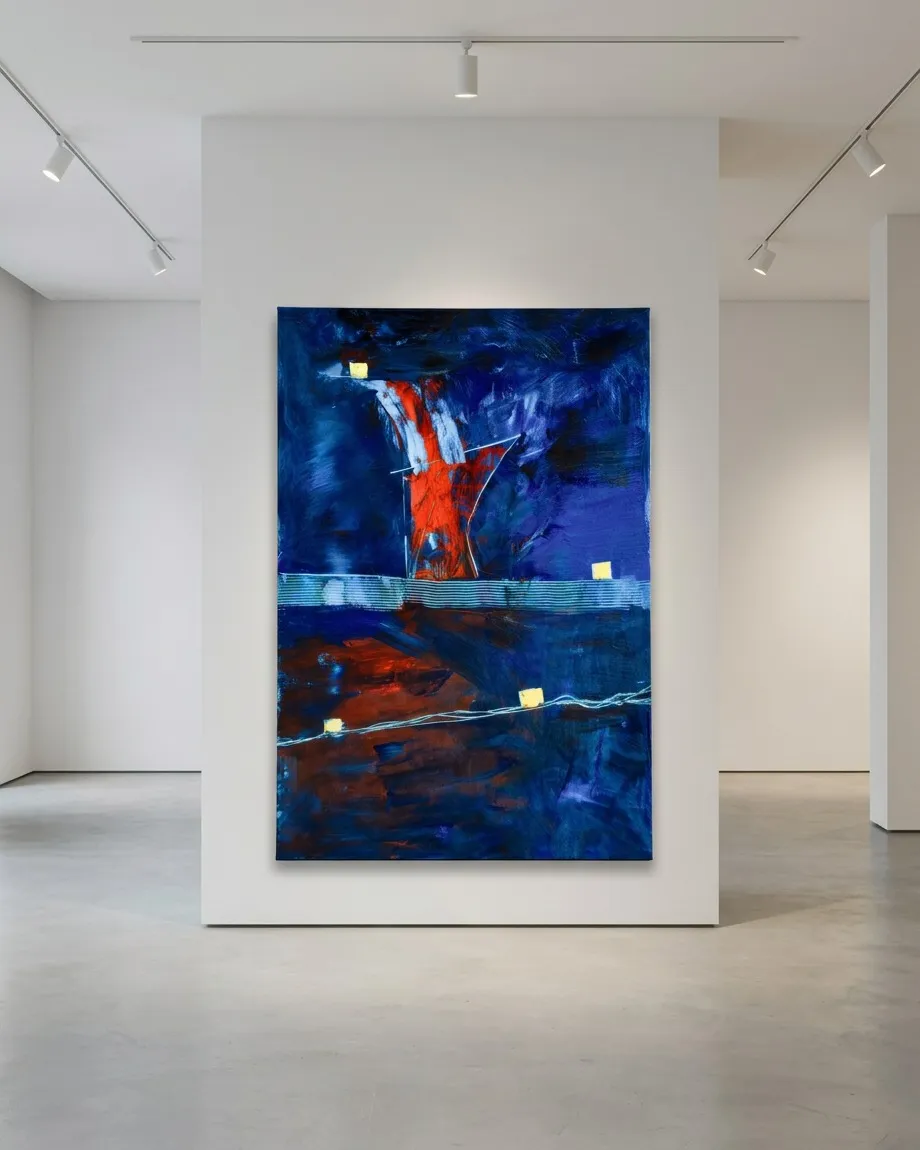
Context study / CLATHRI
Maurizio Valch - CLATHRI in Art Gallery | Minimalism
To enter "CLATHRI", we must suspend the certainties of the trained eye and accept that this canvas by Maurizio Valch is not a static surface, but an accelerator of chromatic particles. Before us unfolds a map of tensions divided by a great horizontal border of parallel white lines, a boundary separating a dense sky, of an almost tempestuous cobalt blue, from a lower abyss dominated by rust and brown tones.
To navigate this territory, we invoke the complicity of two extraordinary observers. On one side, we are accompanied by Johannes Vermeer, the master of silent light, the camera obscura, and the capture of the suspended moment, who is immediately drawn to the almost tactile texture of the pigments. Beside him stands Richard Feynman, the bold physicist who drew the invisible behavior of particles and understood the universe through play and vibration, fascinated by the dynamic energy pulsing beneath the brushstrokes.
We begin the quantum journey by leaping through its four yellow coordinates, those small ports of light that defy the painting's gravity.
Coordinate 1: The Beacon of the Storm (Far Upper Left)
The journey begins in the upper left corner, where a small yellow square floats against a dense and agitated sky. Just below it, an imposing red column stands like an energetic, vertical structure.
Feynman observes this column and smiles; he does not see paint, but a scattering diagram of high-intensity energy, a collision where particles violently alter their trajectories. He wonders if, in reality, that great red column might not be a cosmic lighthouse that only blinks when we close our eyes, leaving the darkness of the studio charged with an invisible radiation. Vermeer, conversely, ignores the chaos of the blue storm and concentrates on the small yellow square. For him, it is a precise aperture in the wall of a camera obscura, an infinitesimal optical window through which external light filters to reveal the drama of the interior space. Where the physicist sees a chaotic dance of electrons in thermal friction, the seventeenth-century painter finds a sacred quietude, a domestic miracle suspended in the void.
The First Threshold: The Barrier
Descending from the tempestuous heights, we encounter the great barrier of parallel white lines that slice the canvas from side to side. At this point of transition, the voice of Maurizio Valch himself emerges from the canvas:
> "When I drew that horizontal grid of white lines, I felt I was imposing a forced order upon a territory that demanded to scream. I do not know if what I was painting was a shield to safeguard the abyss from the storm above, or if I was constructing a prison, a clathri to lock away the noise of the world. In the end, I preferred to think of it as a physical staff, a structure where the sound of matter freezes just before turning into pure chaos."
Coordinate 2: The Sentinel of the Border (Middle Right, Above the Grid)
Our second port is the yellow square perched directly upon the right end of the white barrier. It is a thermal control point.
Stopping here, the body experiences a strange physical transition. How does the difference in atmospheric pressure feel on the skin between the upper zone—that cold, thick cobalt blue pressing downward—and the lower zone, dominated by warm browns and rusts that exude the density of the earth? Vermeer perceives this square as a perfect point of balance, a grain of golden sand holding the weight of the entire sky so that it does not crush the earth. Feynman, however, analyzes it as a quantum transition state: the yellow square is a potential mediator, a node where the pressure waves from both hemispheres destructively interfere to maintain peace at the border.
Coordinate 3: The Anchor of the Current (Lower Center, on the Wavy Line)
We now leap toward the lower abyss, landing on the yellow square that rides upon a bright, wavy line.
This white line snakes from one end of the dark zone to the other. Feynman leans in enthusiastically: to him, it is not a whimsical stroke, but the classical trajectory of a particle trapped in a magnetic field, a sine wave carrying information through the dense medium. He forces us to ask: why does the current at the bottom of the canvas need precisely this wavy line to keep from overflowing and spilling over the edges of the painting? Vermeer observes the same point and focuses on the relief of the oil; he detects how the yellow overlaps the dark current with an almost sculptural density, acting as a warning beacon for navigators in a sea of mud and iron.
The Second Threshold: The Resistance of Yellow
Before reaching the final coordinate, the vibration of matter returns the artist's voice to us, revealing the mystery of the material that makes up these ports of light:
> "Sometimes I stop before the four yellow squares and find it difficult to recognize them as mine. Although it was I who placed the pigment on the support, these small areas seem to operate under a different physics within the studio. They have a different temperature; when I bring my hand close, I feel them emitting an autonomous heat, as if they did not entirely belong to me and continued to feed from an energy source that activates only when the painting is left in the dark."
Coordinate 4: The Spark of the Abyss (Far Lower Left)
The journey concludes at the far left of the lower wavy line, at the last yellow square. We are in the deepest part of the painting, surrounded by brown shadows and bursts of cobalt blue that have managed to filter down from above.
Here, the gazes of our two guides finally intertwine. Vermeer contemplates this final point of light as the last flicker of a candle resisting being extinguished by the immensity of the night, a reminder that light always finds a way to manifest, even at the bottom of the well. Feynman, for his part, sees in this square the collapse of the wave function, the precise instant in which energy localizes and becomes visible to the observer.
The journey through "CLATHRI" ends here, but the painting continues to pulse. At the border where the blue clashes with the grid and the rust is contained by the wavy line, there remains an unresolved area of mystery: a constant vibration that continues to warm the canvas, suspended in the space that separates science from art, waiting for the next gaze to light its yellow beacons once more.
- Original artwork
- CLATHRI
- Actual dimensions
- 31.5 × 47.2 in / 80 × 120 cm
- Presentation
- Digital contextual visualization
Context references
abstract art in white gallery · minimalist paintings for living room · blue and red abstract painting · maurizio valch art exhibition · clathri maurizio valch gallery
About this visualization
This visualization places the artwork within an architectural context to help collectors and viewers imagine its presence in a real space. It is an interpretive reference, not an exact reproduction: the original work remains the sole authority for scale, color, surface and material presence.