Context study / CLATHRI
CLATHRI Painting in Gallery Exhibition | Maurizio Valch
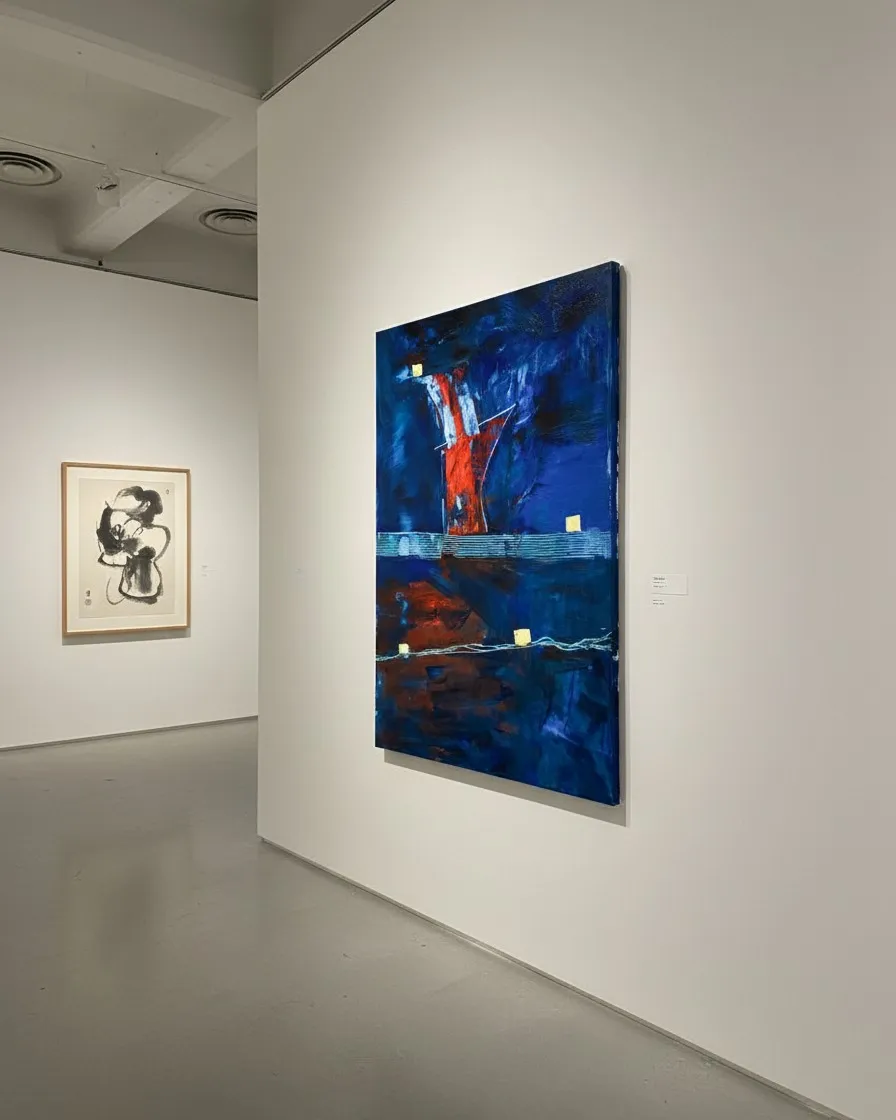
The visual geography of CLATHRI unfolds as a territory suspended between the night and the wound, structured by an imposing horizontal band of thin incised lines that divides the composition into two complementary planes. This gate or grid—restoring the original Latin sense of the title, clathri—immediately introduces the experience of exposure as a structural rather than a merely psychological condition of the pictorial space. Against an abyssal background of indigo blue and dark burnt sienna patches, a vertical crimson column stands as a core of muted fire hemmed in and illuminated by oblique white strokes. This red body, trapped yet resilient behind the scraped bars of paint, embodies a radical vulnerability: that of matter exposed to the cosmic elements of the canvas, which nevertheless refuses to dissolve, asserting its physical presence against the oppression of the boundary segmenting it.
When facing the canvas in the studio, the process is not about illustrating an idea, but unearthing a presence through the physical accumulation of successive layers of acrylic and oil. It is a constant dialogue of addition and subtraction, where the act of scraping the material becomes archaeological: incising that central grid onto the wet plane to cut through the surface and reveal the layers pulsating beneath. The permanence of the painting does not lie in static immutability, but in its geological capacity to accumulate time and effort in every scar inflicted upon its skin. By wounding the canvas with a palette knife or point, the initial exposure is not lost to oblivion but acquires the solid, stone-like presence of an autonomous stratum or monolith capable of standing on its own once it leaves the studio.
Amid this cartography of tensions and confinement, the viewer is surprised by a luminous anomaly of an almost mystical character: four small squares of golden yellow and a wavy white line that snakes fluidly across the lower zone of the canvas. Here, wonder breaks in, manifesting not as superficial ornament, but as a set of rescue beacons and sparks of awe interrupting the blue and sienna abyss. These golden blocks act as sentinels of the space, reference points and coordinates for silent navigation guiding the gaze above and below the rigidity of the central grid. Offering a poetic counterpoint to the severity of the geometric structure, wonder springs precisely from the most hostile and exposed margins of the work, opening alternative paths of escape where the eye can rest and rebuild its relationship with the void.
In this painterly practice, wonder and exposure are not opposing forces, but two shores of the same river that require each other to exist. For this reason, these small golden accents are deliberately placed at the outer edges of the painting, seeking a subtle yet constant vibration with the thrust of the central red keel dividing the darkness. Seeing the finished work, imposing in its dimensions of eighty by one hundred and twenty centimeters, resting in space and revealing itself as a deeply tactile threshold, confirms that art must disobey the sterile coldness of gallery walls. The wonder pursued here is not the false promise of a painless beauty, but the resistance of a rustic, almost primitive light that manages to survive and shine with dignity from within a severely eroded, scraped, and rebuilt material.
Ultimately, CLATHRI consolidates itself as a masterful synthesis where exposure, wonder, and permanence merge into an active membrane of friction that directly challenges the viewer's perception. The grid that names the piece reveals its dual function: it is not only the bar that imprisons color, but also the structure that supports it and gives it a place in the world. The permanence of the wound engraved on the fabric is, paradoxically, what allows the wonder of the golden points to shine with unusual vigor, showing that the exposure of the infinite background is the indispensable condition for the visual journey to find redemption. Thus, the contemporary painting of Maurizio Valch ceases to be mere representation and becomes a tactile and existential map, a threshold where the boundaries of the inner and outer self touch, converse, and finally reconcile within the material.
- Original artwork
- CLATHRI
- Actual dimensions
- 31.5 × 47.2 in / 80 × 120 cm
- Presentation
- Digital contextual visualization
Context references
large abstract paintings for living room · contemporary art gallery · buy abstract art · maurizio valch exhibition · large wall art decor
About this visualization
This visualization places the artwork within an architectural context to help collectors and viewers imagine its presence in a real space. It is an interpretive reference, not an exact reproduction: the original work remains the sole authority for scale, color, surface and material presence.