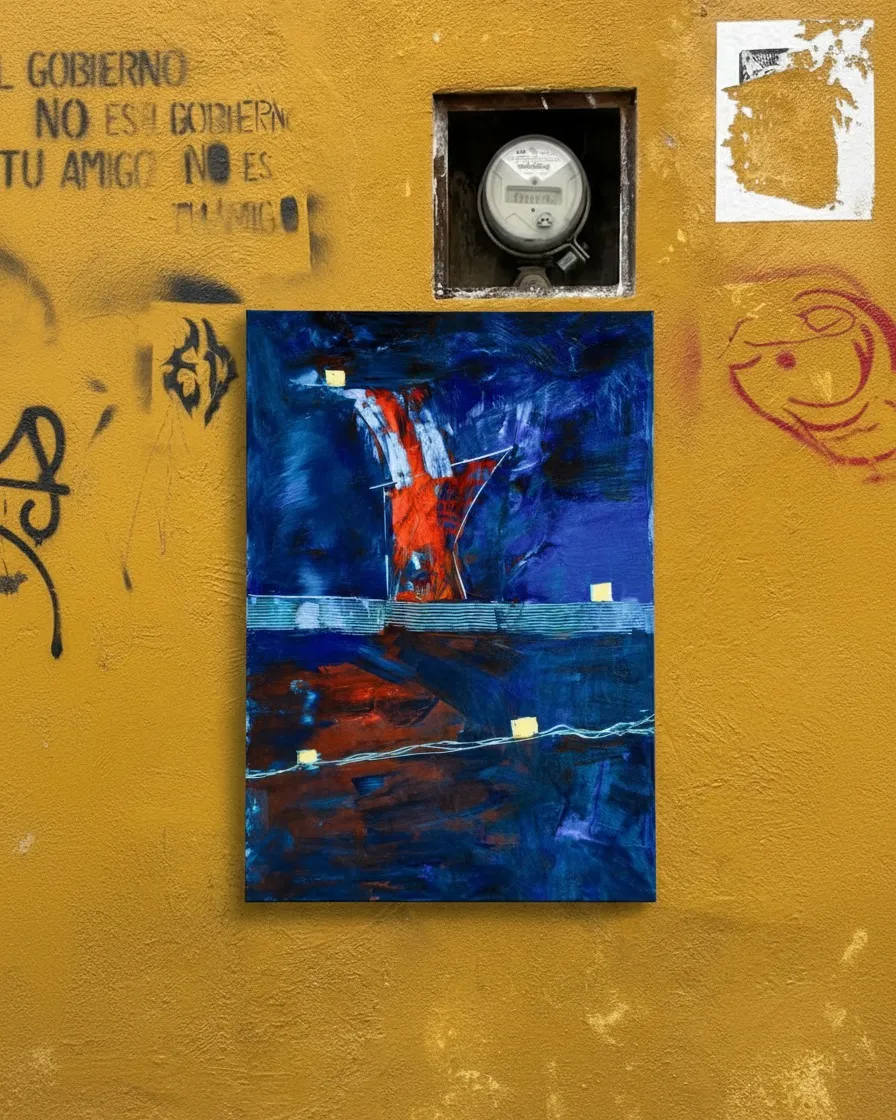
Context study / CLATHRI
CLATHRI by Maurizio Valch: Abstract Art in Urban Setting
Hanging CLATHRI on a worn yellow urban facade, flanked by graffiti and crowned by an unprotected electric meter, does not devalue the painting; on the contrary, it radicalizes its condition as a threshold. In this profane context, stripped of the protected silence of the white gallery, the work operates like ancient rustic altars built at crossroads. Approaching the transcendent does not require the consecrated architecture of a temple nor the complicity of recognizable religious iconography. Instead, it occurs through the abrupt irruption of a verticality that suspends the street's noise, forcing the passerby to halt before a spatial order that belongs neither to the time of haste nor to bureaucratic utility.
Working on the lower half of the canvas, piling up burnt sienna and Prussian blue, the focus was not on celestial maps or sacred geographies, but on the real weight of a ground that accumulates night. There was an almost defensive impulse in tracing that white wound running across the base, linking the small yellow rectangles like someone attempting to mark an indecipherable abyss to avoid getting lost in it. Painting, in its physical origin, is an attempt to order what overwhelms us. Those horizontal incisions termed clathri are not geometric decoration; they emerged by scraping the wet material in absolute silence, like a grate placed between terrestrial gravity and a fire threatening to consume the canvas.
That upper fire, an ascending mass of lacerating reds and electric oranges, dispenses with any narrative of martyrdom or revelation to embody the pure vibration of the spirit. Here, abstraction touches the sacred by renouncing representation: there are no angels, crowns, or saints, but rather the physical tension of matter attempting to shed its own weight. This visual topography evokes the silent gravity of Mark Rothko's atmospheres or the spatial event of Barnett Newman, but with a mineral, almost brutalist harshness. The order established by the clathri barrier does not nullify the mystery; it preserves it, keeping the upper zone as a space of transit where the blue air seems to move at a different speed, pushing the fire structure toward that last quadrant of solitary light.
Contemplating the painting exposed to the elements on this peeling wall reveals that the work has taken a direction that rational will could not have planned. For a long time, the path of consciousness seemed like a great heroic quest, a tiring ascent requiring visible ladders and clear goals. However, looking at that single yellow square suspended in the upper left corner, so far from the electrical wiring below, shows that the transcendent is not conquered through psychological effort. The fire at the center does not seek to go anywhere; it simply burns in its present, reminding us that silence arrives when the mind finally understands the limit of its own noise.
Lacking dogmas and closed allegories, CLATHRI allows the viewer to inhabit the interval of its mystery. The work does not impose a belief; it offers a rough, eroded surface where the gaze stumbles and is forced to turn inward. In the dialogue between the roughness of the canvas and the vulgarity of the urban environment, contemporary art recovers its oldest function: to be a refuge for the invisible. Ultimately, there is no theological resolution in this tension of blues and reds; there remains only the physical presence of the work, sustaining the possibility of a transcendent experience revealed, paradoxically, in the middle of the street against a wall cracked by time.
- Original artwork
- CLATHRI
- Actual dimensions
- 31.5 × 47.2 in / 80 × 120 cm
- Presentation
- Digital contextual visualization
Context references
contemporary art in the street · blue and yellow abstract painting · urban artistic photography · maurizio valch painter · contemporary street art
About this visualization
This visualization places the artwork within an architectural context to help collectors and viewers imagine its presence in a real space. It is an interpretive reference, not an exact reproduction: the original work remains the sole authority for scale, color, surface and material presence.