Context study / CLATHRI
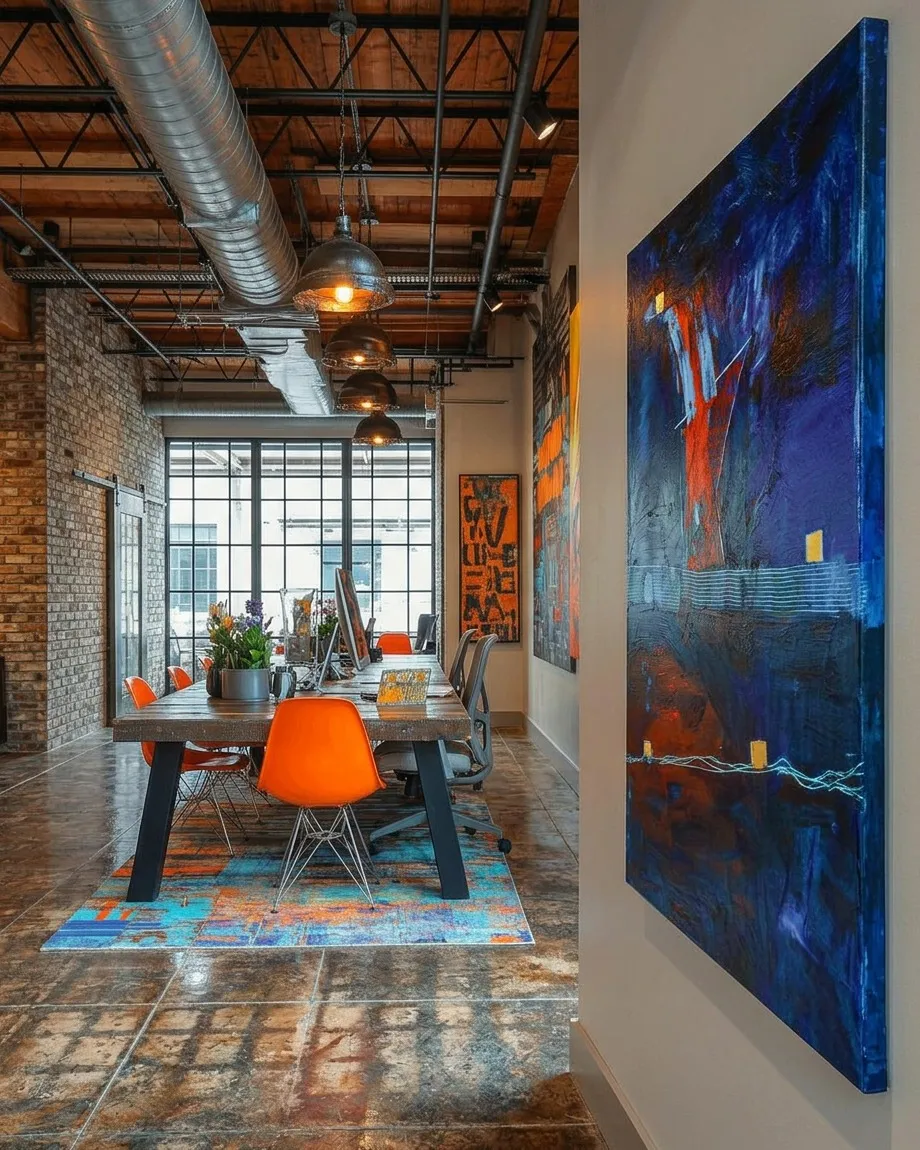
Large-format abstract painting CLATHRI in loft-style office
CLATHRI stands as a field of chromatic and tectonic tensions where the eye is immediately confronted by a violent contrast of forces. Upon a dominant, dense mass of indigo blue, which fluctuates between the shadow of dark cobalt and the depth of the night, a vertical crimson structure rises—a core of low fire claiming the center of the plane. There is no peaceful integration here; the belonging of this red element is defined not by comfort or harmonic assimilation, but by constant physical and territorial friction against the blue abyss surrounding and pressing against it. This material clash is rigidly modulated in the middle section by a horizontal framework of white incised lines cutting transversally across the canvas. This grid, directly invoking the etymology of the screen or clathri, operates as a visual custom-house, a plane of physical containment regulating the movement of matter, dictating which forms can expand toward the surface and which must remain confined in the lower strata of the composition.
When facing the stretcher, my work consists not only of accumulating layers of oil and acrylic, but also of a violent and deliberate exercise of subtraction. It is the systematic scraping of the wet matter that allows me to open these incised traces, unearthing the white light that beat hidden beneath the layers of blue and crimson. This physical gesture, in which the palette knife wounds the pigment, responds to a need for protection. While tracing this lattice of incised lines, I wonder if this boundary acts truly as a shield to safeguard the warm vibration of the center against the erosion of the void, or if, on the contrary, it has become a cage condemning that red mass to absolute isolation. Under my hand, the paint behaves like a dense, reactive skin; each incision is a defensive scar, a tactile furrow that halts the collapse of forms and delimits the space where matter can resist without being diluted by the gravity of the background.
Strategically suspended in this turbulent cartography, small quadrangular blocks of a dense, golden yellow emerge, breaking the hegemony of the blues and muddy browns. These geometric accidents operate as points of trust within the material chaos of the work. Their function is not to illuminate the entirety of the pictorial territory with an all-encompassing clarity, but to establish themselves as discreet rescue buoys or optical handholds for the observer. In "CLATHRI", trust is not posited as a monumental certainty or a monolithic structure, but as a fragmented sequence of small support points. They are minimal thermal refuges anchoring the gaze, offering a footing of chromatic stability against the drift and uncertainty of the surrounding space, proving that solidity is built from small insistences of light.
In the lower area of the canvas, where the tones thicken into organic browns, dense earths, and dark sediments, I decide to decline absolute control over the matter. In this territory of gravity and settlement, I trace a sinuous and almost electrical line carrying the last yellow blocks, rescuing them from definitive sinking. Here, my constructive process assumes the physical laws of gravity: I allow the pigment to fall and accumulate at the lower edge of the stretcher, for it is in this lower stratum where belonging and trust find their ultimate synthesis. I trust the sediment as the necessary ground of the painting; I accept that light does not only inhabit the height of the crimson or the tension of the incised lines, but must also reside in the mud and the decline. The territory of origin of the work is not complete without this dense base where the paint, following the wound of the scraping, finally reposes and consolidates as a terrestrial body.
Ultimately, "CLATHRI" operates as a surface of articulation where the concepts of belonging, protection, and trust converge in a dense material synthesis. The boundary imposed by the grid and the incised traces loses its status as a hostile barrier to become an active membrane of tactile contact, a physical shore where the chromatic interior and the raw exterior meet and dialogue. There are no lyrical concessions in this meeting: the work is defined by its structural rigor and its raw physical presence. With its 3-centimeter depth, the canvas dispenses with protective frames or ornaments that would isolate it from reality. Exposed directly to the space of the room, the stretcher presents itself as an independent body firmly supporting its own weight, its own sedimented light, and its own fractures, proving that painting is a self-sufficient territory capable of inhabiting real space under its own laws of resistance.
- Original artwork
- CLATHRI
- Actual dimensions
- 31.5 × 47.2 in / 80 × 120 cm
- Presentation
- Digital contextual visualization
Context references
large paintings for modern offices · loft decor with abstract art · rustic industrial office interiors · creative workspace design
About this visualization
This visualization places the artwork within an architectural context to help collectors and viewers imagine its presence in a real space. It is an interpretive reference, not an exact reproduction: the original work remains the sole authority for scale, color, surface and material presence.