Published work / FACIES
ACIES
A face divided between two ways of looking
- Size
- 82.7 × 55.1 in / 210 × 140 cm
- Series
-
FACIES
 Painting series
FACIES
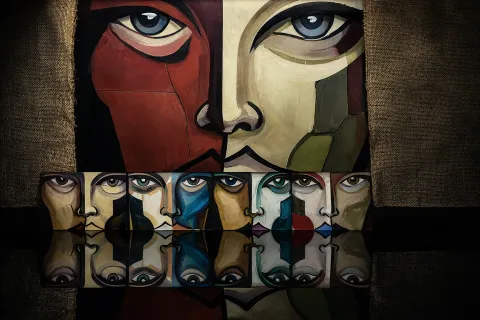
The «FACIES» series by Maurizio Valch explores contemporary abstract face painting. These works, realized in acrylic and oil on canvas, present structural art of fragmented faces, where identity emerges as an evolving surface – a visual coexistence of forms, gazes, and silences. View series
Painting series
FACIES
The «FACIES» series by Maurizio Valch explores contemporary abstract face painting. These works, realized in acrylic and oil on canvas, present structural art of fragmented faces, where identity emerges as an evolving surface – a visual coexistence of forms, gazes, and silences. View series
- Context studies
- 8
Conceptual Note
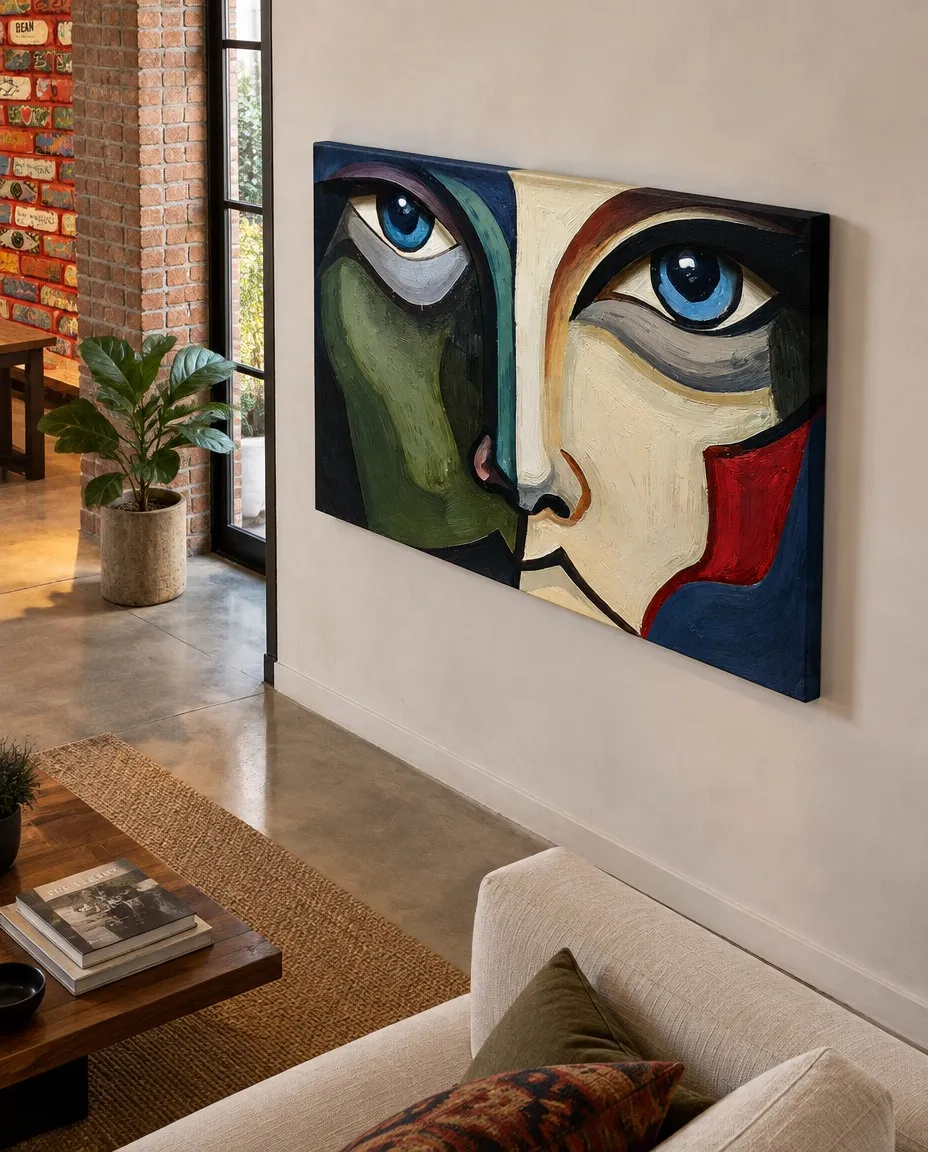
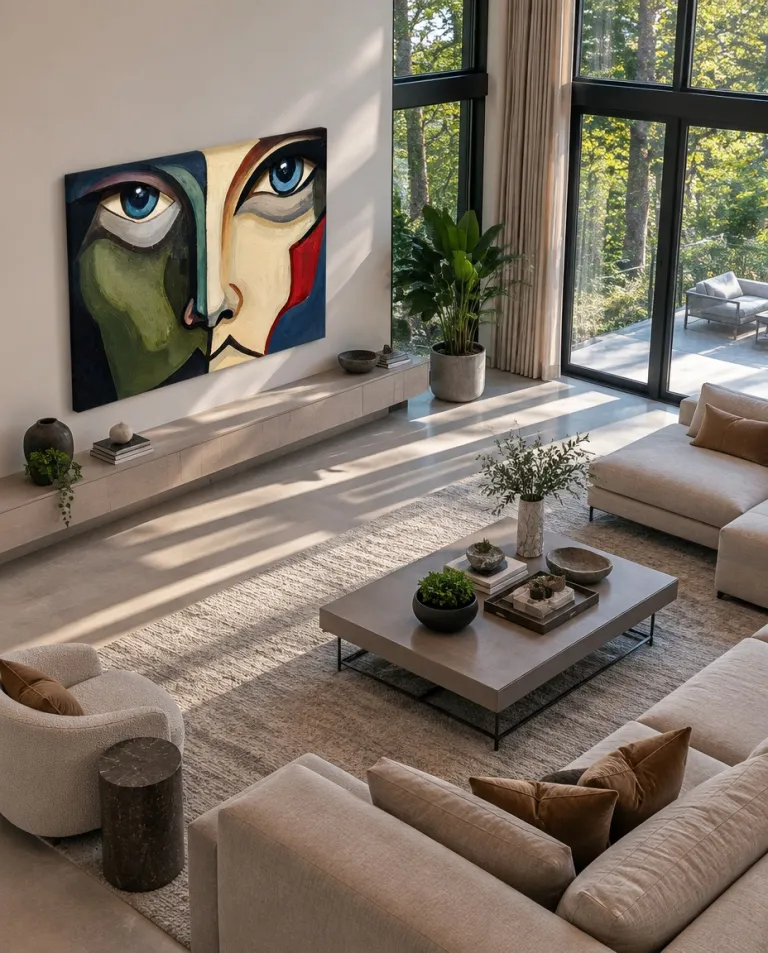
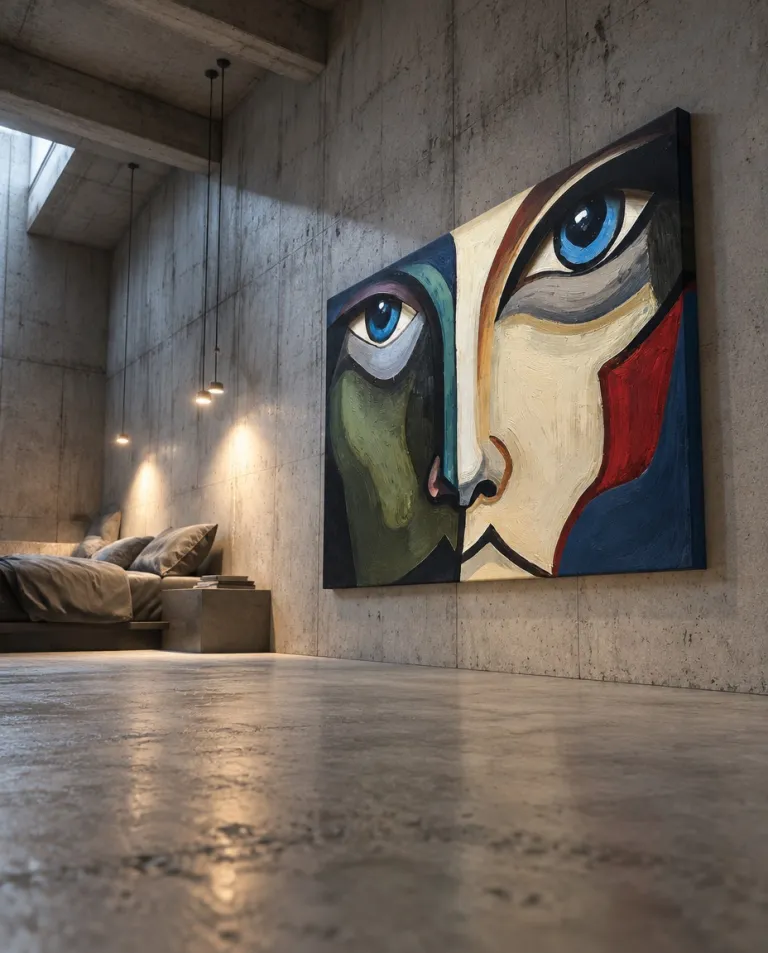
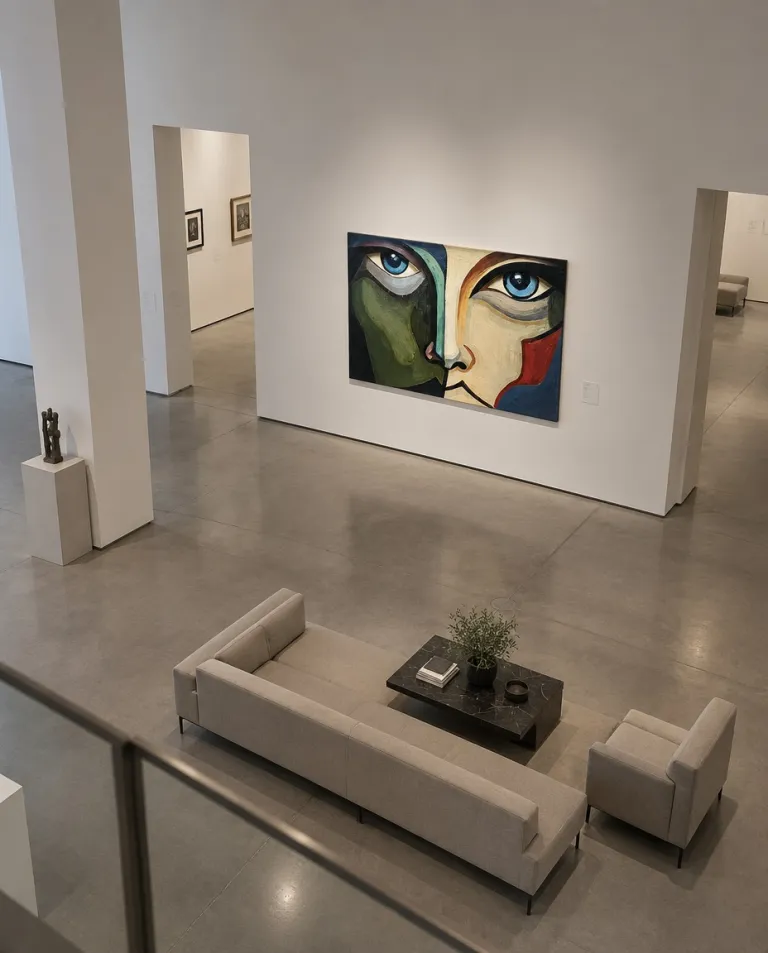
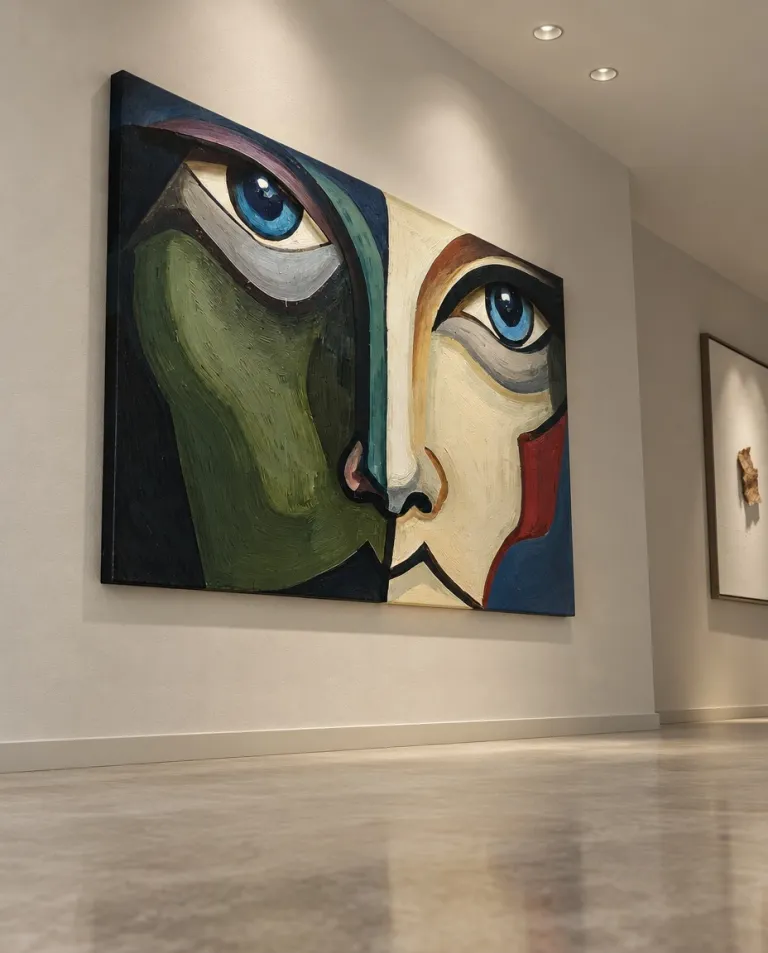
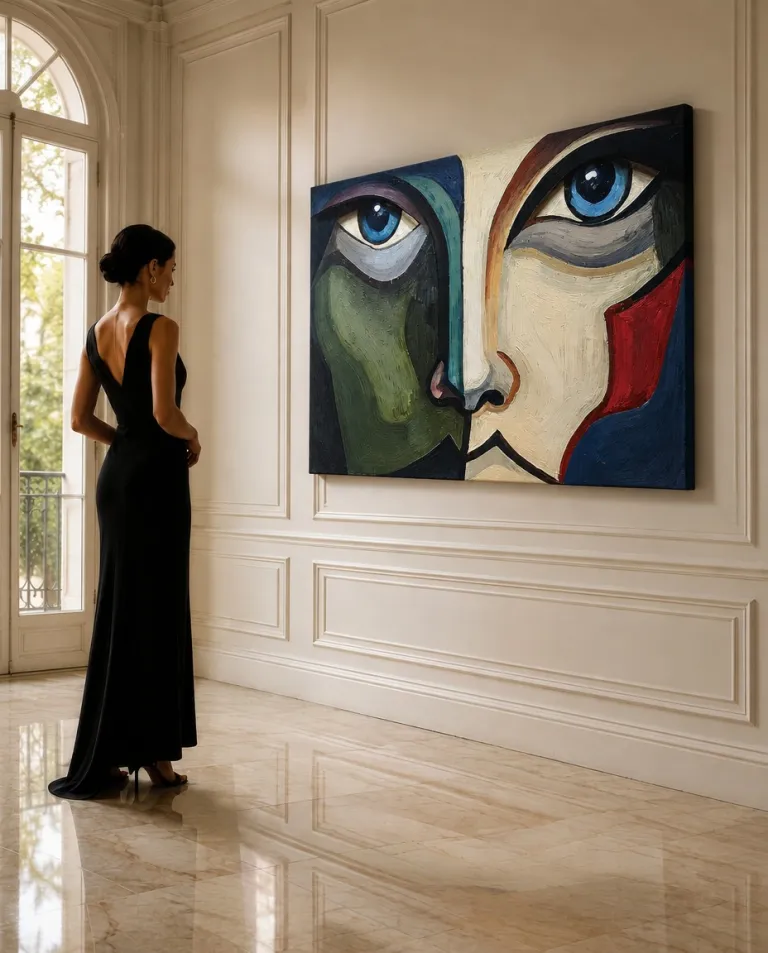
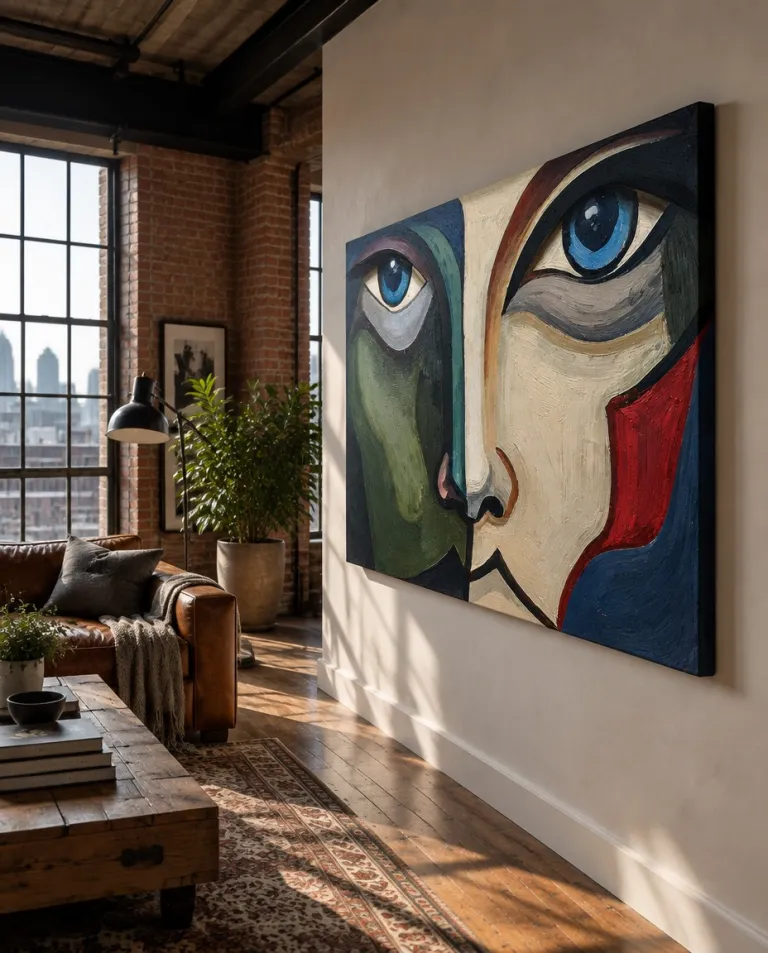
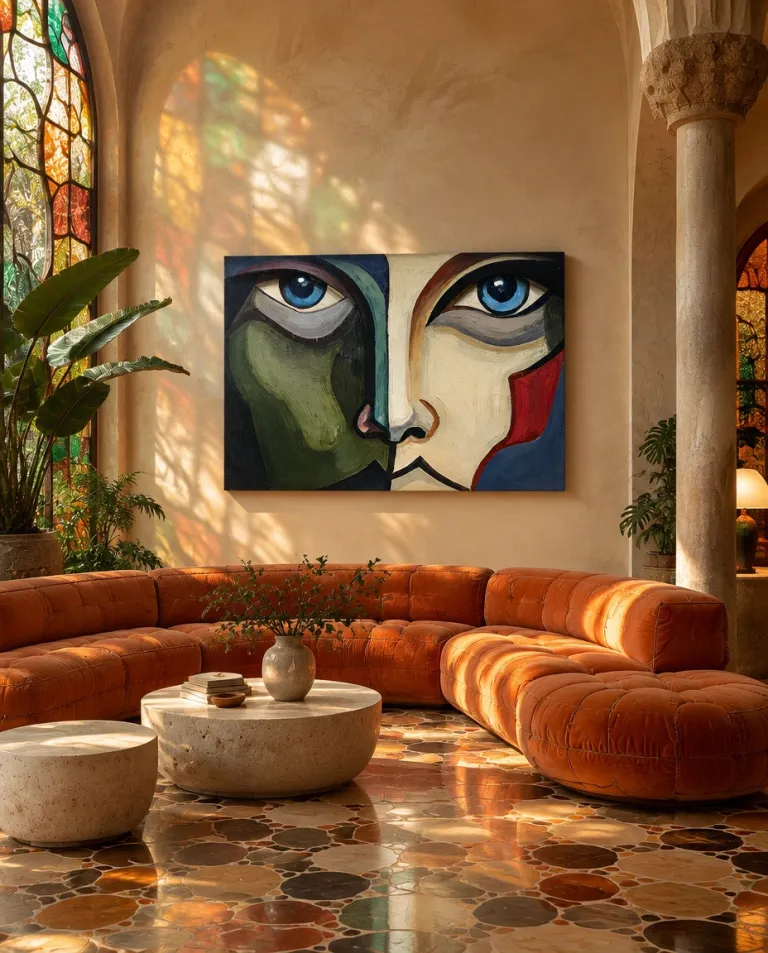
Imagine covering the green half of ACIES; leave only the ivory and red side visible. Uncover it, cover the other side, and look again at both eyes together. The question that emerges is not what this surface represents, but this: what does each eye lose when the other disappears, and which one produces the presence of the person looking? At first, the image accepts convention: two blue irises, a nose between them, a mouth below; a unity persuasive enough for the eye to name it without effort. But the close-up offers no safe distance. There is no room, shoulder, or landscape on which to rest. The face fills the field like a machine brought too close to its operator. The left side, green, dark, and crossed by deep blue, seems to receive the gaze at a slower pace: its surfaces hold the light, sink it, return it late. The right side, ivory and cut by vivid red beside the cheek, arrives first; not because red signifies alarm, but because it forces the eye to readjust its orientation, as if a signal had been placed too close to the face. When both halves are uncovered again, the nose seems to join them. A moment later, one discovers that it also works as a gate: it lets resemblance pass through, but does not guarantee that it will arrive intact.
Roberto Fontanarrosa was an Argentine writer and cartoonist capable of finding intelligence, tenderness, and absurdity in everyday life, and his humour understood that a face can say one thing while its eyes do another. Here, he might suspect that the two eyes are neighbours by necessity: they have shared a nasal bridge, a brow line, and a frontal direction for too long, and so they pretend to know one another. The suspicion is comic, but not reassuring. The eye on the left seems watched over by the shadow surrounding it; the one on the right, more open against the ivory, seems to have received different news. Their blues recur, and that repetition should stitch them together. Yet the highlights do not fall with the same obedience, the edges do not breathe alike, and the lower curve of each eyelid does not quite answer the other. By that logic, the nose would be a poor mediator: too narrow to negotiate two versions of the world and too central to allow them to ignore one another.
The vertical band compels us to move closer, until the idea of a face gives way to a boundary between surfaces. On one edge, a blue-green descends from the forehead; on the other, ivory gathers around the bridge of the nose. It is not a clean line. It widens, contracts, allows itself to be invaded by black shadows and dense lights. Every visible direction in the matter makes the contour that had seemed settled waver: the boundary resembles a seam; then, a scar without a wound; then, the narrow space between two plates that never quite fit together.
I could not make the incompatible settle into place without resistance. When the dark area seemed to accept the light, the light became too close, too insistent, and the joining began to seem like an imposition by the looking eye. I wanted to attend to that hesitation without turning it into a comfortable separation: the painting had to retain a centre, but a centre unable to govern everything else. In that band, each form demanded its own continuity while denying that of its neighbour; I could not decide for them without losing the pressure that holds them together.
Margaret Mead was an anthropologist who learned to distrust what a culture considers natural by observing how other lives organise the body, relationships, and the gaze. At first, she might take the joke about neighbours by necessity as evidence of division reached too quickly: two distinct ways of looking, two ways of ordering the face, two systems that do not coincide. But the painting corrects that reading. Fontanarrosa had noticed that coexistence is uncomfortable; Mead returns that discomfort does not prove the existence of two separate identities. What perceptual pact requires two eyes to form a single interiority? Where does the certainty come from that a nose must bring together what the eyelids, shadows, and directions of the surface keep in disagreement? The green half will not be turned into an “outside” of the light half; nor does the ivory area occupy the role of a stable “inside.” The red beside the cheek does not complete a difference: it interrupts the desire to classify it. From a distance, it resembles the edge of a mask; closer up, it is a wedge that compels us to recognise that the light side, too, contains its own difficulty in appearing.
A child might ask: “If both eyes are the same blue, why does the one on the left seem to be looking from before the one on the right arrives?” The precision of that question changes the test. It is no longer a matter of deciding which half belongs to which person, or of assigning emotions to colours. It is a matter of noticing that each eye receives a different face. The left one sees, perhaps, a face that must still pass through a dense darkness; the right one sees a face already exposed, surrounded by ivory and by the oblique warning of red. In attempting to bring them together, the viewer’s eye makes a small, persistent physical effort: it jumps from iris to iris, follows the bridge of the nose, loses the edge of a cheek again, holds the gaze until the painted skin refuses to smooth itself out. Then the child’s question ceases to be innocent. If one arrives late and the other too early, perhaps neither is looking forward: perhaps each is checking whether the other has invented the observer.
I now realise that the painting returns a gaze I cannot arrange from one side alone. I thought the centre could hold the tension, but the centre has also begun to ask which part of me needs the eyes to coincide. Difference no longer remains still in the green, ivory, or red; it moves when someone covers one half, recovers the other, believes they recognise a face, and discovers that they have recognised only their need for unity. I do not know where that gaze ends, because when I return to it, I find that it is measuring me too.
In the end, no answer remains that can stabilise the machine. What remain are the two blues: close, almost alike, suspended on either side of a band that joins and cuts. From afar, they again promise agreement. Up close, one retains a shadow the other does not possess, and the other receives a light it cannot share. The eye returns to them to verify the coincidence; the surface offers instead two ways of not losing one another entirely.