Context study / ACIES
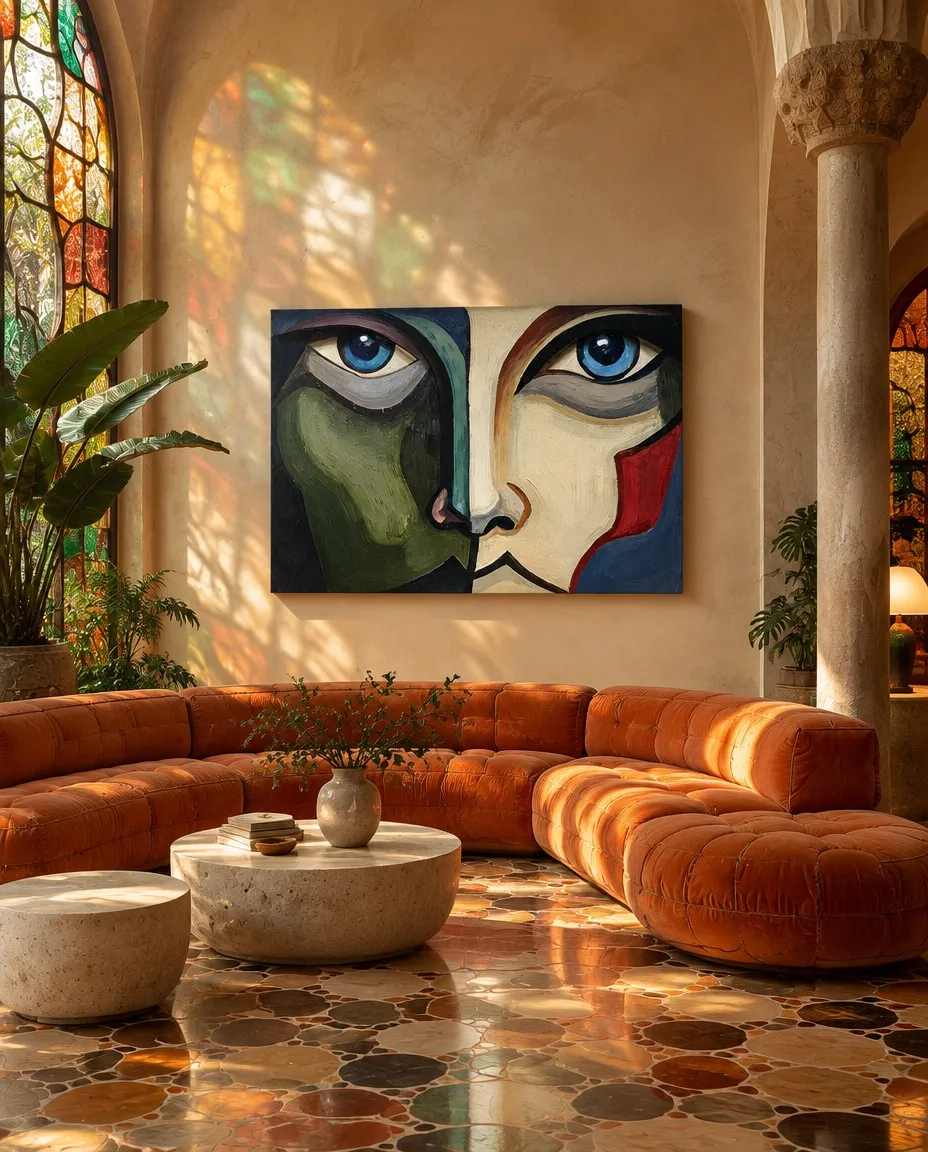
ACIES by Maurizio Valch in a Living Room with Stained Glass and Arches
A test for an eye that will not obey
ACIES measures 210 × 140 cm and occupies the wall as a presence that allows no sufficient distance. The blue eyes are too close together and yet fail to meet: each seems installed in a different room of the same face. The visible surface accumulates thicknesses, interrupted directions, dark edges, and areas of colour that never quite settle. The green on the left weighs, withdraws, absorbs; the pale right side, crossed by red and blue, appears to have been pushed towards the light. The viewer steps back and discovers that the eyes remain there; moves closer and notices that they are not two windows, but two demands.
To begin with, the luminous half claims the field. One need only imagine the left eye covered for the right side of the painting to become almost too available: the blue of the pupil gleams beneath a marked eyelid, the pale skin receives the impact of white, a red band cuts across the cheek as if it had arrived late to a conversation. This half seems to say: look, there is a face here; there is something legible here; this is the side that knows how to present itself.
Then Byung-Chul Han appears. He is a philosopher who has considered how constant exposure, performance, and the disappearance of otherness transform our ways of living and looking.
His suspicion falls upon that brightness. Not because light is guilty, nor because the blue eye conceals a lie, but because its openness seems to have learned to offer itself before anyone asks. There is a gentle violence in that gleam: the violence of what makes itself too easily visible, of what promises that knowing will be equivalent to focusing. The right eye seems innocent, but perhaps it has merely perfected a courteous form of surveillance. It allows entry, while deciding what can be seen.
The light half is not the tranquil half. The red does not set it ablaze; it forces it into tension. The blue does not cool it; it gives it an almost damp precision. Beneath the eyelid, the pupil does not rest: it seems to sustain an attention exhausted by being available. Han would not allow this side to be mistaken for a transparent truth. A wholly exposed gaze can cease to be a gaze and become a surface for the consumption of another gaze.
Maurizio Valch
I cannot accept that one area is night and the other day, even though at first they themselves seem to want to arrange themselves that way. One withdraws and the other demands to be seen, but neither prevails. When the division becomes too sharp, something in the image resists: the eyes remain the same blue and yet do not share the same distance. The question left suspended is this: What part of us invents the other eye so as not to remain alone when a gaze splits in two? I cannot find an answer that does not tear the seam still further.
—
Now the imagined hand changes sides. The right eye is covered. The painting loses its promise of clarity and enters the green field, dark, almost nocturnal. But the darkness does not behave like a well. There are variations of green, veering marks, densities advancing and receding around the left eye. The pupil retains the same blue, though here it seems less displayed, as if it had to make its way through matter unwilling to be simplified.
Rita Levi-Montalcini enters this part. She was a neurologist who investigated how nerve cells grow, orient themselves, and find signals for survival.
The gaze changes its question. It is no longer a matter of discovering what that green represents or what wound the shadow recounts. The pupil becomes a place in search of a signal. Not a symbol of the interior, not the gateway to a soul, but a small concentration of attention: something orients itself, feels its way, measures the distance from that which might nourish its direction. The left eye does not close; it works within a thickness.
Levi-Montalcini’s intelligence draws the image towards contact. Even what is separate seeks something. A minimal direction is enough: a gleam, a proximity, an edge that answers. The dark eye seems to extend towards the central seam, as if there were a faint signal there. But the painting resists that functional hope. There is no guarantee that the two halves are made to connect. The green can move closer without becoming a bridge. The pupil can orient itself and find no nourishment.
“Why are both eyes the same blue if they are not looking at the same place?”
For a moment, the question leaves both sides without a role. It also unsettles both intelligences. Han had seen, in the luminous half, the risk of compulsory transparency; now he sees that the dark eye is not simply the intact reserve of the other. It too needs an answer. It too seems exposed to an absence. Otherness is not a self-sufficient fortress: it can hurt because it needs recognition without reduction.
Levi-Montalcini, for her part, finds a limit in the impulse to connect. Not every proximity heals. Not every signal should become a route. Some connections submit one eye to the rhythm of the other, forcing a pupil to look where it did not want to look. The black edge of the lips, reduced to a resistant form, seems to know this better than anyone: it does not smile to mediate, does not speak to translate. It merely holds an interruption.
—
With both eyes open, the face promises what so many faces promise: unity. Two eyebrows, one nose, one mouth, one frontal surface. But the promise fails in a precise way. There is no final fusion; there is a negotiation remade every second. The right eye seems to look from a brightness under suspicion. The left looks from a density that cannot take refuge in its secret either. The two blues resemble two words spoken by different mouths.
The vertical seam does not divide an identity that was already complete. Rather, it compels a distance to be made between two ways of attending. On the light side, attention seems cast outward, captured by the possibility of being seen. On the dark side, attention seems to gather itself, not to protect an essence, but not to disperse. If both eyes attempt to form a single gaze, they fail because each brings a different economy of contact.
Han would have to admit a bodily need in that attempt. It is not enough to defend separation as though every union were domination. There is a real tension in the desire for the eyes to coincide, if only for a moment. Levi-Montalcini would have to admit that growing towards a signal does not make that signal good. One gaze can reach towards another and encounter a necessary boundary. Neither prevails, because the painting offers no agreement: it keeps the eyes open while denying them a common vision.
The face occupies almost all the space, but its centre is not full. The nose seems to be made and undone at the same time: a pale band descends between the eyes, meets shadows, dark edges, a brief curve, and loses certainty again. There, division is no longer merely a cut. It becomes a defective passage, an area where both halves brush against one another without knowing whether the brush is contact, intrusion, or a mere optical accident.
Maurizio Valch
Now the painting no longer seems to await a gaze: it returns two. One demands recognition and the other seems to distrust that recognition, yet both fall upon the person looking at them. The painting ceases to belong to me because the crack holds something I cannot translate. It is not an empty place; it is a pressure between the eyes, a way of being separate without vanishing altogether. Each time I try to bring them together, one of them changes its distance.
—
A small area remains, more obstinate than the large colours: the edge where the nose narrows before touching the mouth. There, the white does not fully belong to the brightness on the right; the shadow does not fully belong to the green on the left. The black of the lip rises slightly, breaks off, holds a minimal curve as though it had learned to fall silent without closing.
Both eyes remain blue. They do not help one another; they do not abandon one another. Between them, the seam slowly descends to that mouth reduced to an edge, and at the point where black almost touches pale skin, a tiny, vibrant space remains, seeming to look without a pupil.
- Original artwork
- ACIES
- Actual dimensions
- 82.7 × 55.1 in / 210 × 140 cm
- Presentation
- Digital contextual visualization
Context references
contemporary painting in a living room with arches · wall art for a warm living room · face painting in an eclectic interior · large painting above a terracotta sofa · stained-glass decor and contemporary art · painting mockup in a Mediterranean living room
About this visualization
This visualization places the artwork within an architectural context to help collectors and viewers imagine its presence in a real space. It is an interpretive reference, not an exact reproduction: the original work remains the sole authority for scale, color, surface and material presence.