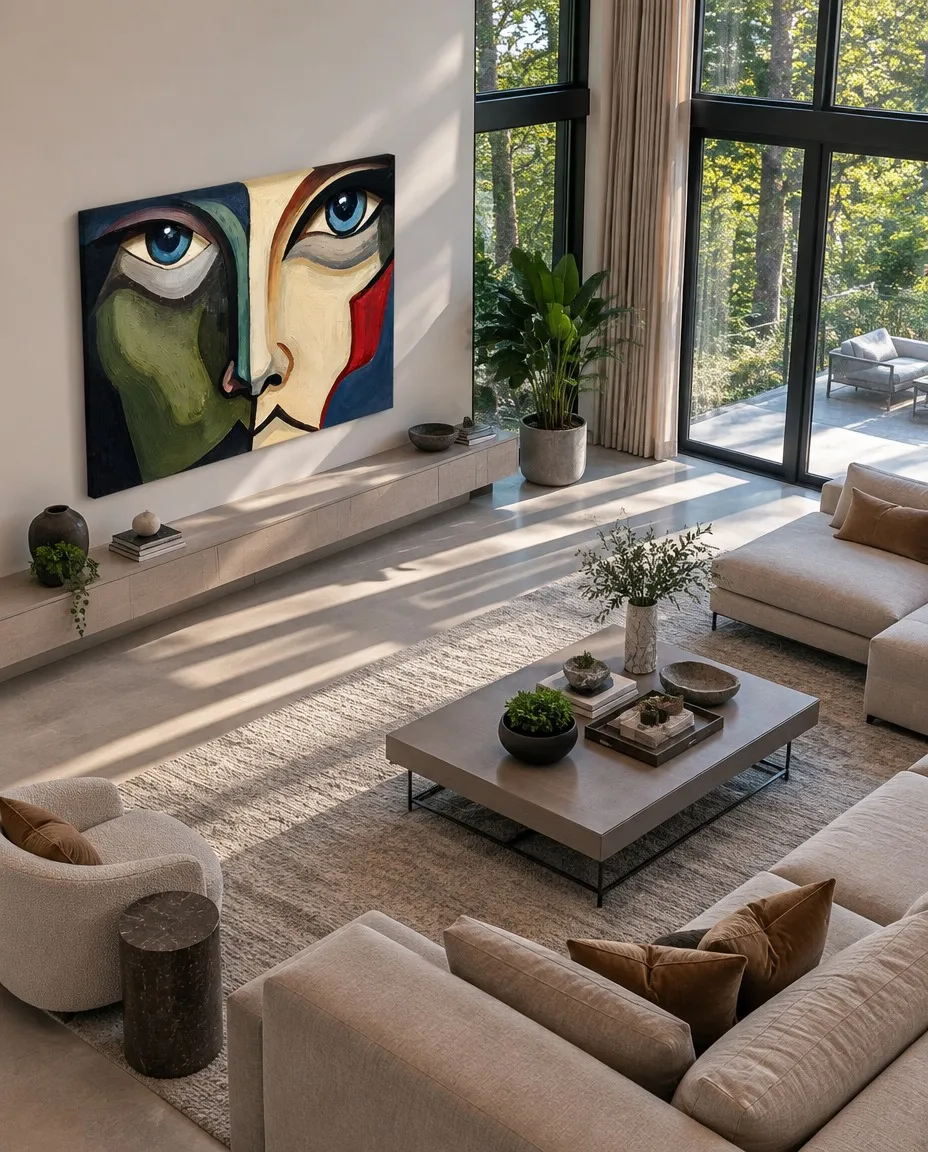
Context study / ACIES
ACIES | Fragmented Face by Maurizio Valch
It is impossible to fix one’s gaze on both eyes at once. When the left eye—blue, sunk into opaque greens and black—becomes the centre of attention, the right turns into a peripheral presence, a lamp too white beside a red wound. When one looks at the right, the other seems to withdraw into a cold depth, as though it had arrived at the face first and must now share it reluctantly. The nose tries to be the agreement: a central ridge, narrow, almost vulnerable. But the eyes sign nothing.
Try something simple. Cover the light half for a few seconds, from the bridge of the nose to the right edge. Leave visible the dark green, the nocturnal blue, the pupil that seems to hold a small gleam beneath the eyelid. Without its neighbour, that half is neither sinister nor dramatic: it seems concentrated, even fatigued; a face that has remained awake watching over something that does not appear. Now cover the dark half. Ivory, red, and blue expand. The right eye loses its apparent balance and becomes too exposed, almost compelled to stay alert. Uncover both parts again. You will notice the violence: each side had acquired a temperature of its own and, once reunited, can no longer pretend it never had one.
Donna Haraway is a thinker attentive to the strange bonds between bodies, creatures, and histories. She enters here and immediately detects a problem of kinship. There is no unified face that was subsequently broken; there are matters of attention forced to share cheekbone, nose, and lips. The green need not be forest, nor the red blood: both are climates that touch without ever quite mixing. But that breadth narrows as one approaches the pupils. No network is sufficient to explain two eyes that seem to watch one another from so close by. One might want to know what the other conceals. The other might be tired of being interpreted by its sibling.
The division does not fall across the face like a line drawn from outside. The face seems to push against it. Beneath the dark eye, a greyish fold weighs down as though the gaze had a double eyelid; beside the light eye, the ivory receives light with a harshness that offers no comfort. The mouth, split within its own economy of shadow and tone, cannot decide whether it is closing or holding back the faintest laugh. Not a kindly laugh: the laugh that appears when someone proposes classifying an animal still learning how to have legs.
I feel this line in the middle of the face as a pressure that will not let me take distance. I cannot hold these two zones together without noticing that they reject one another, nor can I separate them without each losing something of its weight. It unsettles me that the work has moved away from what I thought I knew about it: now the nose does not seem a border between two identities, but the narrow place through which a single presence tries to breathe while two gazes pull in different directions.
Tove Jansson was a writer and artist able to find tenderness and danger in the same room. She looks at the green half and asks, without seeking solemnity’s permission: “Why does the dark side seem cold when the other eye is so close?” The question compels a return to a tiny area: the lower edge of the left pupil, where the blue does not shine in the same way as it does on the right. There is a visual moisture there, a shelter. Perhaps the dark side does not threaten; perhaps it is shrinking back. Perhaps it is not a mask that conceals, but a part of the face that has learned not to take up too much space.
The light half protests. Its vertical red does not want to be called exposure, wound, door, or blanket. It clings to the cheek like a band that has come too close to the eye. If the dark side is cold, this one may be excessively warm: not the warmth of an emotion, but that of someone sitting before a window without a curtain. Haraway resists the green’s timidity. A difficult relation is not resolved by granting one half the right to appear vulnerable. Yet the left eye does not return the gaze with mastery. It barely holds it. The right pupil, by contrast, possesses something of impatient watchfulness, as though it wanted to check whether it has already been noticed that no one is really in command.
I now listen to the eyes unevenly. The one on the left seems directed inward, though not like a secret: rather like a room that does not know whether to open. I do not feel that the right one is looking at me; I feel it is looking at the edge of its neighbour, waiting for a signal that does not arrive. The central line neither joins nor entirely cuts. It leaves me before a proximity I understand less the longer I observe it, as though the face needed me not to choose which of its two climates deserves to be called a face.
The mouth complicates everything again. Its strokes meet beneath the nose, but they neither kiss nor cleanly contradict one another. There is a small interruption, an angularity that prevents it from being read as a single gesture. Is it silencing an argument? Is it about to ask that they stop covering one half of it? Jansson’s question persists, but changes place: perhaps the cold does not belong to the green; perhaps it appears exactly where both colours are forced to recognise one another.
From afar, the face seems monumental, assured in its frontality. Up close, that assurance comes undone in edges that never quite align: the black tightening around the left eye, the red rising beside the right, the bridge of the nose unable to distribute the face fairly. One eye seems to look outward. The other seems to be waiting to be looked at. The doubt is which one began first.
- Original artwork
- ACIES
- Actual dimensions
- 82.7 × 55.1 in / 210 × 140 cm
- Presentation
- Digital contextual visualization
Context references
ACIES Maurizio Valch · fragmented face painting · contemporary painting with blue eyes · abstract face wall art · green red and ivory figurative painting · contemporary artwork for a modern living room · large horizontal face painting · Maurizio Valch FACIES series
About this visualization
This visualization places the artwork within an architectural context to help collectors and viewers imagine its presence in a real space. It is an interpretive reference, not an exact reproduction: the original work remains the sole authority for scale, color, surface and material presence.