Context study / ACIES
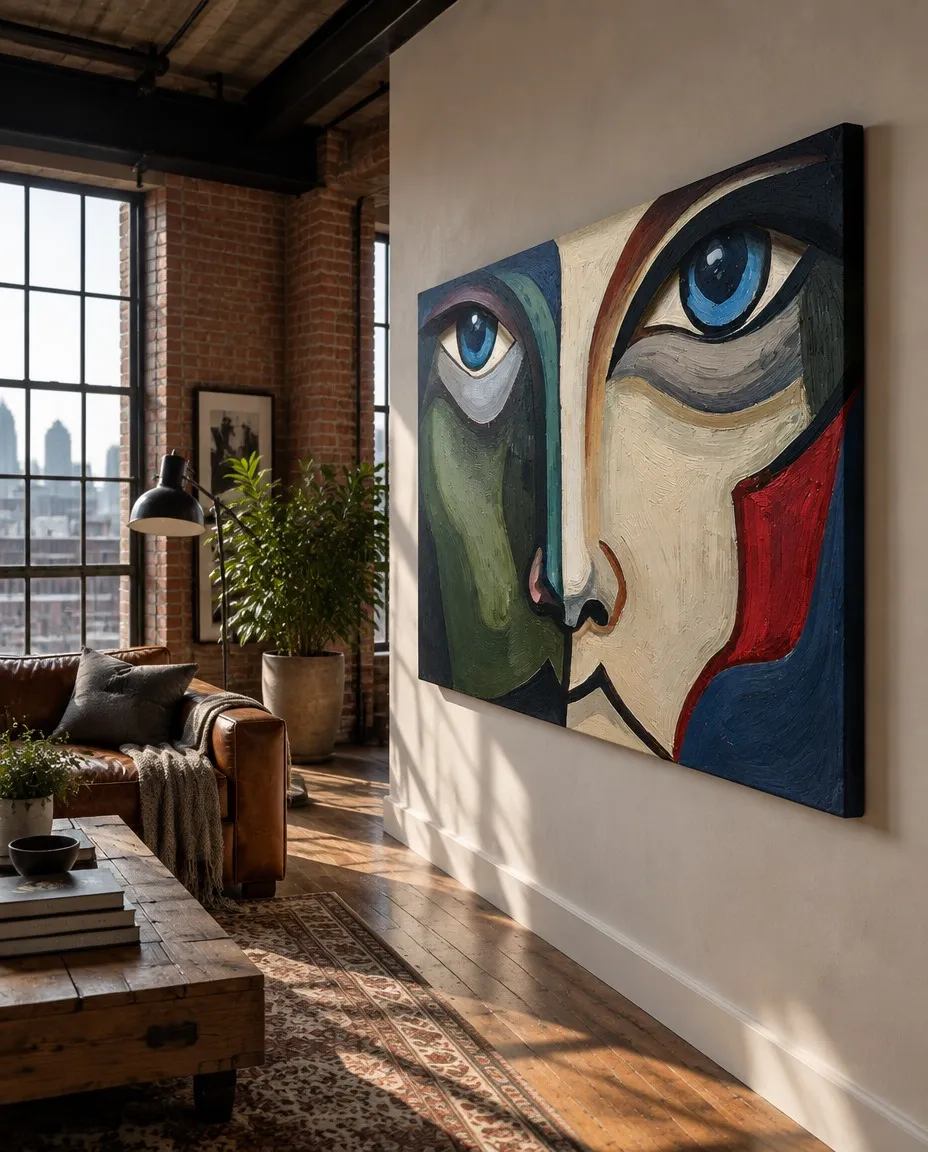
ACIES by Maurizio Valch in an Industrial Loft Living Room
ACIES faces us directly, yet it does not yield itself head-on. At 210 × 140 cm, the face commands a scale of presence: it cannot be taken in with a comfortable glance. The line descending the forehead, crossing the bridge of the nose, and grazing the mouth does not act as an axis of symmetry; it acts as a test. On one side, dark green, blue, and black seem to breathe denser air. On the other, cream, grey, red, and blue seem exposed to a light that never quite becomes rest. The task is not to recognise two halves. It is to determine whether they could come together without either having to forget the climate in which it learned to look.
The first difficulty lies in the eyes. They are two blue irises, yes, but not two versions of the same eye. If attention settles first on the eye above the green field, the viewer’s own face tends to tighten near the temple: that eye seems to retain a peripheral alertness, as though attending to something taking place beyond the painting. Moving to the eye on the light side, the tension does not disappear; it shifts to the brow. There the gaze seems closer, more direct, less willing to let the visitor slip away. Then the hidden question arises: which eye is looking at the other, and which is looking at the observer?
David Attenborough is a naturalist and narrator whose patience with living beings helps us perceive that nothing alive is an immobile surface. Before ACIES, his attention would not begin with the idea of a divided personality, but with a difficult coexistence of living conditions. The left cheekbone, with its deep green and black areas, might be the edge of a habitat where light arrives filtered, delayed. It would not be “nature”; it would be a temperature, an imagined humidity, a zone in which the skin seems to have learned to protect itself. The light side, by contrast, offers a different exposure: cream, grey, and blue do not promise serenity, but a surface that has endured too much brightness.
Attenborough would observe the pupils as one observes an animal that has detected movement. Not for their size, but for their vigilance. The blue irises do not rest within the face: they organise the fields around them. The grey beneath the eyes is not a mere shadow; it alters the pressure of the gaze, making it heavy on one side and cutting on the other. Nor do the black areas obediently serve to darken. They are densities. They interrupt the continuity of visible flesh and make it uncertain where the edge of a cheek begins and where a depth opens.
At first, the division seems indisputable. It is there: vertical, obstinate, descending from forehead to mouth like a scar unwilling to declare what wound produced it. But nearer the nose, certainty becomes less secure. The septum belongs entirely to neither climate. It is a transitional strip. The nose attempts to occupy the centre, even as the centre itself has become suspect.
I cannot decide whether the line separates or supports. When I look at it, the two parts seem to know different things about me, and that difference unsettles me more than a clear opposition would. I want to say where one half ends and the other begins, but the closer I get, the more the boundary moves towards my own eyes. At times I think I have constructed a divided face; at others, that the face has divided me in order to look at me from two places.
After that voice, Attenborough can no longer classify with the same composure. If the organism returns the gaze, it is no longer possible to stand outside it and describe its conditions of existence as one might note the behaviour of a creature at a distance. The dark green of the cheekbone is not territory available to us. It looks back. The black that outlines an area of the face does not merely protect or enclose: it also expels. Nor does the light zone accept identification as an opposing, pure, sunlit region. The grey beneath the right eye clings to the cream and makes it less hospitable. The red at the side, near the cheek, does not decorate the surface: it breaks in as something that arrived before the face could make room for it.
Gabriel García Márquez was a writer for whom memory and strangeness could coexist with the precision of the everyday. Before this face, he would perceive a house shared by inhabitants who do not live under the same time. He would not invent a story to explain it; rather, he would recognise the discomfort of a coexistence that cannot become familiar. One side seems to remember the world from a persistent half-light. The other seems to have arrived late at an illuminated scene already under way.
But Attenborough objects: the face needs no genealogy in order to be alive. It needs no parents, episodes, or narrative secrets for its eyes to contradict one another. It is enough to see how the left eye inclines towards the fissure, while the right seems to maintain a more open distance. It is enough to notice that the black edge on the forehead is not an unfinished sentence, but a physical presence pressing against the brightness. García Márquez accepts the objection, but offers another in return: precisely because the septum, the grey, the red, and the mouth are so present, they are more unsettling than any argument. There is no need to tell what happened to the face. One need only admit that its precision prevents it from being made reassuring.
Then a girl—or a boy, not yet knowing that the question matters—might ask: “If the face is washed, which side goes down the drain first?” The question seems small because it asks for neither symbols nor causes. Yet it alters the entire test. It compels us to see the boundary not as a wall, but as a possible mixture. If something could go first, would the other half remain intact? Or would the water also carry away the blue of the irises, the grey beneath the eyes, the black that appears attached to the surface? Perhaps the line of the face does not separate two stable materials, but two ways of resisting being washed away.
Now the mouth begins to matter differently. It is less certain than the eyes. The eyes hold their positions, keep watch, receive. The mouth, by contrast, seems to be trying to learn a shared pronunciation. It neither opens fully nor closes into a decided expression. Beneath the nose, the vertical line arrives as an instruction the mouth does not quite obey. One end seems to have acquired a dark hardness; the other retains a brightness unable to erase the misalignment. The viewer may feel a slight contraction around their own lips, as if the face in ACIES were asking for a word the observer’s face does not know how to pronounce.
Here García Márquez speaks again of memory, though no longer as narrative. A memory may be a difference in temperature between two cheeks. It may be the fact that one zone receives red as interruption while the other has no place for it. It may be a mouth holding two accents without managing to choose one. Attenborough, altered by this idea, stops asking what species inhabits the green and asks what kind of attention has allowed two climates to remain attached to the same skin without cancelling one another out.
The provisional answer does not say “two identities.” It says: two systems of survival. But that, too, is insufficient. The dark side is not only defence; it has an intensity of presence that attracts. The light side is not only exposure; it retains grey folds that make it difficult to pass through. Both eyes seem to have learned different ways of remaining awake. And perhaps the work is not split. Perhaps it tests two incompatible ways of sustaining the same attention without either being able to claim the whole face.
I no longer feel that the division is merely a wound, nor merely a seam. I resist thinking of it as survival, because there is something less useful and more fragile within it. I also resist calling it memory, although I know the face seems to hold a divided language. Now I perceive a tenderness I had not expected: not because the parts are reconciled, but because neither entirely expels the other. The painting no longer belongs wholly to me; it retains an area I cannot name and that perhaps does not want to be named.
The question of the drain returns with unexpected gravity. It is not a matter of knowing which colour would be lost first. It is a matter of understanding that washing a face would mean deciding what counts as surface and what has become inseparable from it. The red at the side now seems like something that would not come away easily: not because it is an emblem, but because it has changed the temperature of the neighbouring cheek. Nor would the dark green come away as a separate layer: it has taught the left eye to look from a reserve. And the black areas, far from disappearing, might be the last thing left when everything else tries to clear.
As one approaches the painting, the face ceases to function as a recognisable image and becomes relief, cut, mass, resistance. The line of the forehead is no longer an abstract boundary: it seems an edge interrupting the passage of the gaze. The nose no longer mediates; it divides and reunites at once. The mouth does not resolve anything. Seen up close, the two blue irises neither confirm unity nor accept a clean separation. Between them is a relation that cannot be fixed: at moments they seem to watch each other; at others, to take turns looking outward.
The test of impossible reunification does not fail because the parts do not fit. It fails because bringing them together as though they were pieces of a former face would impoverish what each has learned. The dark side knows that a gaze can arise from density. The light side knows that light, too, can unsettle. Between them, the red does not become a bridge, but it prevents the division from being silent. The mouth continues to seek a shared pronunciation without promising to find it.
It is best to end before the left eye, raised above the green and black zone, because it does not allow us to forget that the opposite half exists. Its blue does not offer itself as refuge: it seems to sustain a vigilance arriving from afar and yet directed towards the central line. When one fixes on it, the right eye falls outside the immediate field of vision, but does not disappear. It continues on the other side of the nose, in the greyish light, beside the red that interrupts the cheek, as a second attention that has not yielded its place.
- Original artwork
- ACIES
- Actual dimensions
- 82.7 × 55.1 in / 210 × 140 cm
- Presentation
- Digital contextual visualization
Context references
large painting in an industrial loft living room · contemporary art for an exposed brick wall · face painting in an industrial interior · horizontal painting for a living room with large windows · loft decor with wall art · painting mockup in an industrial living room
About this visualization
This visualization places the artwork within an architectural context to help collectors and viewers imagine its presence in a real space. It is an interpretive reference, not an exact reproduction: the original work remains the sole authority for scale, color, surface and material presence.