Context study / ACIES
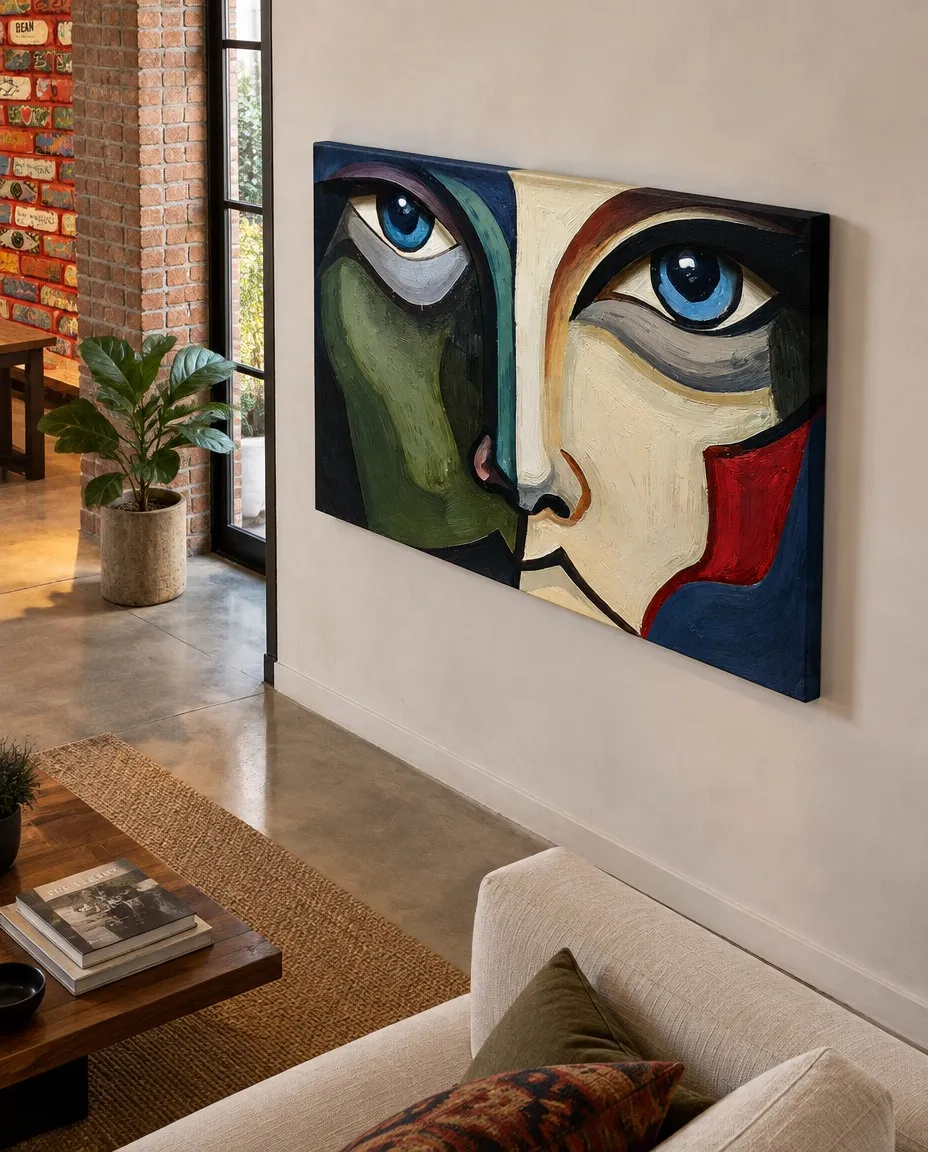
ACIES | Fragmented Face by Maurizio Valch
The incision does not divide the face: it forces it to hold together as a door does when someone pushes from both sides. On the left, green opens onto no landscape; it thickens, sinks inward, and protects an almost vegetal dimness that promises no refuge. Black gives it an edge that seems to absorb the cheek, while turquoise beside the eye does not lighten it: it cools the air of that half and lends it a difficult distance. On the right, the pale skin offers no rest. It is crossed by ochres that make it earthy, by blacks that close it in from above, by a red that declares neither wound nor passion: it occupies a corner, presses outward, as if it wanted to dislodge the eye. The two blues look forward. But they do not arrive together. The left one seems to have heard something first; the right seems to respond when it is already too late.
Wolfgang Amadeus Mozart was a composer capable of making several distinct voices coexist, argue, and produce a shared form of joy or tension. Here he finds not a compliant pair of eyes, but two rhythmic entries that only pretend to coincide. The green-blue eye enters with a contained, almost sideways vigilance, though it faces forward; the other opens with a more exposed clarity and, for that very reason, less certainty. Between them, the nose descends like a faulty bar line: it marks a measure, tightens it, shifts it. Acies: not a word that explains, but an edge that compels one gaze to measure the other. Mozart would want to hear a relationship. A disagreement that, despite everything, still composes. But the central line does not coordinate: it stitches and separates in the same movement.
I look at these two eyes and feel that the image has begun to look without needing me. I recognise the discomfort of that boundary which should have ordered the face and now seems to crush it from within. I cannot decide which half sustains the other; when I try, the face becomes unfamiliar to me. I feel that a decision has broken away from me and continues ahead, with an obstinacy I can no longer correct.
Then a question appears with the cruel precision of a child’s question: why does the nose have to work so hard to keep the face from splitting apart? Nothing in the painting can return it to innocence after hearing it. The bridge of the nose ceases to be a recognisable centre; it seems too narrow a piece, forced to bear two incompatible weights. There is a shadow beneath the left eye that withdraws into the green, as if it had found somewhere to sleep. Beneath the right, the shadow extends differently: it does not rest, but tenses itself against the clarity of the skin. The nose works. It joins under pressure. It holds a conversation that may already have ended.
It is worth trying something without solemnity: mentally cover the left eye. The pale half does not become simpler; on the contrary, the red along the lower edge takes on a strange thrust, and the visible blue seems exposed in a room that is too large. Notice your breathing: it may become higher, less evenly distributed. Then restore the left eye. The face does not regain its unity; it merely regains the habit of appearing to be one. Now the green occupies a territory that does not accompany the other side, and the dark band beside the nose seems less a shadow than a resistance. Unity was the viewer’s expectation, not a fact of the image.
Barbara Hepworth was a sculptor who conceived form as a body traversed by void, weight, and its relation to space. Her arrival disrupts Mozart’s listening because she no longer allows the fissure to be understood merely as an interval between two voices. She forces it to have thickness. What seemed a rhythmic line becomes a spatial pressure: the face may not be divided, but folded around a void that remains behind the nose and cannot be seen. The shadows beneath the eyes are no longer pauses; they are inaccessible cavities. The red band on the right is no longer an intrusive note: it becomes a plane pushing from within, a slanted wall that reduces the face’s space. This is not a face being represented. It is a room too narrow for two presences being constructed.
Mozart still tries to make the eyes listen to one another. Hepworth insists that they are separating in volume. And the work resists them both: it denies the first a resolution, and the second a clean void. There is no pure cavity, because visible matter advances in striations, accumulations, and thicknesses that halt the light and make it stumble. There is no stable counterpoint, because the black on the left seems to invade the pale zone without fully crossing it, while the ochre on the right brushes the central edge as if trying to persuade it to yield. The face is a wall. The wall is relief. The relief resembles a face unable to decide which way it falls.
In this division, I hear a music that does not quite reach the body, but I also feel that the body does not fit within the music. I do not know whether the void is behind the nose or whether it arises before my eyes when I try to bring them together. I dissent from any reconciliation that comes too quickly: the face does not ask for harmony; it asks for space, and at the same time refuses to grant it. I remain before that contradiction without knowing whether I have constructed it or have merely arrived too late to see it.
In the end, the left eye—the one that seemed more sheltered by greens, blacks, and mauves—can no longer be read as the secret side of a face. In its blue there is a small clarity that offers no comfort; it barely interrupts the density around it. It had seemed a secondary detail, a glimmer held within the mask. Now it contains another difficulty: that of someone who may not have been looking at the same world as the eye on the other side of the nose.
- Original artwork
- ACIES
- Actual dimensions
- 82.7 × 55.1 in / 210 × 140 cm
- Presentation
- Digital contextual visualization
Context references
ACIES Maurizio Valch · fragmented face painting · contemporary painting with blue eyes · abstract face wall art · green red and ivory figurative painting · horizontal painting for a living room wall · contemporary art in a brick interior · FACIES series Maurizio Valch
About this visualization
This visualization places the artwork within an architectural context to help collectors and viewers imagine its presence in a real space. It is an interpretive reference, not an exact reproduction: the original work remains the sole authority for scale, color, surface and material presence.