Context study / ACIES
ACIES by Maurizio Valch | Contemporary Painting in a Gallery
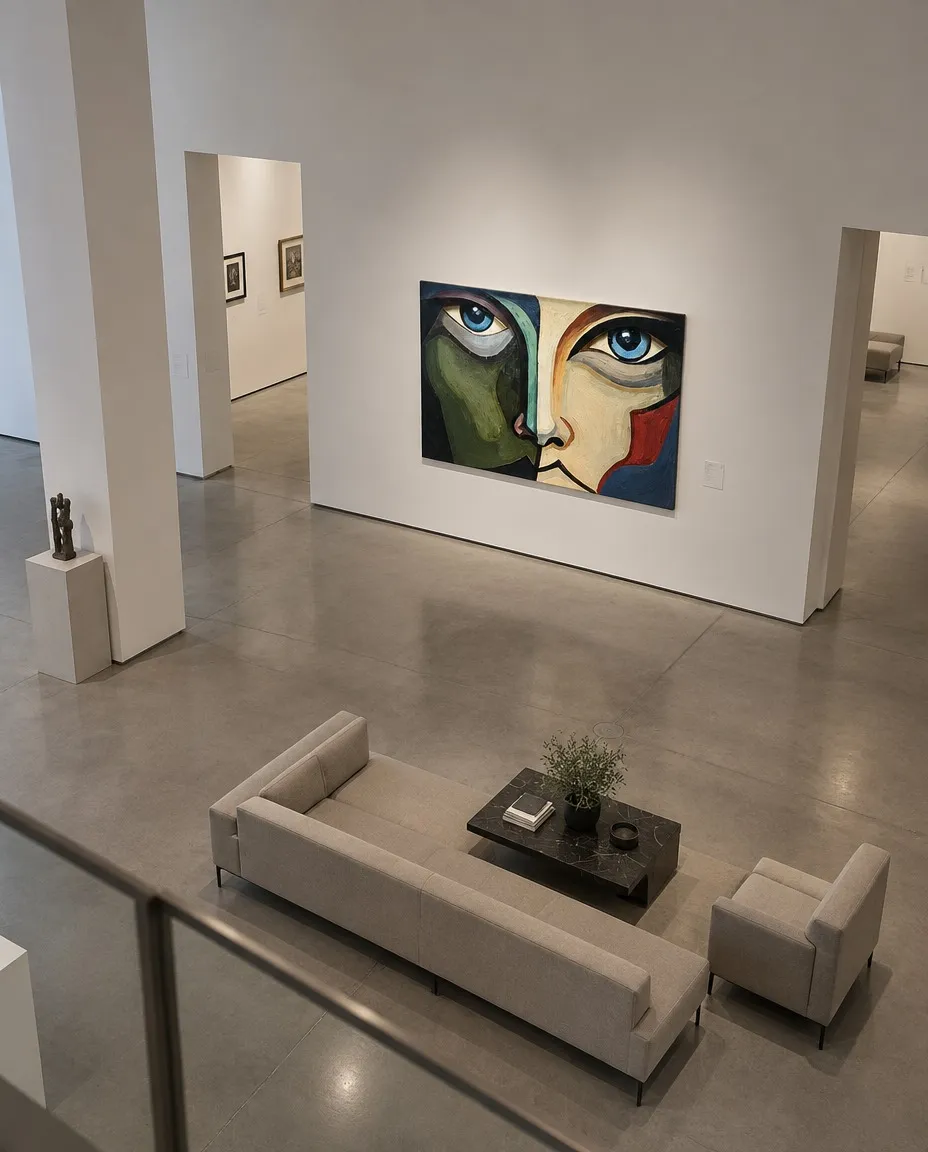
ACIES does not offer a face to be recognised: it places one before us, at a distance that forces the viewer’s eyes to work unevenly. On the viewer’s left, a blue eye seems held within a greenish, dark, dense area; it is not hidden, yet entering it is difficult. On the right, the other blue eye opens over a lighter skin tone, crossed by a red cheek and a low, almost lateral blue that returns the gaze with unsettling frankness. Between them, the nose does not quite join them: it descends like a bridge built while the two territories are still arguing over who has the right to cross it.
The central line seems exact only at first. It drops from the forehead, brushes the glabella, narrows along the bridge of the nose, and reaches a displaced mouth, as though the lighter half had pulled the lips a few millimetres towards its side. It is not a clean division; the matter perceptible on the surface allows each edge to retain small uncertainties, densities, and shadows that do not wholly obey an assigned distribution. The face is divided, yes, but the division does not seem calm. It has something of a seam still pulling at the skin.
Zhuangzi suspected that something may be changing before we know what to call it. From that suspicion, the two eyes would not be two inhabitants forced to share a head, but two moments in a transformation arrested before us. Who looks through the dark eye? Who through the light one? Perhaps the question already arrives too late: perhaps one is becoming the other, and this face is merely the imprecise point at which metamorphosis still preserves two pupils.
Satyajit Ray knew that a still face can contain an entire scene. Yet Ray would not allow transformation to erase the tension so quickly. There is a long, silent second during which these eyes remain open. Something happened before the frame: a word, a wait, a decision not to look away. And something continues offscreen, behind the frontal view. The face looks towards its viewer, yet also seems to attend to an inner conversation that cannot be heard. For Ray, the vertical edge is not an illusion created by viewers anxious to classify: it is a temporal scar, an editing cut left visible because no one has managed to splice the two takes together.
I look at this face and cannot make it obey me. I think I recognise a face, and immediately one of its halves gets ahead of me, looks without asking permission, and leaves the other as if it had only just arrived. I do not feel that I have divided something in order to explain it; I feel that the division has begun to decide for itself where my gaze ends. When I follow the bridge of the nose, I find an area that refuses to belong to either side, and there the image becomes less certain than I am.
Zhuangzi might answer that the scar exists only because the gaze insists on immobilising what changes. Ray would reply that this answer is too quick, almost elegant: one need only look at the mouth to notice that the conflict has weight. It does not quite belong to the greenish darkness or to the lightness crossed by red; it seems to have received contradictory orders and to have chosen a minimal grimace, a resistance. The painting need not tell a story for the viewer to imagine duration. It is enough to hold the eyes for a few seconds: the left may seem watchful, heavy, absorbing; the right questioning, exposed, capable of returning the gaze like a cutting light. But the impression reverses if one lingers a little longer. The one that kept watch begins to surveil; the one that questioned seems to ask for help.
Try something without making it a method: cover the greenish half with one hand and look only at the light eye. The mouth may seem sharper, closer to a sentence that has not been spoken. Then cover the light half. The remaining eye may not seem sombre, but concentrated; the mouth may tilt towards another possibility, less accusatory, more closed in upon itself. When you remove your hand, the point of union may cease to be the nose. Perhaps it will appear in the effort to compare two presences that cannot be viewed separately without altering the entire face. Or perhaps none of this will happen: every viewer brings their own way of making cuts.
A child’s question then runs through the painting, with the peculiar seriousness of questions that do not know they are strange: if one of these eyes falls asleep, does the nose have to choose which side to breathe through? The question does not lessen the tension; it makes it bodily. It makes us think of air passing through that narrow centre, of a breath that belongs neither clearly to the green nor to the red, neither to the black surrounding one part of the face nor to the light exposing the other. The nose ceases to be merely a compositional axis: it seems the place where two rhythms try not to suffocate.
Now I feel that the painting no longer allows me to look at it from outside. I feel a slight discomfort in my own face, as though my eyes had to choose a different distance before each painted eye. I do not know which half observes the other, nor do I know whether the separation remains where I thought I had seen it. I only know that the image has withdrawn from me far enough to continue negotiating without me, and that this negotiation grants me no answer.
Ray would insist on returning to time: remain before the work; do not resolve it. Zhuangzi might ask why one wishes to decide which eye comes first, which side governs, which half is truer. Neither fully persuades the other. For yes, the line may be a viewer’s necessity, a rule drawn by the habit of separating. But yes, too, the line has weight, interrupts, organises the breathing of the viewer, and makes it impossible to cross the face without feeling a brush of contact.
In the end, the central edge no longer seems like a boundary drawn between two colours, nor a suture capable of healing the difference. Nor is it a peaceful union. It is an active, narrow, stubborn region, which does not quite belong to the dark eye or the light one; it passes through the nose, diverts the mouth, and rises again towards the space between both gazes. There, in that strip no one conquers, perhaps the face is not divided: perhaps a gaze is still awkwardly learning to have two shores.
- Original artwork
- ACIES
- Actual dimensions
- 82.7 × 55.1 in / 210 × 140 cm
- Presentation
- Digital contextual visualization
Context references
ACIES Maurizio Valch · contemporary painting in gallery · fragmented-face art · large horizontal face painting · blue-eye painting · abstract figurative art for living room · contemporary wall artwork · green red and ivory painting
About this visualization
This visualization places the artwork within an architectural context to help collectors and viewers imagine its presence in a real space. It is an interpretive reference, not an exact reproduction: the original work remains the sole authority for scale, color, surface and material presence.