Context study / ACIES
ACIES by Maurizio Valch | Contemporary Face Art
A binocular vision test for a face that does not match itself
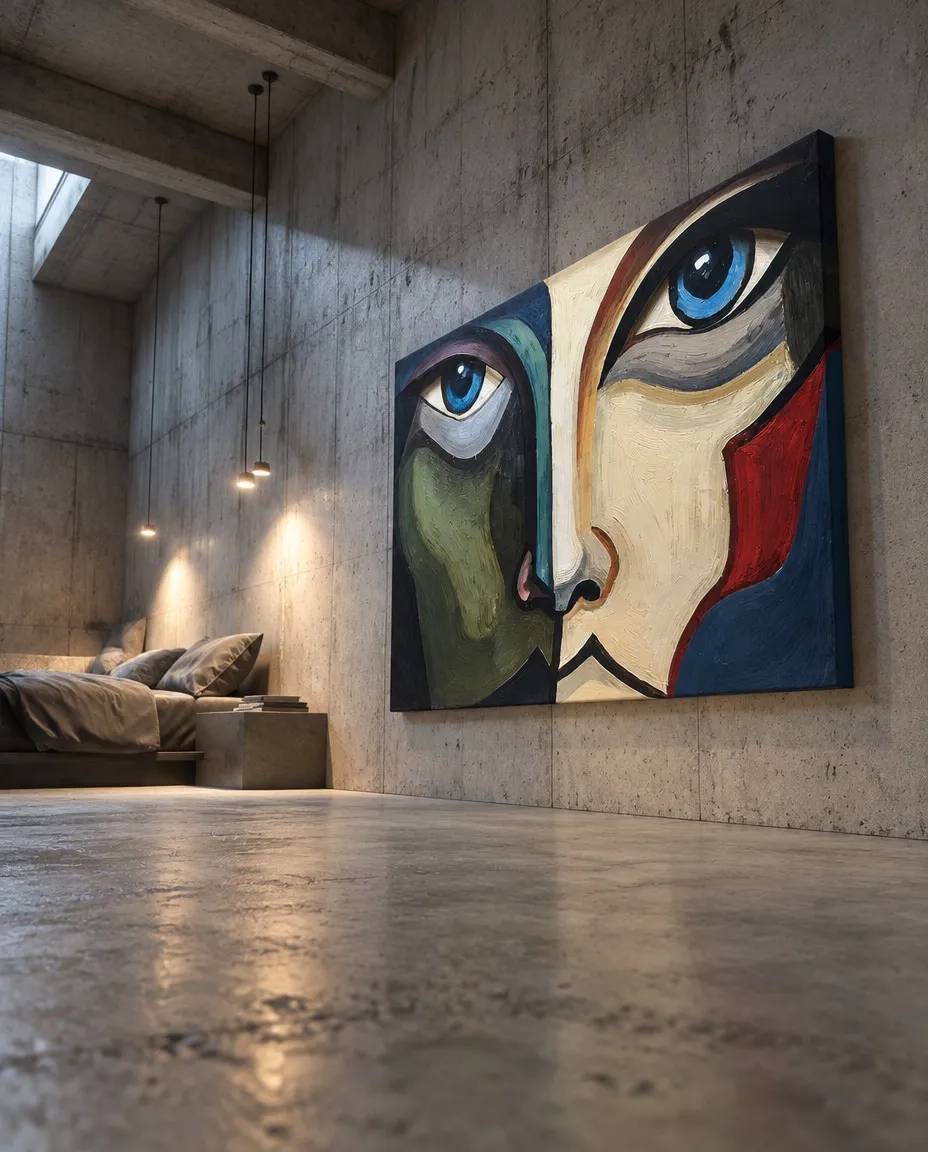
At a certain distance, ACIES offers an initial courtesy: it seems to be a face. It faces forward, occupies the field like someone who has decided not to step aside, and its two blue eyes offer the first pact of unity. There is a nose, two brows, an implied mouth, a forehead that holds the composition together. For a few seconds, the gaze accepts this face as one accepts a closed door: not because one knows what lies behind it, but because the shape of the door seems sufficient.
But the unity does not last long. The left side sinks into a dark, dense green, vegetal only because it seems to grow from within rather than reflect light. It is not a calm green; it retains shadow, grey, the density of a wet leaf or a wall that has absorbed too many seasons. The right side, by contrast, opens into a fractured clarity: pale flesh, creamy planes, an incursion of red that does not quite belong to a cheek, and a dark blue that cuts across the edge as though the face carried a second face behind it. The near-symmetry fails with precision. There are not two equivalent halves: there are two ways of occupying the same rectangle.
The question begins to narrow: what happens when each eye receives a different version of the same person, and the bridge of the nose becomes the border that prevents us from deciding which one is dreaming the other? From afar, that border seems like a vertical line; up close, it becomes more unsettling. It does not divide cleanly. It tilts, grazes, becomes stained with alien tones. The nose does not settle at the centre as an arbiter: it seems to have arrived late to an argument already under way.
The eye on the green side compels one to come closer. There is a moist concentration in it, an alertness that never quite turns outward. It is lodged in a more enclosed zone, as though it had to look through a depth that has not yet fully cleared. The other eye, on the light side, seems to do the opposite: it keeps its distance. It gleams with an almost insolent sharpness, opens its eyelid towards the viewer, and seems to know something the other eye has not yet received. Both are blue, yes, but they do not share a temperature. One cools from within; the other illuminates from a taut surface.
Then breathing becomes strange. Not out of drama, but because of a small mechanical difficulty: looking at one eye means abandoning the other. The face does not allow them to be fixed at once without something slipping out of focus. The gaze moves back and forth like someone trying to follow two conversations separated by a very thin wall. Perhaps the eyes have not even agreed on what they are watching. One seems attentive to an immediate danger; the other, to an apparition too far away.
Maurizio Valch enters this hesitation, not to resolve it, but to make it more immediate.
When I look at this face now, I do not feel that it has two sides: I feel there are two presences that have agreed, for a moment, to occupy the same edge. I cannot force them to recognise one another. Sometimes I think the dark part is looking at the light one; at other times I feel that both are looking at me, and that the painting no longer needs my intention in order to hold itself facing forward.
The nose then changes function. It is a seam, because it joins. It is an accident, because it does not seem designed to sustain peace. It is a customs post, because it requires each eye to declare what it brings before crossing to the other side. Beneath it, the mouth does not unite: it breaks off. An angular shadow touches a brightness, a dark fold brushes against a reddish edge, and the resulting gesture never quite becomes expression. Perhaps it is only the place where the two speeds graze each other without blending.
Andrei Tarkovsky made time and waiting into a way of looking at the visible when it is about to change.
Within that duration, the eyes of ACIES cease to seem simultaneous. The left one might belong to the second before a revelation: it is still inside something, still has not emerged from the green surrounding it. The right one might belong to the second after: it has seen, received a light, been exposed to a clarity it does not know whether to celebrate or resist. There is no need to turn this into an explanation. It is enough to let the painting take time. To look at it not as a still image, but as a frontality in which an edit has taken place without separating the frames.
What kind of shot would this be? Not exactly a close-up, because a close-up usually brings a face nearer in order to make it legible. Here, proximity makes it less reconcilable. Nor is it a screen, although the eyes return the gaze with the obstinacy of a surface that does not wish to be crossed. Perhaps it is a cut occurring within a single face: the green side continues when the light side has already begun to live after it. The painting holds both moments and does not allow us to decide which has priority.
But duration does not necessarily bring revelation. Time accumulates in the visible matter, in those areas where the brushwork seems not to have accepted a smooth solution, yet it does not clarify the dispute. Waiting before the painting does not repair the face. It only makes us more sensitive to the fact that the right eye does not arrive in the same present as the left.
Here it is worth pausing at the central band, almost without naming it. It is not a line: it has width. There is a zone where pale tones, black, greenish hues, and shadow push against one another. The nose forms a small architecture of passage; above, between the brows, the division curves and tightens; below, near the mouth, it becomes a less certain edge. The painting offers neither a pure left half nor a pure right half. It offers contacts, incursions, rejections. The green touches the brightness. The red interrupts a cheek, but perhaps it is also trying to contain it.
A child’s question appears here, and it is harder to dislodge than any theory: if one eye takes a little longer to wake than the other, does the whole face know it is awake?
Nāgārjuna considered how things depend on one another and come undone when we try to fix them as though they were alone.
The certainty of the “two halves” then begins to lose substance. Where exactly does the green side begin? In the colour, the eye, the direction of the brow, the shadow touching the bridge of the nose? Where does the light side end, if the red seems to have seeped in as an interruption and the blue at the right edge sustains a depth as dense as the shadowed zone? Before comparing two sides, one would have to find two sides. And the painting does not offer them separately: it compels each part to exist through contact with the other.
Yet this dissolution does not reassure. The face does not become a benign cloud of relations. The eyes weigh too heavily. They have volume, insistence, a kind of gravity that prevents us from treating them as mere effects of their surroundings. The frontality presses upon the viewer’s body: the shoulders adjust, the head seeks to align itself with the painting, the gaze returns again and again to the bridge of the nose like someone checking whether a crack has moved during the night.
Waiting requires something to remain in order to endure; distrust of the halves prevents that something from becoming a stable essence. Between these demands, ACIES does not choose. It lets the left eye remain a presence slowly ripening in its darkness, while the right refuses to be reduced to a consequence of that darkness. One insists on time. The other insists on dependence. The painting forces them to accept a mutual discomfort: nothing is isolated, yet nothing thereby loses its capacity to resist.
When I finished it, I did not feel that I had brought anything together. I saw an area that had remained further away than the rest, as though it did not entirely belong to the surface before me. I could recognise the face and, at the same time, not know from which side it was taking place. That strangeness does not disappear when I look again; it changes position, sometimes hiding beneath a brow, sometimes settling in the red.
Returning to the whole, the first impression—a frontal face, a unified presence—can no longer be recovered intact. The composition remains a face, but now the face seems like a task vision never quite completes. The dark green is no longer simply on the left: it occupies a slowness. The brightness is no longer simply on the right: it seems to have been reached by news that arrived too quickly. The red does not function as an accent; it interrupts the edge of the cheek with the force of something that did not agree to wait its turn. The blue of both eyes does not guarantee kinship: it makes them more strangely different.
The nose remains between them, narrow and obstinate. It neither reconciles nor fully separates. It is the place where the gaze stops to decide, only to discover that deciding is precisely what the painting has made impossible.
On stepping away, one retains above all the light eye: not exactly its blue, but the gleam that seems to remain a moment longer than the face. And when one tries to return to the green eye, the other has already shifted position.
- Original artwork
- ACIES
- Actual dimensions
- 82.7 × 55.1 in / 210 × 140 cm
- Presentation
- Digital contextual visualization
Context references
ACIES Maurizio Valch · contemporary face art · dark green and red face painting · large painting with blue eyes · horizontal abstract figurative painting · wall art for a brutalist interior · contemporary painting for a minimalist bedroom · painting with a divided face
About this visualization
This visualization places the artwork within an architectural context to help collectors and viewers imagine its presence in a real space. It is an interpretive reference, not an exact reproduction: the original work remains the sole authority for scale, color, surface and material presence.