Context study / ACIES
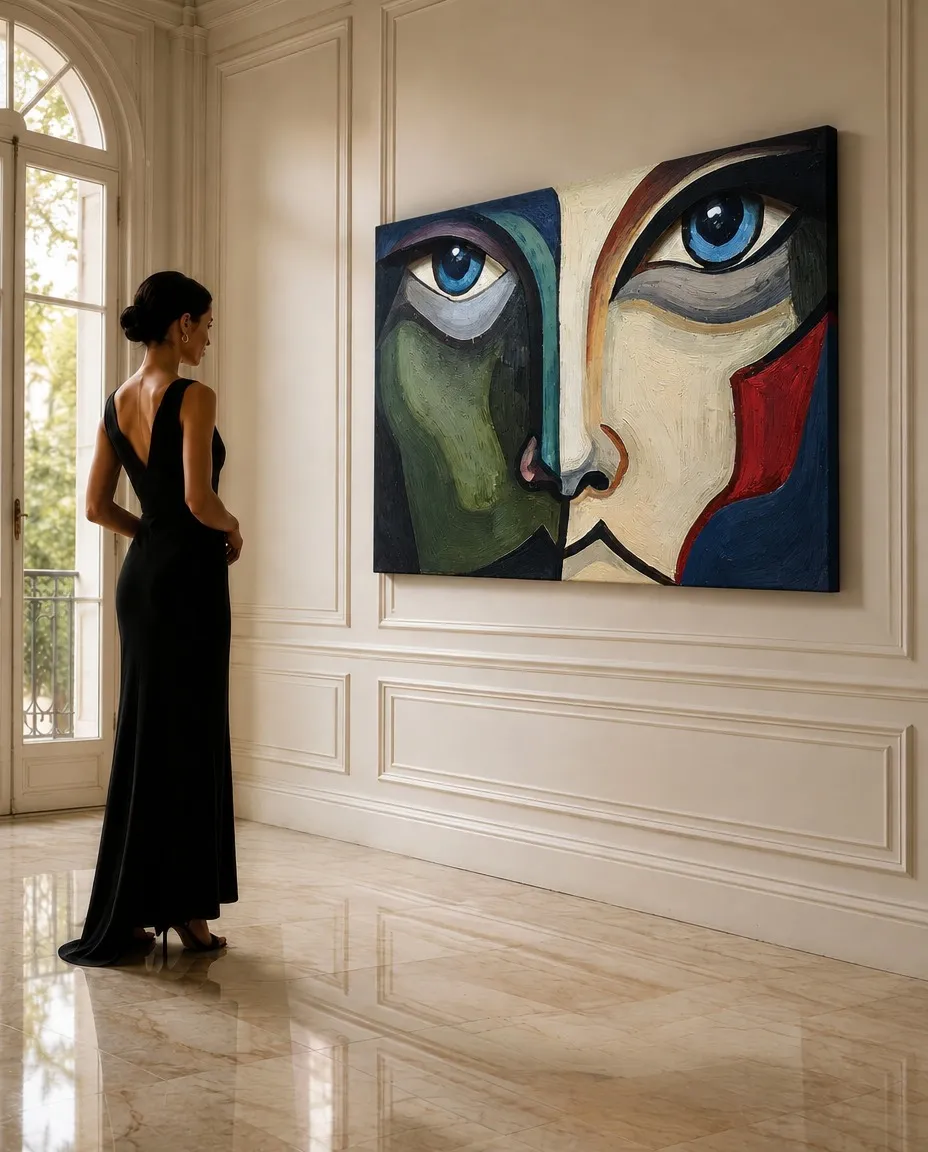
ACIES by Maurizio Valch | Fragmented Face Painting
Imaginarily cover the green half. Do not close your eye: cover only that part of the painting, as though covering a window with your palm. What remains is a blue eye, pale skin, a dark arch, a nose that seems to have arrived from somewhere else. What changes in your breathing? Does your jaw loosen or tighten? Do you want to hold that isolated gaze, or retreat before it gives something back with too much precision?
Now cover the light half. Leave visible the dark green, the black holding it in, the other blue eye suspended above a dense mass. The face does not disappear, but it loses its agreement. This eye does not seem alone in the same way as the first: it remains accompanied by a darkness that is neither background nor an explainable shadow. What happens in your neck as you look at it? Why does one half compel you to come closer while the other makes you seek distance?
Uncover the image.
There are no two clean half-faces. The central line does not divide precisely: it rises across the forehead, descends over the bridge of the nose, tightens around the nostrils, and reaches the mouth like a seam that has had to learn how to breathe. On one side, green occupies more than a simple profile; on the other, the light tone opens as an exposed surface. Yet neither side ends where it should. The nose belongs to both and fully obeys neither. The mouth seems the place where the division realises it has gone too far.
The asymmetry is not a visual accident. The left eye seems lodged in a cavity of blue, black, violet, and green; its contour is compressed, as though looking required passing through layers. The right eye, by contrast, opens over a light zone and receives a dark curve extending towards a red band. Both irises are blue, yes, but they do not sustain the same task. One keeps watch from within a thicket; the other seems to have been placed on guard.
I move closer and discover that the separation was never a calm rule. I wanted to see it as a decision, but it began behaving as if it had its own pulse. I feel that one half demands air and the other fears losing its edge; I do not know which of the two belongs less to me. When I look again at the mouth, the line no longer appears drawn: it appears as a demand made of the face.
At close range, the visible surface interrupts any reading that is too smooth. Ridges of paint accumulate weight around the eyes; thick curves encircle the cheek, catch on the bridge of the nose, and open out again. The black does not only enclose: it also supports. It forms an inner frame for the green, marks the sockets, hardens the edge of the pale face, and prevents the colours from scattering like pieces without a home. The gaze catches on these roughnesses. It does not travel across skin; it travels across a kind of uneven terrain.
The red on the right side first appears as an edge. It does not yet ask for a name. It folds beside the eye, runs down the cheek, and remains contained by dark blue and black. It may look like a piece placed too close to the face, like fabric caught in a door; it may look like the announcement of a second face that never fully arrived. It is best not to hurry. The red has no obligation to declare where it comes from.
Pablo Picasso had the fierce intuition that a face can think through several geometries at once.
His intelligence immediately recognises that this face has refused to obey anatomy as if anatomy were a customs barrier. He sees the displaced profile, the eye that does not align with its neighbour, the nose shared by incompatible territories. He would try to dismantle unity in order to show that unity was always a fragile habit. But something here arrests that impulse. The eye on the right seems to demand something of the one on the left. Coexistence is not enough; there must be an answer.
That demand makes the solidarity of the halves strange. Neither can expel the other without losing part of its own capacity to see. Like two people obliged to use the same window, they might spend the afternoon arguing over who occupies the frame better; yet if one covers the glass, both are left without a view. The painting introduces this small domestic discomfort into a monumental face.
Optical test. Imagine that the vertical line is not a crack, but a door less than a millimetre wide. Bring your face close to it without trying to open it. What might pass through that gap: a word, a look, an apology, an order, a tremor, a breath?
Do not answer yet.
Picasso tries to pass through it with a form: perhaps he shifts an eye, bends a nose, lets one profile become two. His form fits, but it does not pass through whole. The door scrapes it. On the other side, something remains that is neither a figure nor a solution: the obligation to look at someone who looks differently.
Nelson Mandela understood that inhabiting a division does not require accepting it as destiny.
His presence does not come to stitch the face together with a kindly slogan. He looks at the narrow door and refuses to call it reconciliation before knowing who had to make themselves smaller to cross it. He asks what price a face pays in order not to expel its unfamiliar part. The green, which had seemed merely a dense zone, then receives new pressure: it is not a side available to be corrected. Nor does the clarity of the other half become innocent by being exposed. Both sustain a proximity that cannot be turned into an embrace.
Picasso must reconsider his enthusiasm for simultaneity. Two superimposed profiles may free form, but here coexistence carries moral weight: one eye does not permit the other to become mere variation. Mandela, in turn, must reconsider the hope that the border might become passage. The painting retains the right not to open fully. Some doors are not promises of entry; sometimes they are the exact measure of a distance that still demands attention.
Then the red changes condition. It is no longer merely an edge. It becomes an intruder: something that has entered the face without permission and yet cannot be removed without changing everything. There is no need to decide whether it is a bandage, a flag, a wound, or a remnant. Each name fixes too quickly what the red keeps in motion. It may be the part that unsettles the pale eye, the band that prevents the skin from becoming too certain of itself. It may even be indispensable if the face is not to become an identity too neatly groomed.
A child’s question hangs before the two irises: when this face sleeps, which of its eyes stays awake to look after the other?
It is not a decorative question. It compels us to admit that the blue eyes are not duplicates. The left does not look with the same weight as the right. One seems to guard a dark reserve; the other, an almost cutting exposure. And yet they share imagined eyelids, a nose, a mouth that divides and joins without resolving the conflict. If one dreams, perhaps the other does not keep watch out of fear, but because the boundary needs witnesses.
I cannot force these halves to reconcile without taking away their breath. The eyes no longer obey me as parts of a single face; they watch one another, protect one another, and distrust one another. At times the division seems violent, but at times it seems like care: the minimal space that allows something different to remain close without being absorbed.
Return now to the central line. It no longer seems merely a compositional device, a scar, or a separation between two possible characters. It is a boundary each side needs in order to preserve its difference, and rejects because that very difference leaves it incomplete. The green does not translate into nature or illness; it persists as density, as a region where the eye must work harder. The brightness does not equal peace or transparency; it is a surface subjected to the pressure of red, black, and the neighbouring gaze.
The blue eyes have changed. The left no longer seems enclosed: it seems alert to any advance from the seam. The right no longer seems dominant: it seems to be learning, with uncomfortable patience, not to make its field of vision the only possible face. Between them remains a door too narrow for a complete answer, and open enough for the painting to continue looking.
- Original artwork
- ACIES
- Actual dimensions
- 82.7 × 55.1 in / 210 × 140 cm
- Presentation
- Digital contextual visualization
Context references
ACIES Maurizio Valch · fragmented face painting · face painting with blue eyes · contemporary art with a divided face · green and red abstract figurative painting · large-scale wall art · horizontal contemporary face painting · wall art for an elegant living room
About this visualization
This visualization places the artwork within an architectural context to help collectors and viewers imagine its presence in a real space. It is an interpretive reference, not an exact reproduction: the original work remains the sole authority for scale, color, surface and material presence.