Context study / ACIES
ACIES by Maurizio Valch | Split Face in Green and Ivory
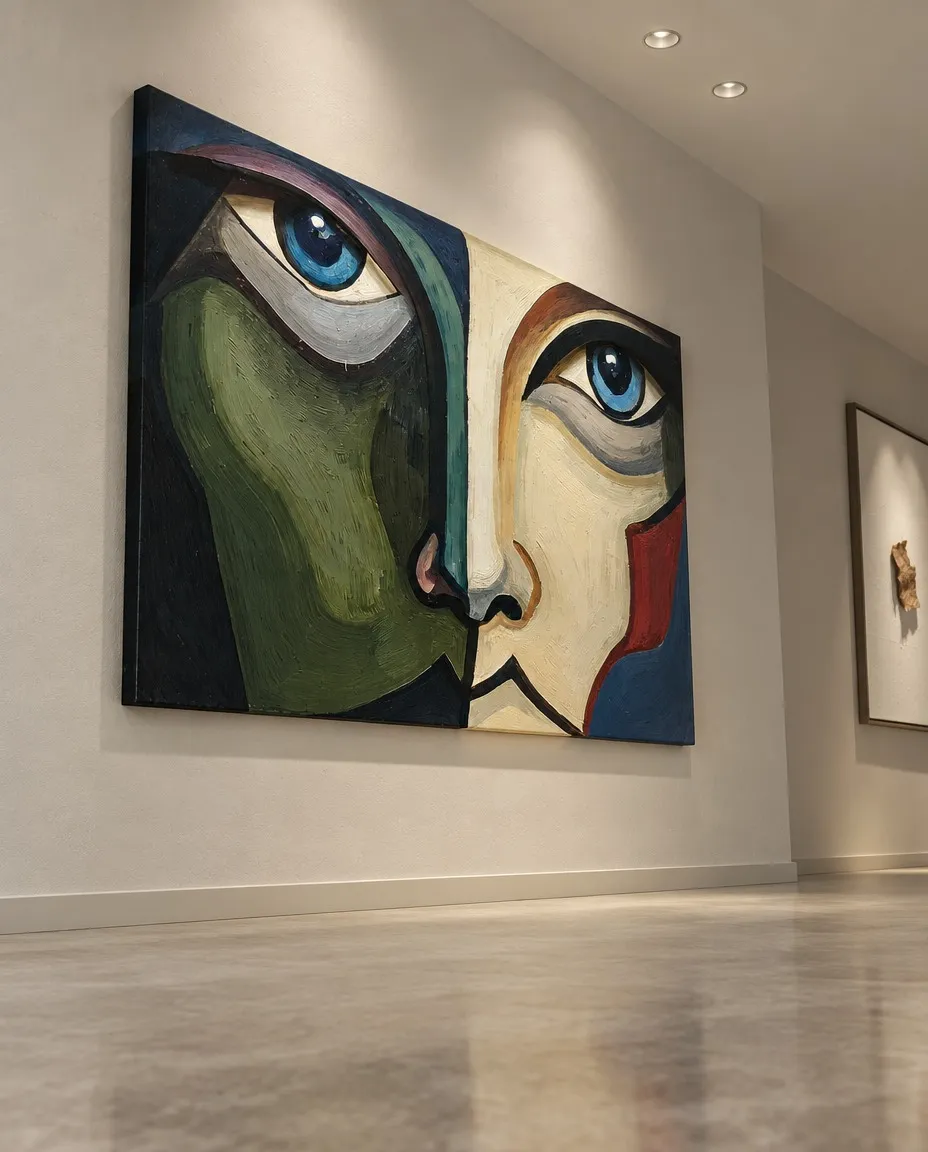
From a distance, the two blue eyes arrive before the face. They do not present themselves as a pair: they watch one another. The left one, sunk into its dark green field, seems to have learned to bear a heavy shadow without lowering its lid; the right opens its blue within a brightness that never quite reassures. Between them lies a minimal, brutal distance: they share a nose, the edge of a mouth, the tilt of a head, yet each pupil organizes a world by different rules.
The eye jumps from one to the other and catches on the vertical cleft. At first it seems like a line: a clean, almost administrative decision, drawn so that neither half might encroach upon the other. But it only takes moving a little closer for that cleanliness to become suspect. The line does not simply cut; it tightens. The contours press up against it as though the face had been caught between two breaths that cannot coincide.
Which part of this face is looking, and which part is being looked at from within?
The green side refuses to be called a background. It has a density that pushes forward, a darkness that does not recede even as the right eye claims all attention with its bright blue. The visible surface retains directions: furrows, drags, thicknesses that compel the gaze to draw nearer. Up close, the face comes apart into rough decisions, areas that seem to resist one another. Yet when one steps back, the nose returns to where it belongs, with an almost comic obstinacy.
If a face splits in two, why does the nose still know where the centre is?
The laugh does not last long. The nose is not at the centre as an arbiter; rather, it seems to be the place where both sides brush against each other without granting any respite. Its bridge rises between the eyes and, instead of joining them, makes it more palpable that they do not look from the same place. The left eye is entitled to distrust the right: the latter shines too much, opening with an elegance that seems belated, as if it had arrived at the face after the meeting had already begun.
Kazuo Ohno was a Japanese dancer whose work explored vulnerable bodies, metamorphosis, slowness, and presences that seem to come from another state of life. Here I would not ask for a character for this face; I would ask for weight. Which half falls first? Which one bears the invisible neck? The green side seems to carry gravity, the work of not coming loose from the dark edge. The light side, by contrast, seems to breathe a second later, only just late, like a figure that has begun a gesture and remained suspended before finding its support.
The painting then ceases to be a split face and becomes an impossible posture. There is no mask over a face, nor a face behind a mask: there is a forehead leaning at two speeds, two cheeks that do not receive light in the same way, a mouth that barely manages to negotiate its continuity. The black curve beneath the nose does not fully obey either field. There the face rehearses a grimace, perhaps a word, perhaps the effort of keeping together lips that have signed no agreement.
I do not know which side arrived first, because looking at them I feel that each pushes the other out of place. I wanted to find an outer boundary and found a pressure that passes through the image and into me. When I try to fix the left eye, the right opens inside me with too much brightness; when I follow the red, the green darkness resumes the weight of the face. I cannot say that I made a portrait that divides: I see a face that ended up looking at me before I could decide where it began.
Rachel Carson was a writer and scientist who taught us to perceive natural life as a delicate network of signals, consequences, and silences. The vertical line then changes function. It is no longer the decorative scar of a separation; it is an edge of contact. On one side, the black shadow alters the green; on the other, the light band receives the red and lets it advance toward the mouth. Nothing remains isolated. The blue of each eye changes the temperature of what surrounds it: beside the dark area, blue seems to draw depth from shadow; beside the light, it seems to introduce a small, cold alarm.
There is no need to assign fixed roles to those colours. Green does not behave as landscape, red as a danger signal, or the light area as repose. The red reaches the face like an intruder who has arrived too late for a meeting and yet manages to change everyone’s position. It descends from the right cheek, touches the edge of the mouth, approaches the lower blue, and makes us look again at the black that defines the profile. A curve produces a consequence; an edge grows taut; blue responds.
Ohno might suspect that this face is about to move. Carson would object that it is on the verge of nothing: it is trying not to break a very precise balance. But the left eye points to something both hypotheses have overlooked. It does not look exactly where the right eye looks. There are not only two climates on the surface: there are two directions of vigilance. One seems to hold the scene from a shadowy depth; the other seems to receive something arriving from in front. The question shifts. It is no longer a matter of finding out which half observes and which is observed, but of noticing that each eye may be doing both, with a minimal difference in time.
Moving closer makes the blue uncomfortable. Its highlights are too alert; they are not innocent details. The eye approaches to see how they are set into the pupil and discovers that the visible matter refuses to be smoothed out at close range. There are raised textures, shifts in direction, small pauses. But when one steps back, those thicknesses cease to be terrain and resume their obligation to form a gaze. The viewer’s body makes this back-and-forth movement: it tilts its head toward the surface, steps back so that the face may close again, then moves forward once more because the face never quite does.
I do not wholly accept that the face is going to dance, even though I see in it a posture that cannot find rest. Nor do I accept that it is only defending a balance, because the eyes insist too strongly to remain still. I would like them to belong to the same gesture, and I cannot compel them to do so. I prefer to let them retain the question I do not want to resolve, because every time I bring them together, a new distance appears between them.
The mouth sits below, small before the disproportion of the eyes, but not secondary. Its dark line takes something from the left and something from the right without becoming common property. It seems the only place where both halves speak at once, though one pronounces the consonant and the other retains the breath. Near it, the red ceases to resemble a cheek, a wound, or a mask; it becomes a lateral pressure, a presence that shifts the profile and prevents the light from remaining intact.
Nor does the vertical cleft remain straight when viewed after the eyes. At the top it separates fields; at the nose it becomes a brushing contact; lower down it seems to veer towards the mouth, as if it needed to check that the face were still there. The seam does not divide two complete entities: it compels two incompatible rhythms to use the same edge of the nose, the same lip, the same instant of looking.
And when one finally returns to the left eye, its blue no longer seems enclosed by shadow. It remains suspended beside the dark line of the eyelid, attentive to the small highlight in the right eye, while between them the black curve of the nose sustains, without resolving it, a distance that can no longer be seen as a simple line.
- Original artwork
- ACIES
- Actual dimensions
- 82.7 × 55.1 in / 210 × 140 cm
- Presentation
- Digital contextual visualization
Context references
ACIES Maurizio Valch · split-face painting in green and ivory · contemporary blue-eye painting · horizontal abstract face painting · large-scale contemporary figurative art · textured painting for wall · modern painting for hallway · original face artwork
About this visualization
This visualization places the artwork within an architectural context to help collectors and viewers imagine its presence in a real space. It is an interpretive reference, not an exact reproduction: the original work remains the sole authority for scale, color, surface and material presence.