I. The Mark That Flees the Center
There is an insurmountable distance between the desire to fix a signal in space and the suspicion that any fixation is equivalent to an act of violent occupation. When a surveyor drives a stake into the ground, or when a painter draws a thick line on a blank canvas, they are not merely organizing the void: they are colonizing it. Western thought carries this obsession with settlement, with the sovereignty of presence. Yet, on the margins of this will to dominate, a more discreet and far more fertile question beats: is it possible to register the passage of time, mark a direction, or send a message without claiming ownership of the territory?
This question is not abstract; it is embodied in the physical friction of matter and the invisible laws of electromagnetism. Paul Klee once wrote that art does not reproduce the visible, but makes visible. But this making visible is not a display of eloquence; it is often an act of subtraction. To acquire wisdom, Lao Tzu reminds us, one must subtract things every day. On canvas, the uncontrolled accumulation of pigment produces an opaque wall that silences space; in the mind, the accumulation of self-interpretations buries the simple event beneath a mountain of psychological justifications.
The painter Maurizio Valch seems to work at this delicate boundary where the pictorial act attempts to shake off the overload of spiritual or moral explanation. In the works of his STRATA series, the surface is not presented as a plane of representation, but as an accumulated ground—a record of acrylic and oil sedimentation patiently deposited and then physically assaulted. The line here is not an addition; it is an incision (incised mark), a cut that wounds the skin of the painting to reveal the reverse or the hidden layer. It is a gesture of vulnerability that renounces the comfort of decorative drawing to confront the raw hardness of the support.
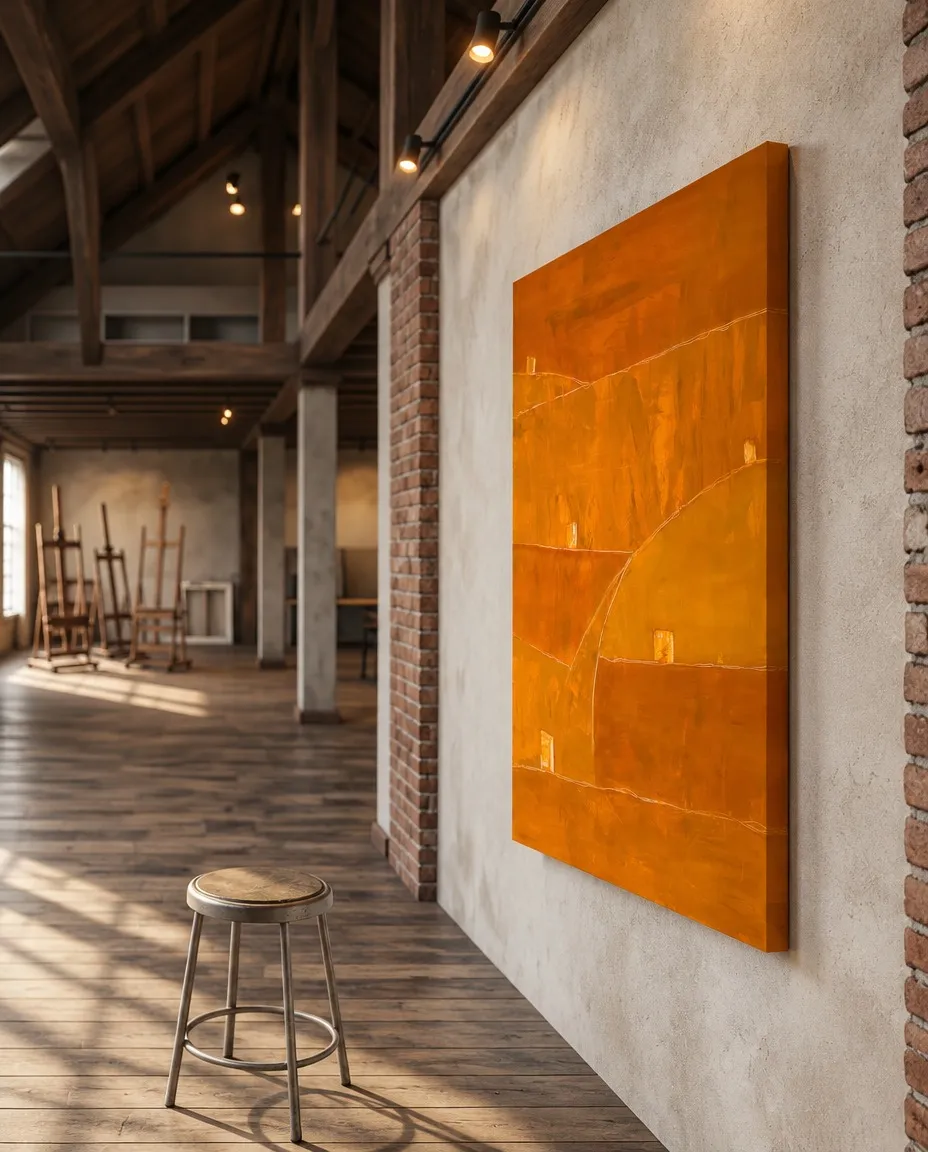
TESSERA in a rustic architectural setting, where the ochre vibration and the incisions of the work dialogue with the texture of the wall and the wooden beams.
When contemplating the work TESSERA, we observe how this large mass of ochre and orange becomes a thermal body. Warmth is not a metaphor for passion here, but a material temperature, a physical density radiating from the accumulation of glazes. The painting does not appeal to a spiritual doctrine for its justification; it demands somatic attention. It is the pure event of color coming forward to meet the viewer. As Antoni Tàpies suggested, the material presence of the artwork serves only as a vehicle to invite the observer to participate. But to participate, in this case, means laying down the weapons of psychological analysis. It means trusting the concrete fact rather than the mind's tendency to transform the fatigue of the road into a heroic quest, or the simple vibration of orange into a theological mystery. The actual event ends up buried beneath its interpretations, and the essay must be, precisely, an effort to exhume it.
II. Dispersion as a Safeguard: Hedy Lamarr's Perspective
How do we send a message through hostile space without it being intercepted by the enemy? How do we trace a line in a territory that cannot be erased or blocked by surrounding noise interference? In 1942, the inventor and actress Hedy Lamarr, alongside composer George Antheil, patented a secret communication system known today as frequency-hopping spread spectrum. Her intuition was of astonishing mathematical precision: if a radio signal is transmitted on a single static frequency, it is extremely vulnerable to jamming and detection. But if the transmitter and receiver constantly shift frequencies in unison, following a pattern encoded on a perforated paper roll similar to that of a player piano, the message becomes invisible to anyone trying to block it. The signal does not occupy space; it moves through it via a choreography of absences and appearances.
I will let Hedy herself take the floor to detail this obsession with escape:
"People believe that beauty is a form of presence, but for me it was always a cage of fixed attention. They look at you, they define you, they lock you into a single coordinate of the spectrum. That is why I understood interference before I understood mathematics. The enemy wants you to remain still on your frequency so they can bomb you. The secret of freedom does not consist in screaming louder, but in fragmenting. Dividing the signal into eighty-eight different frequencies, jumping from one to another in fractions of a second, being everywhere and nowhere at once. When the interceptor reaches the channel where they thought they heard me, I am already just a residue of heat on the next channel. Frequency hopping is a geometry of evasion. It is understanding that to preserve the secret of a path, it must never become a monument. The line must be a trace that self-destructs at the very instant of its transmission."
This mathematical perspective of Lamarr sheds unexpected light on the structure of Valch's incisions in works such as FISSURA or RETENTIO. Those incised marks crossing the strata of color are not highways for the gaze; they are lines of hesitation. The artist's stylus cuts into the paint, but the line falters, breaks, jumps to another area of the canvas, leaving small isolated geometric blocks like tesserae in the middle of a desert of pigment. There is no central channel of communication. The viewer's gaze is forced to leap from node to node, searching for a synchronization that relies not on continuity, but on the suspicion of control.
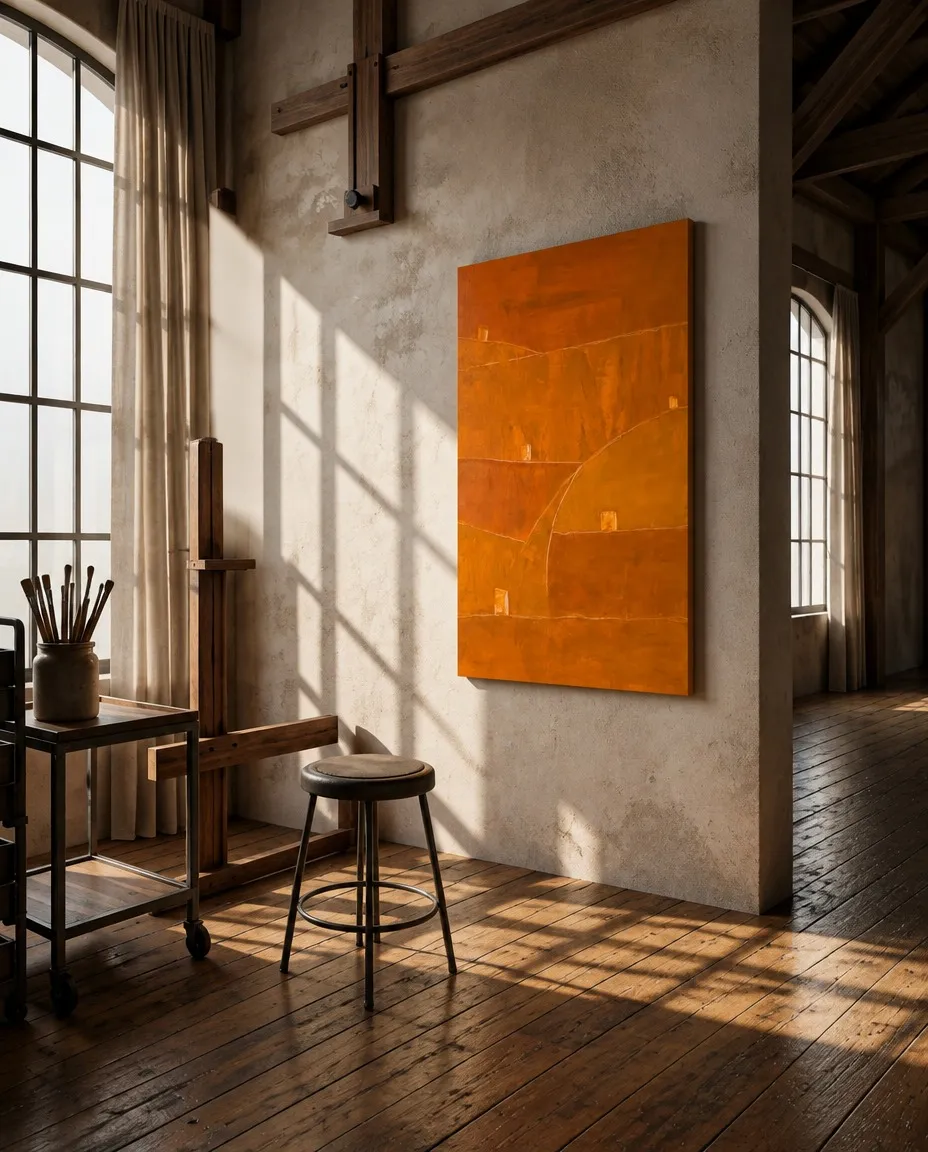
The natural light of the loft highlights the geological dimension of TESSERA, making the chromatic layers and the discrete spatial tesserae vibrate.
III. The Lightness of Silence: Mira Schendel's Perspective
Faced with the rigor of the spread spectrum, which seeks to secure transmission through mathematical fragmentation, stands the mysticism of absolute detachment from form. For visual artist Mira Schendel, space is not a radio-electronic battlefield that must be encoded to evade the enemy; space is the matrix of silence, a primordial void that human haste insists on filling with noise and meaning. In her famous works on rice paper, the graphic sign does not assert itself: it floats in transparency so extreme that the support itself seems on the verge of dissolving under the weight of the trace.
Let us now listen to Mira's voice, speaking from the extreme fragility of her silent calligraphy:
"When I place an ink line on rice paper, my intention is not to leave a mark of my presence, but to reveal the immensity of the void surrounding it. The paper is not a passive background; it is a vulnerable body that breathes, bending with the air of the room. Drawing is an act of detachment; it means abandoning the desire for form to endure forever. If you press too hard, you break the fiber. If you try to hold on to meaning, you suffocate the gesture. The true strength lies in transparency, in that lightness that does not fear fading away. The sign must not occupy the surface; it should be barely a caress that allows the void to become visible. In the end, there is nothing to interpret. As Krishnamurti used to say, truth is a pathless land. Any attempt to trace a definitive route on rice paper is a falsehood that interrupts the purity of listening."
This poetics of material abandonment enters into direct friction with Valch's geological heaviness. While Valch accumulates strata, Mira dissolves them. Yet, at the meeting point of these two sensibilities, a crack of extraordinary tension appears. In Valch's work, especially in his use of the incision, there is a moment of renunciation very similar to Schendel's. By scraping the paint, by subtracting volume through the cut, the painter makes a gesture of detachment from form. He is not adding beauty; he is opening a wound in the density of the acrylic so that the light from beneath can breathe.
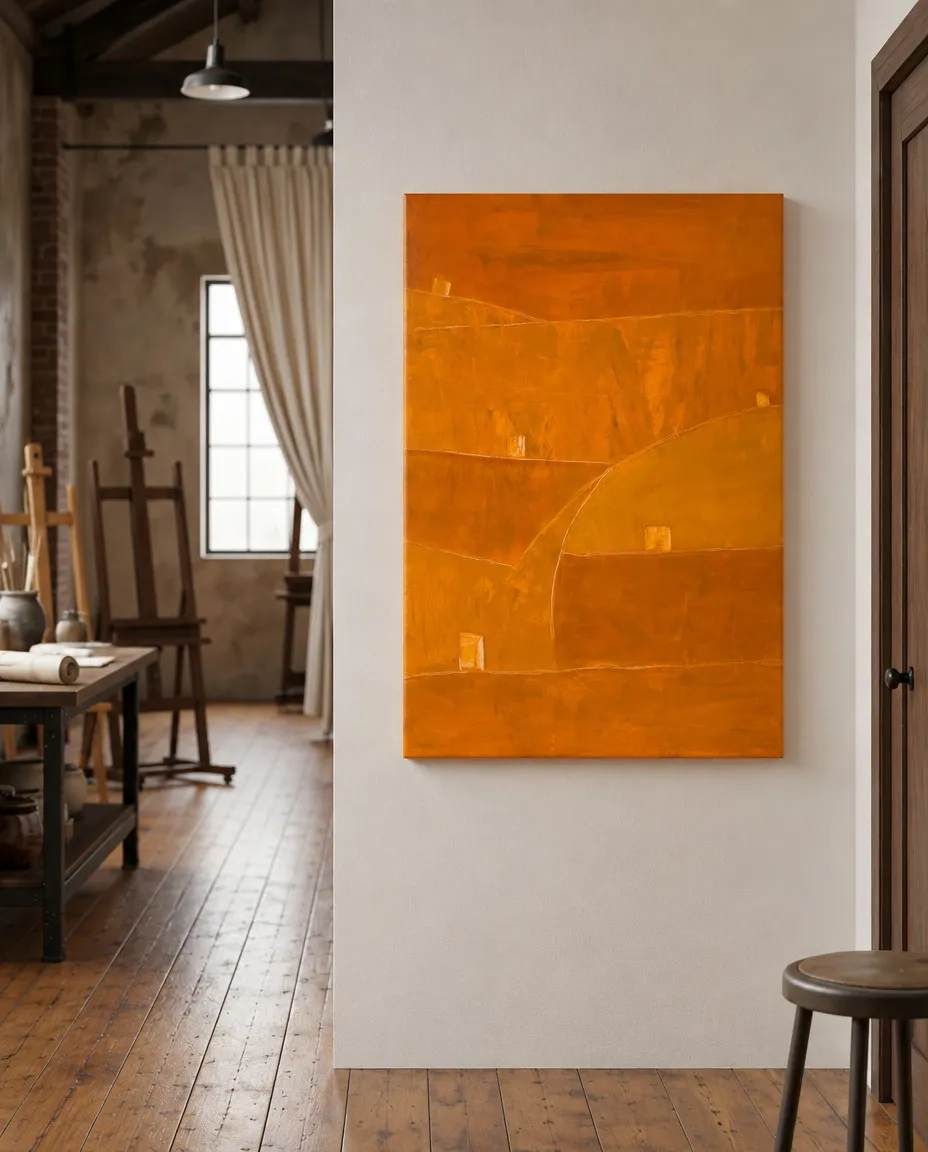
TESSERA suspended in the studio, revealing its texture of cooled fire and the delicate vulnerability of its white traces and incisions.
IV. The Impossible Dialogue: Between Frequency Hopping and Rice Paper
Let us imagine an encounter in a stripped space, free from the coordinates of historical time. Hedy Lamarr and Mira Schendel sit opposite each other at a clean wooden table. On the table lies a sheet of transparent rice paper and a technical diagram of a perforated player piano roll.
Hedy Lamarr: Look at the precision of these holes in the piano roll paper. They are not arbitrary. Each perforation represents an exact jump in time and frequency. If you let the paper remain simply transparent, the signal disperses into the noise of the cosmos. You need a structure, a mathematical code to protect the transmission. Unruled emptiness is the territory where the enemy wins.
Mira Schendel: But Hedy, your code remains obsessed with transmission, with the necessity of carrying a message from one point to another. Why insist that something must be delivered? Your frequency hopping is a beautiful choreography, but it remains an attempt at control. When you look at this rice paper, you see weakness; I see active resistance. Transparency does not need to protect itself because it hides nothing. It has no secrets for the enemy to steal.
Hedy Lamarr: It is not an obsession with control, Mira; it is a matter of survival. If the message guiding the torpedo does not reach its destination, the machinery of tyranny destroys the harbor. The silence you seek is a luxury of those who are not under the fire of interference. The line must be cut, fragmented, and incised with surgical precision in the spectrum. Only mathematical structure sets us free from the censor's gaze.
Mira Schendel: The true freedom Krishnamurti spoke of is that in which the observer is the observed. When you insist on the channel, the transmission, and the code, you split the world into sender and receiver. You create a distance that you then try to bridge with your technology of hopping. If you lay down the urgency of the message, if you let the ink simply settle and fade into the fiber of the paper, you discover that no interference is possible because there is nothing to block. The wound on the canvas of the painter we speak of—this physical cut in Maurizio's painting—is not a channel to send information; it is a threshold to silence the noise of thought.
Hedy Lamarr: Yet, that painter uses a metal tool to cut the paint. That is a physical fact, a mechanical force applied against material resistance. That cut is a transmission line that has decided to stop, a coordinate that has chosen its own detour. It is not pure emptiness; it is a scar that preserves the memory of effort.
Mira Schendel: It is a scar, yes, but an open one. A scar that does not seek to close itself with an explanation. It is the point where your geometric rigor and my emptiness touch. A line that wounds itself in order to cease being a boundary.
V. The Topology of Detour in the Work of Maurizio Valch
The dialogue between Lamarr and Schendel reveals the deep paradox underpinning Maurizio Valch's painting. In works such as STATIO, Compages, or MEATUS, the artist confronts the tension of organizing pictorial space without subjecting it to an authoritarian rule. It is neither the cold geometric abstraction of the classical school nor the chaotic expressionism seeking the catharsis of the self. It is a topology of transit.
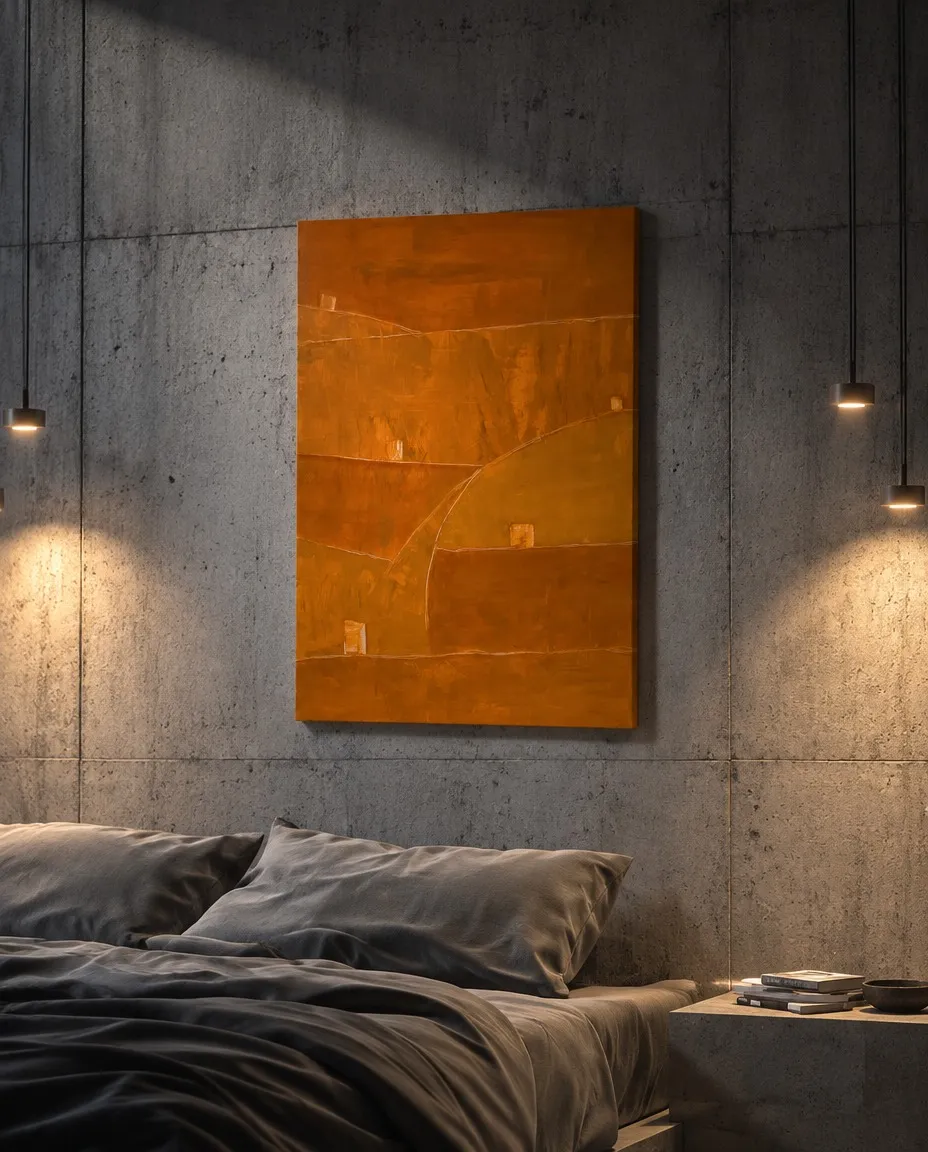
TESSERA on an exposed concrete wall in a contemporary bedroom, integrating its texture of incisions and glazes into a space of quietude and introspection.
Valch's insistence on pure travel (such as his five pilgrimages along the Camino de Santiago on foot or his long bicycle journeys) provides a fundamental key. On the road, the final destination is almost an inconvenience; what truly matters is the instant of transit, that suspended moment where the body belongs neither to the starting point nor the arrival point. It is an experience of detachment that translates directly onto the surface of the canvas. Epictetus asserted that people are disturbed not by things, but by the views they take of things. The painter who walks for days across a Castilian plateau or a deserted plain knows that fatigue is a physical fact, a muscle temperature, a friction against the ground. There is no heroic quest in this; it is the mind that attempts to transform it into a conflict of control and guilt.
When Valch transfers this experience to the studio, he does so through the silent listening to matter. Highly sober works such as CONGERIES or LIBRA do not seek to illustrate the landscape of the journey. What they record is the physical resistance of color as it is pushed with the palette knife, the dust rising from scraping the surface, the density of acrylic opposing the progress of the stylus. The painting thus becomes an eroded wall or skin, related to the raw materiality of Antoni Tàpies, where each mark retains the trace of a real action, stripped of psychological drama.
In the middle section of TESSERA, a thin, light line veers off, seemingly brushing against another without choosing to join it. Lower down, a small square remains isolated in the middle of a densely worked orange area. There is no rule explaining this arrangement. If the observer attempts to force a rational reading—searching for a hidden grid or a symbolic key—the work resists analysis, returning only the vibration of its clay-like temperature. The painting demands from the viewer the same detachment the artist exercised while creating it: abandoning the need to control, to explain, to possess the visual territory. It is about sustaining one's gaze before a surface that remembers, knowing that the true permanence of things lies not in the solidity of an immutable structure, but in the capacity to inhabit one's own fragility with dignity.
At the end of this inquiry, the signal and the void reveal their common root. Hedy Lamarr's frequency hopping and Mira Schendel's rice paper are not opposing forces; they are two ways of safeguarding the secret of life against the aggression of noise and the occupation of space. Maurizio Valch's painting, with its strata of cooled fire and trembling incisions, offers us a temporary shelter: a territory where the material wound is transformed into a channel of silence, and where the original vulnerability of form is transmuted, simply, into a quiet and persistent revelation of light.