Context study / VORAGO
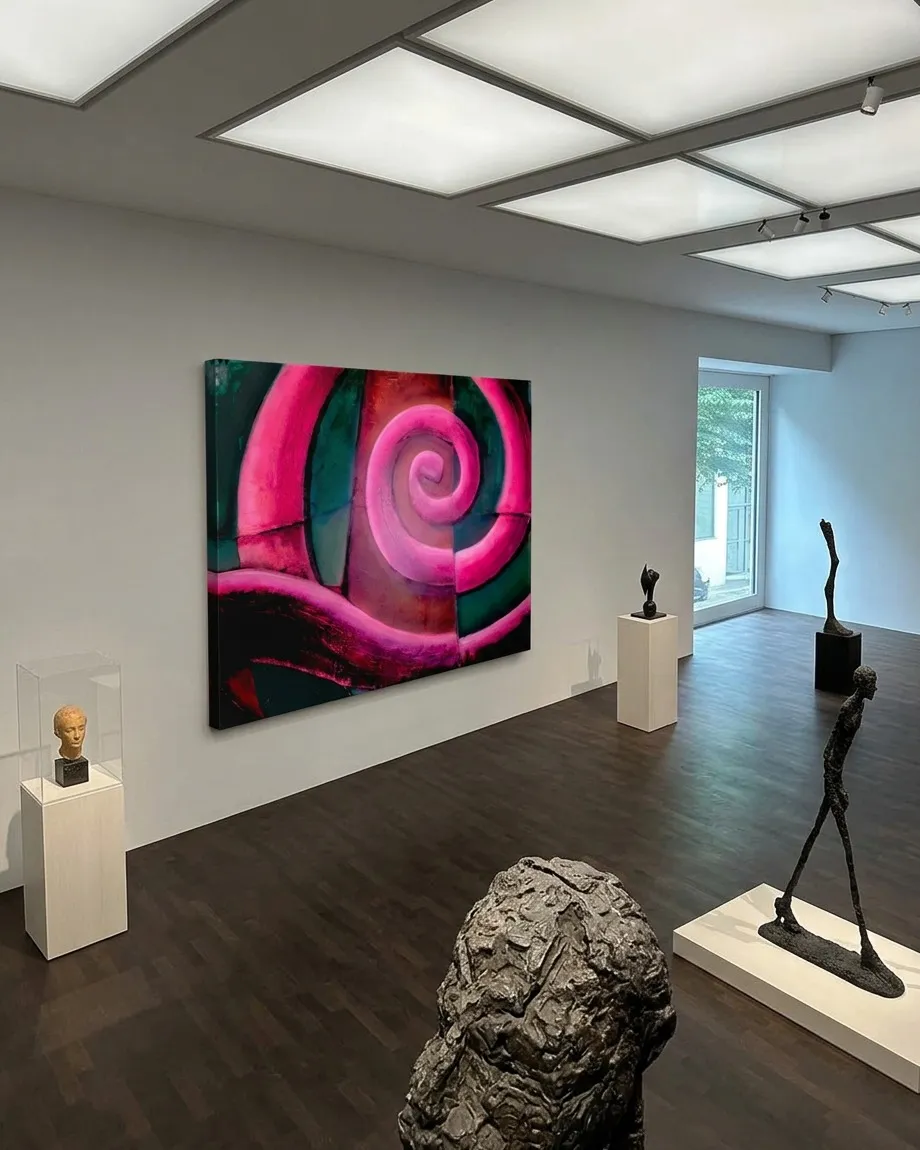
VORAGO Contemporary Painting by Maurizio Valch in Gallery
VORAGO occupies the wall like an image frozen mid-projection accident. From a distance, the fuchsia spiral seems to have arrived before everything else: thick, glowing, almost wet in its light, it cuts through the horizontal rectangle and forces the bluish-greens, blacks, and dark reds to retreat without disappearing. It does not spin elegantly. It coils, yes, but it also bulges, flattens, and breaks. There are areas where it looks like a tube lit from within, and others where the surface becomes fleshy, chafed, worn down, as if it had passed through the same spot too many times.
The machine starts outside. ⟲
It does not rewind an entire film; it rewinds a fragment that resists. The widest loop brings back a pink band that has already been seen, but now it arrives colder, heavier. Then a dark band seems to occupy the space that previously belonged to the fuchsia. Next, a vertical line cuts the continuity: it does not explain or organize it; it simply cuts through. The curve wants to pull the eye inward; the division insists that something has been stopped, misaligned, shifted by a few millimeters.
Víctor Erice is a filmmaker attentive to how light, a wait, or the edge of an image can contain a story without fully telling it. Here, he attempts to prolong a second within the outer curve, giving duration to that great pink loop that seems on the verge of completing itself. But the painting does not grant him the patience of a slowly opening scene: the form has already burst in, arrived too quickly, yet it lingers as if it did not know where to go.
I thought I was following a curve, but the curve began to lead me. I painted an expansion that also felt like a confinement: the more I wanted to open up the path, the more a boundary appeared to stop it. I do not know where that form ends, because in some places it runs ahead and in others it falls behind itself. I see that the spiral does not ask to be obeyed; it imposes a rhythm, breaks off, starts again, and my intention is left looking on from the outside.
After that voice, the outer fuchsia band no longer seems simply a dominant figure. It seems to have grown at the expense of its own limits. The vertical and horizontal seams are not decorations that order the plane: they are places where the rewinding stumbled. Reaching one of them, the spiral does not break entirely, but it shifts pressure. A pink section grows thicker; a dark green becomes almost watery; a black area, instead of serving as a background, advances to touch the edge of the curve like a shadow that has decided to have volume.
The question shifts in tone: what image is being rewound here, and what is resisting returning to its place?
It does not look like a lost image behind the paint. It is in front. It is distributed across its cuts. Perhaps what fails to return to its place is the scale: the same fuchsia is, on the outer loop, a large pushing mass; further in, it becomes a compressed tongue of color; near the core, a small twist that can no longer sustain everything it has dragged along.
Vivian Maier was a photographer with an oblique gaze, sensitive to found frames, reflections, and presences that appear without invitation. She pauses at the split bands as if they were the remains of a sequence of images caught out of the corner of her eye: a street cut by a shadow, a storefront window where two times do not match, a gesture trapped at the edge of a photograph. She wants to freeze one of those moments. She chooses a horizontal seam that crosses the pink and divides it into two temperatures. But the spiral escapes her on both sides: when the frame contains the curve, it leaves out the pressure deforming it; when it includes the pressure, the center seems to have moved.
Erice then observes something Maier would prefer not to admit: the instant is not still. Not because the painting moves, but because the eye takes longer to recognize a turn than to lose the previous one. Maier responds wordlessly, shifting attention toward a blackish-green spot to the left of the center, where the curve does not close cleanly but seems wedged against a dark plane. There, the film does not advance and the photograph does not settle. One is learning not to move forward; the other, to endure without turning its stillness into certainty.
Quick test: trace the spiral with your eyes, from its outer edge to the tightest loop, without moving your head. Do not try to follow a perfect line: accept the cuts. At first, the gaze glides with almost physical ease. Then, passing through the division that crosses the reddish field and the dark green, your breath usually pauses for a moment. Further in, close to the curve tightening on itself, a slight disorientation appears: it is no longer clear whether the eye is entering or if something from the center is pushing it outward. There, the desire to touch changes too. Not to check a texture, but to know which edge lies on top.
A child might ask: is the center too small to keep all the pink that flows into it?
The question dismantles adult prudence. Because yes: there is too much path for that core. Too many segments, too many dark areas bypassed without being left behind, too many divisions refusing to curve. The spiral seems to ask the center to receive a larger mass than it can hold. And the center does not respond with solemnity. It does not open up. It does not culminate. It barely retains a small light twist, a pinkish fold that could be an ending or a stuck piece.
I now see an area that does not feel entirely mine. While the painting was being made, the center seemed like a consequence; seeing it complete, it seems like resistance. It does not deliver what the spiral promises, and that contradiction makes me uncomfortable: the form leads there, but it does not fully belong to that place. I am left with the impression that something stopped before arriving, or that something began to emerge without me being able to see it.
From that point on, the rewinding reverses direction for a moment. ⟲ Outward, the large fuchsia curve is no longer read as a triumphant entrance, but as the edge of an image too large for its own frame. The green and black surfaces stop being spaces behind it: they appear as materials slowing it down, not fully accepting its passage. The cut lines, once discrete, become decisive. One of them crosses the spiral at mid-height, making the pink seem to arrive with a minimal delay relative to itself.
Erice preserves that delay: the moment before the curve aligns once more. Maier preserves the lost edge: what the image leaves out each time someone tries to fix it. Neither manages to claim the core. Between them lies this uncomfortable possibility: a photograph learning to endure while a film learns not to advance.
And in the central zone, where the pink gathers over a small purplish whirlpool, a dark band remains pressed against the curve. It does not fully retreat. It does not fully enter. It seems to be waiting for the next turn to fail in a different way.
- Original artwork
- VORAGO
- Actual dimensions
- 82.7 × 63 in / 210 × 160 cm
- Presentation
- Digital contextual visualization
Context references
pink and black abstract painting · designer painting for modern living room · large format artworks · maurizio valch artist · minimalist contemporary art gallery · acrylic spirals on canvas
About this visualization
This visualization places the artwork within an architectural context to help collectors and viewers imagine its presence in a real space. It is an interpretive reference, not an exact reproduction: the original work remains the sole authority for scale, color, surface and material presence.