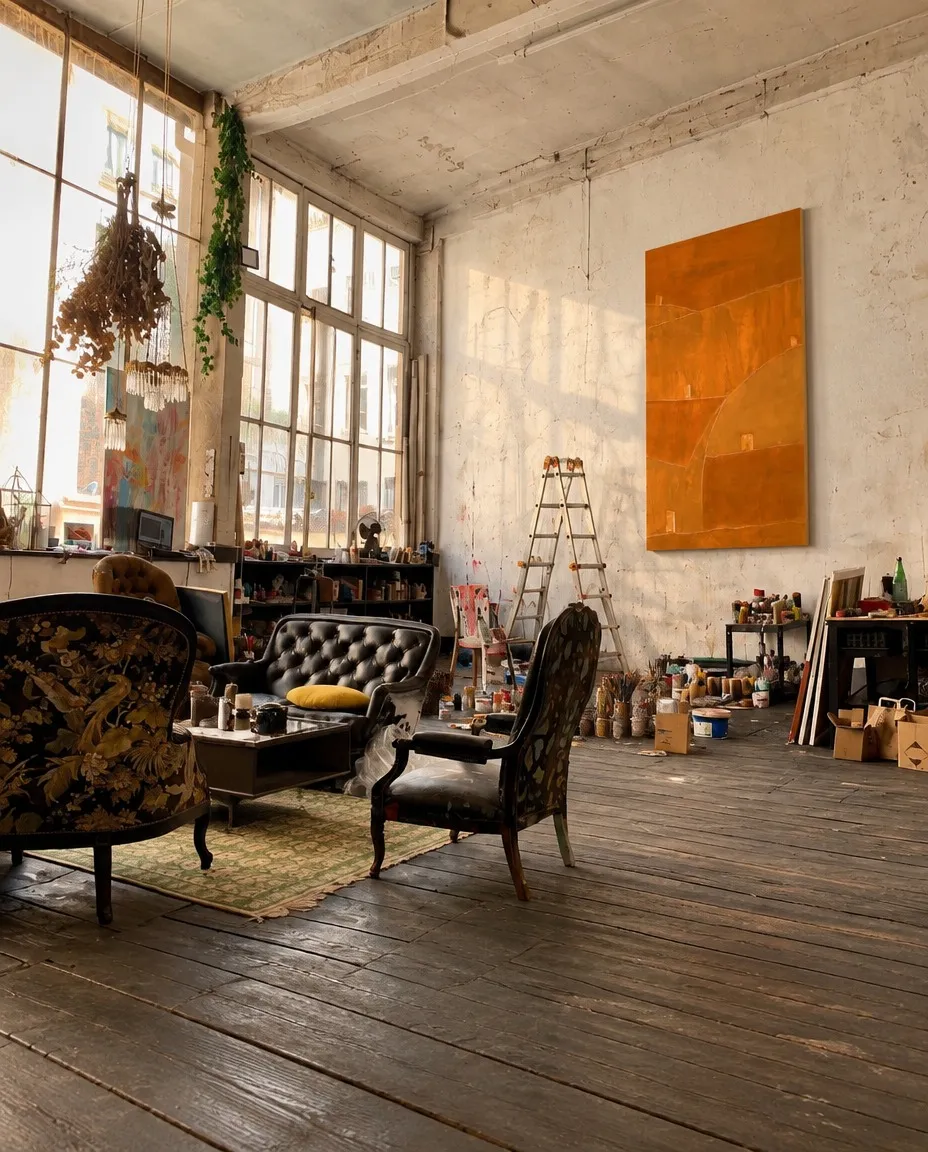
Context study / TESSERA
TESSERA by Maurizio Valch in Artist's Studio | STRATA Series
The surface of TESSERA unfolds before the viewer not as a mere pictorial plane, but as a primordial, sun-baked clay tablet—a prehistoric land registry where terracotta, ochre, and bright orange tones evoke the geological memory of a domesticated territory. The canvas is structured by incised lines, deep physical scars carved directly into the pigment that delimit terraces, slopes, and plots, pointing back to the earliest Neolithic efforts to impose order upon the formless vastness of the earth. Upon these incisions—which act not as simple drawing lines but as foundational wounds establishing the concept of a boundary—sit small quadrangular blocks, tiny structures resembling pieces of a cosmic game or minimal dwellings suspended on the slope. A latent, awe-inspiring tension exists within this visual geography, a silent dialogue between the boundless warmth of the orange void and the extreme fragility of those cubes attempting, with almost poetic desperation, to colonize and bring meaning to the chromatic abyss surrounding them.
When I plunge the tool into the fresh medium—into that tempered acrylic and oil that I have accumulated layer upon layer on the support—I do not seek to trace a representation, but to carry out an act of physical partition. I feel the resistance of the pigment as if it were the very crust of the earth, a stratum that must be wounded to reveal the underlying tones and bear witness to the passage of time and the hand that intervenes. My hands and memory inevitably evoke the light of the Mediterranean, that incandescence I came to know on the cliffs of Nerja and the Andalusian coasts—a clarity that is not an external atmosphere bathing things, but a color welling up from within the baked clay, a mineral radiation pulsing autonomously in the painting. As I excavate the canvas surface, each incised line becomes a physical boundary I impose to contain the immensity of the plane and offer a precarious foothold to those small cubic shapes. I do not paint isolated forms; instead, I sculpt the distance and tension between them, searching for an elemental geometric structure capable of resisting the void and sustaining the gaze against the density of the matter.
This tension between the parceling of the plane and the vastness of color introduces us directly to an engaging philosophical and existential debate on inhabited space. On one hand, the arrangement of these small blocks evokes the notion of temenos developed by Carl Gustav Jung, the celebrated Swiss psychiatrist who analyzed how the human psyche needs to draw sacred boundaries and enclosed sanctuaries to protect the self from the disintegrating chaos of the collective unconscious. In this light, each small square reveals itself as a refuge of consciousness, a space of intimate resistance against the burning tide of the background. However, when confronting this archetype of protection with the observations of the mystic G. I. Gurdjieff, who rigorously examined the automatism of human existence and the mechanical way we build our daily certainties, the work takes on a more unsettling dimension. One might wonder whether this meticulous division of the canvas represents the mind's mechanical tendency to fragment and classify reality in order to lull itself to sleep in pockets of illusory security, or if, on the contrary, the difficult placement of each block on the slope demands a conscious effort and constant self-remembering to avoid sliding toward dissolution. The sharp diagonal running through the center of the space acts as a tectonic fault, an abyss, or an escape route that divides the territory and challenges the rigidity of the imposed structures.
I often encounter interpretations of my work that overburden it with psychological theories, cosmological metaphors, or archaeological readings, but in the solitude of the studio, a block is simply a block and an incision is a physical slit on the canvas. I do not aim to erect temples or encode a secret language of sacred symbols; I am interested in the real behavior of scraped matter, the minimal relief casting a true shadow on the orange plane, and the vibration of color when disturbed by metal. The scale of these squares does not seek to represent the smallness of the human being before the universe, but rather to experiment with the limits of the pictorial space, where a single centimeter of matter must resist the visual pull of the entire chromatic mass surrounding it. I reclaim the right of painting to remain on a threshold of silence and strangeness—as a physical territory prior to words, where the true meaning of the work resides precisely in the unoccupied interval, in that mute air separating one block from another, which resists translation by any conceptual discourse.
Returning one's gaze to the canvas of TESSERA, once stripped of all theoretical speculation, what remains is the pure vibration of its internal temperature. The background orange does not behave as a static plane but pulses with a dull, almost geological radiation, as if the painting were a tempered iron plate retaining heat accumulated over hours. Along the bottom edge, a subtle, barely suggested incised mark seems to open the space outward, indicating that this map of territorial tensions continues to expand far beyond the physical boundaries of the stretcher. The painting thus returns us to a poetic and open contemplation, devoid of definitive conclusions, suspended in the delicate balance between the human need for belonging and the inevitable erosion of time. Floating in the space remains the intuition that these small marks and blocks do not represent permanent possessions, but rather transit stations, reminding us that the true meaning of inhabiting the world is not found in the solidity of a closed refuge, but in the ability to consciously hold oneself on the slope of the path.
- Original artwork
- TESSERA
- Actual dimensions
- 31.5 × 47.2 in / 80 × 120 cm
- Presentation
- Digital contextual visualization
Context references
artists studio painter · large scale orange painting · earth abstract painting · contemporary material art · industrial loft paintings · modern rustic decor · tessera strata
About this visualization
This visualization places the artwork within an architectural context to help collectors and viewers imagine its presence in a real space. It is an interpretive reference, not an exact reproduction: the original work remains the sole authority for scale, color, surface and material presence.