Context study / TENSUM
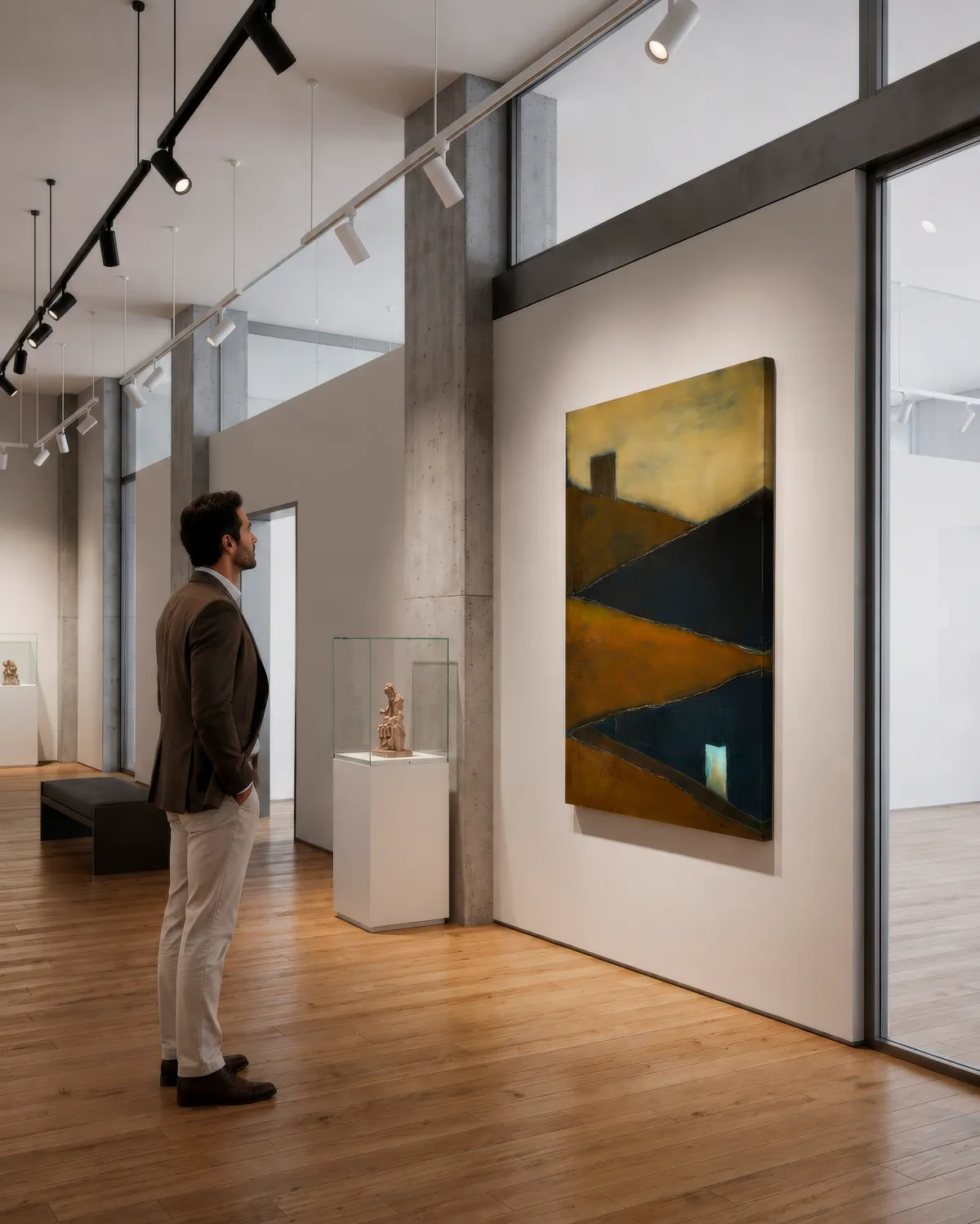
Abstract canvas TENSUM by Maurizio Valch exhibited in gallery | Artwork Mockups
The composition of TENSUM is organized around a violent zigzag trajectory that divides the surface of the eighty by one hundred and twenty centimeter canvas into alternating planes of ochre, earth tones, and a highly dense deep blue. These large chromatic masses do not merely coexist; they are sharply delimited by very light incised lines that glow like tectonic fractures in the midst of the abstract landscape. This geometric journey, angular and severe, inevitably evokes the ideas of G. I. Gurdjieff, a mystic and philosopher who dedicated his life to studying the mechanical nature of human behavior and the tremendous difficulty involved in the true awakening of consciousness. Observing the navigable rigidity of these lines, one might wonder whether this broken path represents a laborious, conscious, and voluntary ascent or if, on the contrary, it places us before the pre-set route of an automatism from which we are unable to escape, raising the dilemma of whether the structured path is a support that sustains us or a labyrinth that lulls us to sleep through its relentless repetition.
When I drag the tool over the wet matter of the canvas, I do not seek to draw an ornamental design, but to make a physical incision, a real cut that penetrates deeply into the overlapping layers of oil and acrylic to expose the luminous stratum hidden beneath. I feel in my arm the physical resistance of the pigment and the tension of opening those zigzag boundaries that separate the dense masses of color; it is a process where the territory of painting reveals itself as rebellious and demands a precise force to be mastered. I am not interested in the complacency of the soft brush, but in scraping, wrestling with the palette knife, and searching for an internal structure capable of dividing the visual space of the canvas without closing it off completely, allowing the surface to breathe through its open wounds.
The dynamic rigidity of the path is interrupted by the presence of two monolithic elements that destabilize and charge the reading of the work with tension: a dark, heavy, and almost architectural-looking block crowning the ochre summit at the upper left end, and a small, bright white rectangle floating like a luminous portal on the dark blue plane of the lower right end. This spatial polarity invites us to summon the thought of Carl Gustav Jung, the pioneer of analytical psychology who unraveled the complex dynamics of tension between the light of consciousness and the deep darkness of the waters of the unconscious. TENSUM proposes a paradoxical geography in a Jungian key, as the Shadow stands solid, visible, and monumental on the illuminated peak, while the Self, represented by that luminous and radiant stronghold, is submerged at the base of the descent, forcing us to sustain a constant tension of opposites where sanctuary and threat do not cancel each other out, but need one another.
There is an atmosphere of dense silence and contained melancholy across the entire surface that connects me immediately with the memory of my own transits through Mediterranean geography. The dirty ochre tone of the sky crowning the canvas evokes that heavy, dusty light of the calima, an environmental dryness belonging to the Andalusian horizons engraved on my body. These blocks and pathways that I place in the pictorial space do not attempt to illustrate any real landscape or be the chronicle of a specific trip, but are the residue of having walked through ancient lands where ruins and mineral soil end up merging into one single thing. For me, painting is the only means I have to sustain that temporal and physical distance, a place where the transit and stillness of memory can coexist without needing to resolve themselves or reach a definitive destination.
Contemplating the overall surface of TENSUM, the gaze remains suspended in the intermediate space that lies between the agitation of the broken path and the unshakeable stillness of the monolithic blocks. The work is not resolved in a single answer, leaving us with the doubt of whether this territory represents an inevitable confinement within the limits of matter or a space of transit harboring the promise of a later liberation. In the end, all theoretical speculation retreats before the forceful physical reality of the painting: the optical vibration produced in the encounter of blue with ochre, the subtle irregularities of accumulated texture, and that thin incised line which, before being a concept or a symbol, is a real scar on the canvas that stops our gaze right at the limit of the visible.
- Original artwork
- TENSUM
- Actual dimensions
- 31.5 × 47.2 in / 80 × 120 cm
- Presentation
- Digital contextual visualization
Context references
buy original abstract art · large paintings to decorate living room · abstract painting with textures and incisions · paintings by contemporary Spanish artists · ideas for hanging large paintings
About this visualization
This visualization places the artwork within an architectural context to help collectors and viewers imagine its presence in a real space. It is an interpretive reference, not an exact reproduction: the original work remains the sole authority for scale, color, surface and material presence.