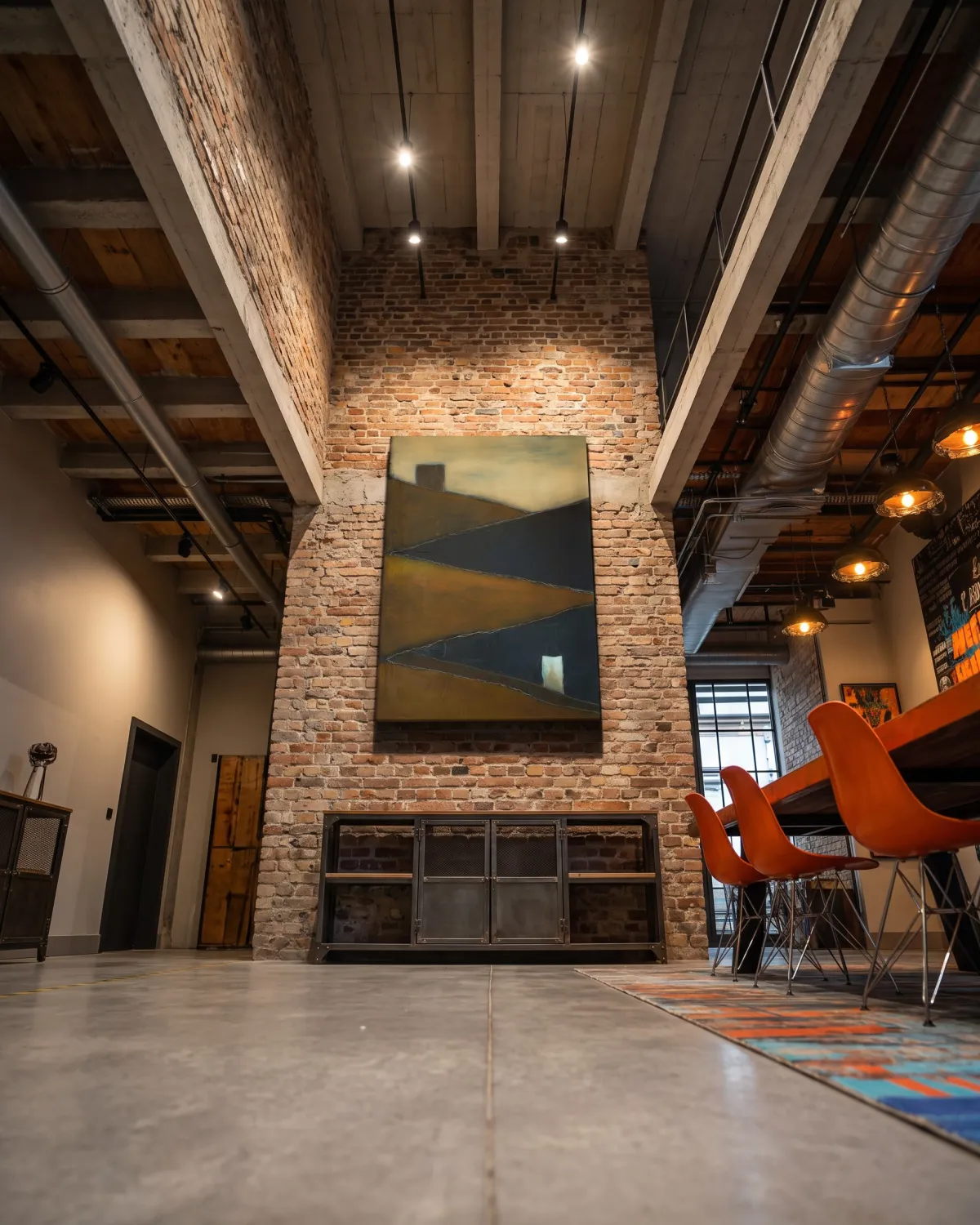
Context study / TENSUM
TENSUM by Maurizio Valch | Cartography of Memory
The composition of TENSUM unfolds as a topography of irreducible tensions, a magnetic field structured around a radical polarity. In the upper-left corner, a monolithic, somber volume rests upon the highest ridge, silhouetted against a suspended haze, while at the opposite end, in the bottom right, a pale rectangle emerges—a luminous threshold that seems to pulse with its own light in the half-shadow. This physical and chromatic distance evokes the dialectic of opposites theorized by Carl Gustav Jung, where the dark peak represents the Shadow or the ancestral sediment of the unconscious, and the lower portal represents the damp, rising promise of individuation and the Self. Under the influence of Gaston Bachelard's insights into the poetics of space and the reveries of matter, this geography ceases to be an external landscape, revealing itself as a cartography of the psyche. We are not looking at real hills, but at the materiality of accumulated memory; we wonder what intimate territory this steep slope traverses, and what silent archetype watches from the peak’s severe fortress, guarding the deepest strata of our own history.
When I face the blank canvas, I do not seek to illustrate an idea, but to provoke a physical event through matter. To build the body of TENSUM, I had to work with the palette knife, dragging the acrylic and oil until they acquired an almost geological density, a texture that gave off that thick scent of dry, parched earth that reminds me of the fields of Nerja. The true turning point in the process is always the destructive and creative gesture of the incision: cutting into the still-wet paint, furrowing the surface with a firm stroke to open those white seams that form the zig-zag. It is not about painting a dividing line, but about wounding the matter so that it reveals its inner substrate, a clean, raw boundary that segments the ocher planes from the blue-black pits, forcing the color to resist the pressure of the void I have just carved into it.
This path that fragments the canvas in a back-and-forth movement acts as an implacable path or an impassable boundary. It is here that G. I. Gurdjieff's perspective sheds light on the structure: this stepped path can be interpreted as a representation of the arduous effort required to break the mechanical nature of human existence. Each turn of the zig-zag is an indispensable shock, a violent interruption of inertia that forces us to awaken from the automatic sleep in which our daily life takes place. One wonders if these white incisions are the scars of our attempts at lucidity or, on the contrary, the rigid rails of a system that conditions and boxes in our transit. The work places us before the constant friction between the automatic march imposed by the relief and the mysterious autonomy of that illuminated portal that, from below, seems to invite a detour, suggesting a way out of the structure.
Solitary as I am in my studio, I prefer to detach myself from the psychological readings or mystical keys that others project onto my work; for me, the painting is above all a matter of atmosphere and silence. I am interested in scale, the weight of the pigment, and how that luminous block in the bottom-right corner appeared almost by chance, claiming its place without asking permission, like a window opening in the middle of a blank wall. I do not paint to explain concepts, but to sustain a physical and inexplicable presence in space; I want whoever looks at the painting to feel the dense air that separates the planes, the gravity of the ocher, and the abyss of the dark blue, stripping the experience of any preconceived narrative to return to the viewer the pure materiality of the painting suspended before their eyes.
Ultimately, the strength of TENSUM lies in its ability to reconnect us with an archaic memory, one that links the first cave engravings and prehistoric dolmens with our atavistic need to mark territory and orient the spirit. The painting does not offer us a safe harbor, an arrival, or an easy redemption; on the contrary, it holds us in an uncomfortable, magnetic suspension. The true tension named by the title is the tension of our own gaze, forced to oscillate indefinitely between the telluric heaviness of the stone crowning the work and the luminous threshold beating in the shadow below. It is in this untamable interval, in this restless alertness, where the work resists, reminding us that meaning is not found in the destination of the journey, but in the very vibration of resistance.
- Original artwork
- TENSUM
- Actual dimensions
- 31.5 × 47.2 in / 80 × 120 cm
- Presentation
- Digital contextual visualization
Context references
large painting for industrial dining room · abstract art on brick wall · original Spanish abstract painting · brutalist art decor · paintings from the strata series maurizio valch
About this visualization
This visualization places the artwork within an architectural context to help collectors and viewers imagine its presence in a real space. It is an interpretive reference, not an exact reproduction: the original work remains the sole authority for scale, color, surface and material presence.