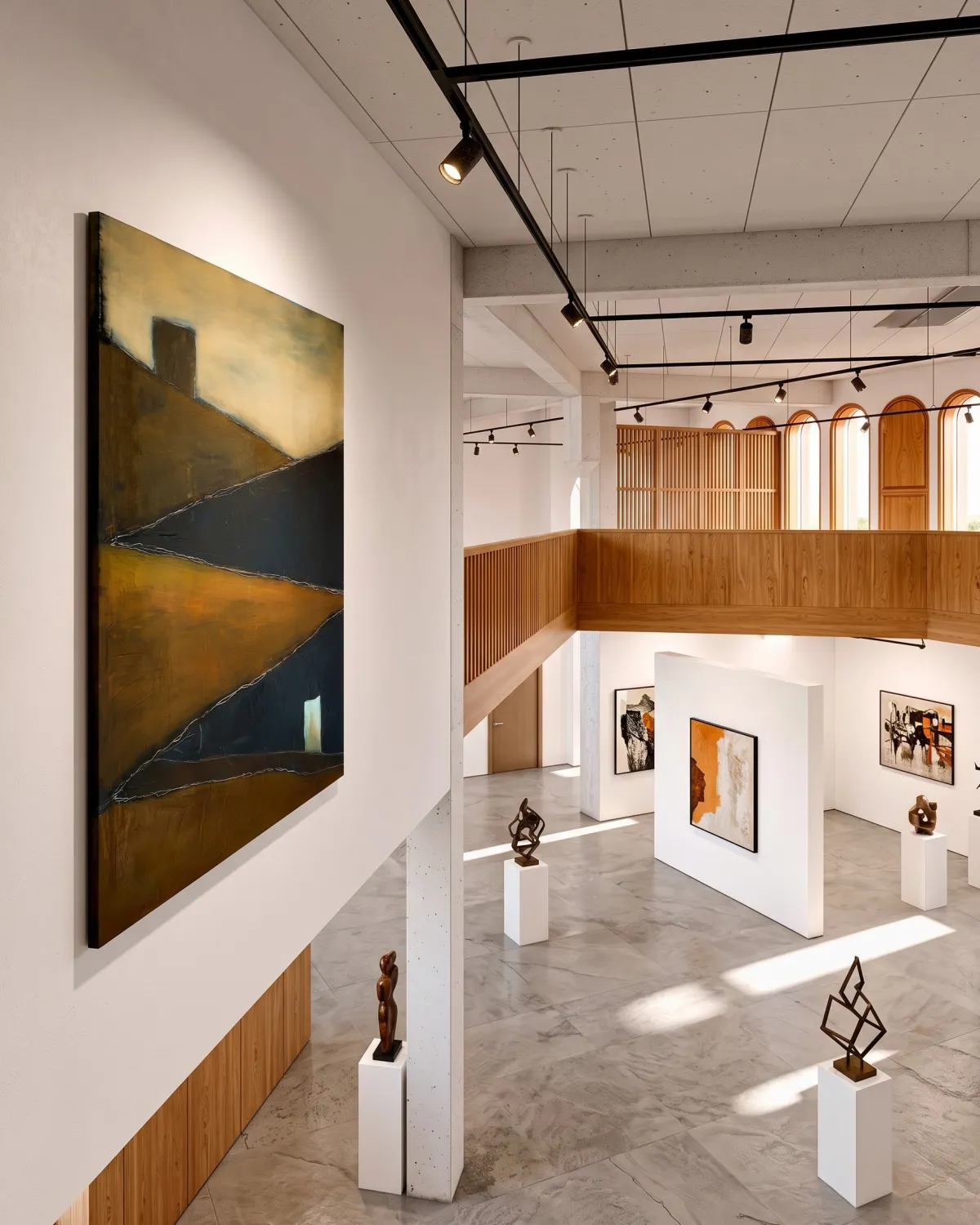
Context study / TENSUM
Abstract Painting TENSUM in Gallery Exhibition - Maurizio Valch
In TENSUM, the pictorial surface is organized through a rigorous compartmentalization of angular planes that ascend in an uninterrupted zigzag, structuring a contained yet latent spatial tension. These chromatic fields, dominated by somber, ochre, and earthy tones, are sharply delimited by pale incised lines that segment the composition. At the extremes of this ascending trajectory, two conceptual vanishing points are established: a small luminous block anchored at the base and a dense, monumental dark mass crowning the summit. This geometric arrangement not only evokes a physical topography or a rugged geological landscape, but also projects itself as a cartography of the psyche. The canvas is transformed into a dual territory, where the boundaries of external geography merge with the folds of a deep mental structure, suggesting that the space traversed is as much a geophysical relief as an inner labyrinth where each plane represents a stratum of consciousness in friction.
When I confront the material on the support, I want the gesture to be not merely illustrative, but a physical event that leaves a mark on the surface. For me, those pale lines are not simple strokes drawn over the color; they are true incisions, incised lines that cut and penetrate the accumulation of pigment, leaving cracks that reveal the lower strata of the work. I conceive this process as a deliberate wound, a scar in the pictorial matter that divides the visual territory and records the actual resistance of the support against my tools. Each of these physical incisions, or incised traces, arrests the flow of color and delimits the planes in an almost tectonic manner, so that the time of making remains frozen in the indentation. I do not intend to paint an orderly landscape, but rather to record the struggle between the force of my hand and the density of the support, opening breaches that force the matter to confess its own history and its own resistance at the limit.
This formal articulation of TENSUM invites a conceptual debate at the intersection of two currents of psychology and human development. On one hand, we can approach the work from the perspective of Carl Gustav Jung, the Swiss psychiatrist who founded analytical psychology and posited the process of individuation as the path of integrating the psyche. From this perspective, the tortuous zigzag ascent would represent the arduous journey toward self-knowledge, where the lower luminous block symbolizes the initial emergence of the Self and the dense upper mass embodies the Shadow—that unconscious stratum that must be confronted and assimilated. On the other hand, the composition resonates with the theories of G. I. Gurdjieff, the Armenian mystic and philosopher who proposed that human beings live in a state of deep mechanicalness, like a sleeping man trapped in automatisms. Under this reading, the zigzag of the painting would not be a path of liberation, but the design of automated machinery, a closed labyrinth where the subject mechanically repeats the same journeys and oscillations without ever managing to awaken, trapped in a structure that simulates movement but in reality perpetuates captivity.
Observing these theoretical readings of my painting, I prefer to distance myself from hermetic psychological or mystical interpretations that attempt to close off the meaning of the canvas. My search does not stem from a predetermined symbolic map, but from the silent impact of memory on matter, specifically from my experiences in the Mediterranean territory. I have always been fascinated by the severity of the southern landscape, like the geological strata observed in the caves of Nerja, where the rock bends and breaks under silent pressures over thousands of years. The zigzag in my painting comes from that silence of open spaces and the observation of barren land, limestone, and the fractured horizons of the Mediterranean coast. The blocks I place at the extremes are not moral symbols of good or evil, of light or shadow, but physical thresholds, openings that suggest a transit without promising a final destination. What interests me is sustaining the tension of the path itself, the vibration of the intermediate space where there are no certainties, only the presence of matter resisting in its pure, interrupted horizontality.
To fully comprehend this spatial tension without falling into symbolic reductionisms, it is illuminating to turn to the thought of Gaston Bachelard, the French philosopher celebrated for his analysis of the poetic imagination and the intimate resonance of inhabited spaces. From his poetics of space, the verticality and stratification of the canvas do not represent mere topographical accidents, but values of shelter and confrontation where human beings project their limits and their dwelling in the world. In TENSUM, the insurmountable distance between the small luminous base and the monumental summit turns the pictorial surface into a mute testimony of human resistance against physical and intellectual limits. In the end, the angular planes and earthy sobriety do not resolve the conflict, but fix it in a tense and imperishable stillness. It remains for the observer to question themselves before this fragmented horizon: are these physical cracks and somber fields the insurmountable limits of our own mechanicalness, or do they constitute, on the contrary, the only material thresholds from which it is possible to fracture the silence and begin the true ascent?
- Original artwork
- TENSUM
- Actual dimensions
- 31.5 × 47.2 in / 80 × 120 cm
- Presentation
- Digital contextual visualization
Context references
contemporary abstract painting exhibition · buy original abstract art · large format minimalist paintings · works from the STRATA series
About this visualization
This visualization places the artwork within an architectural context to help collectors and viewers imagine its presence in a real space. It is an interpretive reference, not an exact reproduction: the original work remains the sole authority for scale, color, surface and material presence.