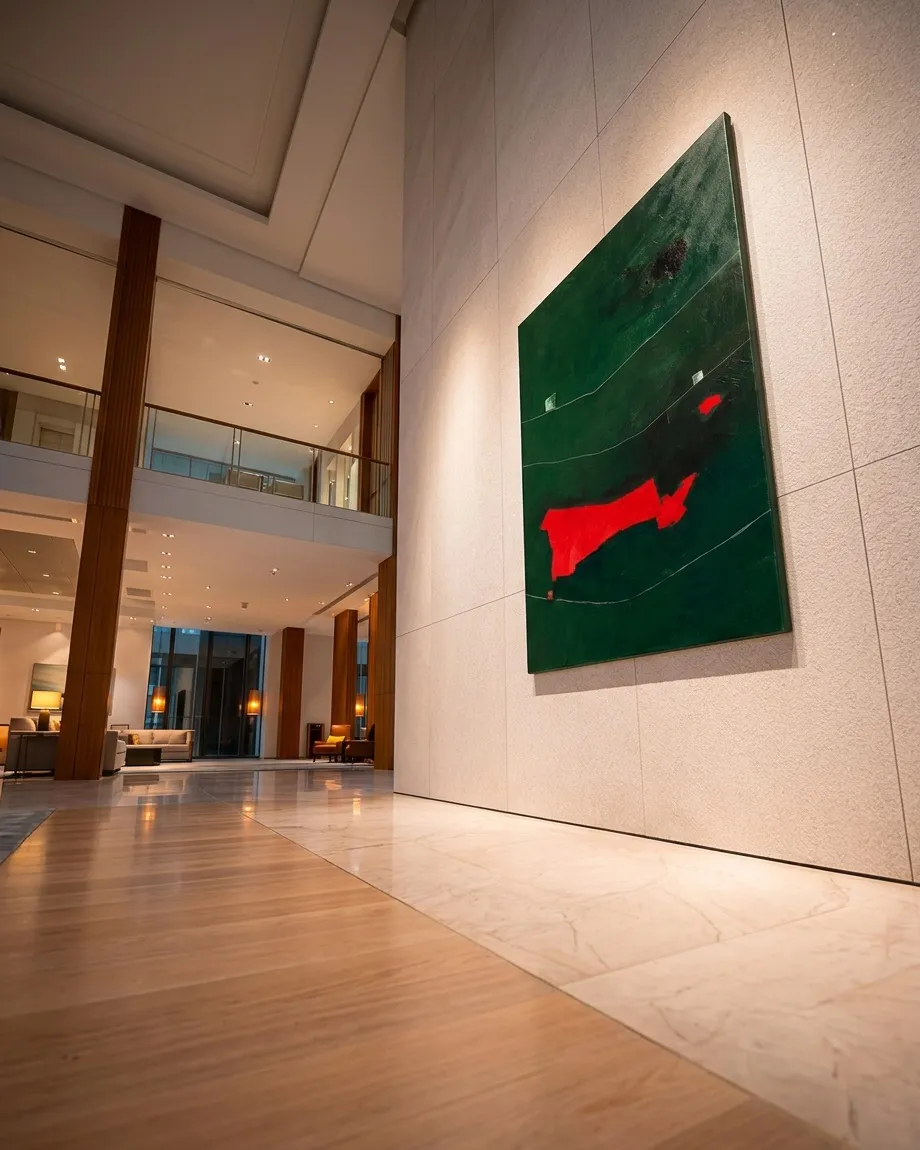
Context study / Sogno di un filo teso
Sogno di un filo teso by Maurizio Valch (STRATA Series)
On the surface of Sogno di un filo teso, the eye first encounters a rigorous spatial division: three horizontal incisions scoring the dense dark green pigment, supporting three tiny, calculatedly spaced quadrangular blocks. This linear structure, suggesting a musical score or high-voltage power lines, immediately contrasts with the organic intrusion of a central red patch resting on a base of black shadow. When examining the movement of these small blocks along their respective threads, it is difficult not to recall the thought of G. I. Gurdjieff and his sharp critique of the automatism of human existence. The incised lines pose a crucial question on the canvas: are these lines mechanical, predictable trajectories along which we travel asleep, oblivious to the depth of the field surrounding us, or do they represent, on the contrary, the conscious, voluntary effort to sustain a precarious balance—the "self-remembering"—over the abyss of an untamed matter? For Gurdjieff, human beings move most of the time under the influence of inertia, and only a deliberate act of attention can awaken them from their lethargy; thus, the taut thread becomes the narrow path of awake attention dividing the vastness of the painting.
When I bring the spatula to the canvas, I do not seek to draw a line on the plane, but to wound the matter, to open an actual furrow in the accumulation of wet oil. These incisions crossing the work are physical scars that interrupt the vibration of the green; a color that, for me, does not function as a passive background, but as the embodiment of a telluric density, imbued with the tactile and mineral memory of the Mediterranean soil of Nerja, stripped of any figurative representation. By dragging the tool, I want the viewer to feel the physical resistance of the pigment. However, this linear order of taut threads and calculated trajectories breaks abruptly when I allow the large red patch to emerge in the center; an asymmetric, rough block that disrupts the stillness of the surface, imposing itself as a reminder that living matter possesses its own weight and refuses to be confined to the rigidity of a predetermined path.
This central intrusion, characterized by its fiery red color and jagged contours, finds a psychological anchor when analyzed under the theories of Carl Gustav Jung. Far from representing a simple wound or a mark of physical pain, the red block, backed by the dense black shadow extending beneath, acts as the formal manifestation of the Shadow or the Self emerging from the depths of the collective unconscious, here symbolized by the vast green territory. While the small quadrangular blocks above embody the geometric fixity of the rational ego and its attempt at control through linear rules, this magmatic and asymmetric core claims its sovereign space in the composition. It is the intrusion of the instinctive and archetypal challenging the dictatorship of the Cartesian order, reminding us that beneath the apparent calm of the structured map pulses a primitive energy that cannot be fully domesticated or subjected to the path of a straight line.
The title I chose, Sogno di un filo teso, refers precisely to that fragile aspiration of balance in the midst of an expanding void. In the scale of one hundred and twenty by eighty centimeters, every movement of the spatula has been an exercise in restraint, where I sought to suspend time within the two-dimensional space of the canvas. The "dream" of the thread is, perhaps, the longing for structural tension to be sufficient to support our path without breaking under the weight of the inexplicable. Above this stage of conflicting forces, I allowed a dark smudge to float, an almost dry, faded pigment operating as a black sun or an inaccessible coordinate. It does not seek to intervene or explain; it is a mute presence installed in the upper third, watching the canvas in absolute silence, consolidating the painting not as an answer, but as a hermetic territory that refuses to reveal its laws at first glance.
Finally, the coexistence of these elements finds its synthesis in a perspective akin to the thought of Osho, who defended the dissolution of rigid patterns in favor of freedom and existential flow. The painting then reveals itself as a field of tensions where rule and wild life continuously measure each other: the taut thread is not necessarily a rope imprisoning experience, but the indispensable bridge to cross the abyss of consciousness without getting lost in it. In the end, there is no definitive resolution to release the tension accumulated between the geological green, the volcanic red, and the thinness of the incised trace. The canvas returns the gaze to the observer in an expectant silence, inviting them to inhabit the discomfort and beauty of this suspended space, taking the risk of walking the tightrope of one's own being without the urgency of finding solid ground on which to stop.
- Original artwork
- Sogno di un filo teso
- Actual dimensions
- 31.5 × 47.2 in / 80 × 120 cm
- Presentation
- Digital contextual visualization
Context references
large format abstract painting · Maurizio Valch STRATA · abstract painting for high ceilings · minimalist decor with art · contemporary art for hotels
About this visualization
This visualization places the artwork within an architectural context to help collectors and viewers imagine its presence in a real space. It is an interpretive reference, not an exact reproduction: the original work remains the sole authority for scale, color, surface and material presence.