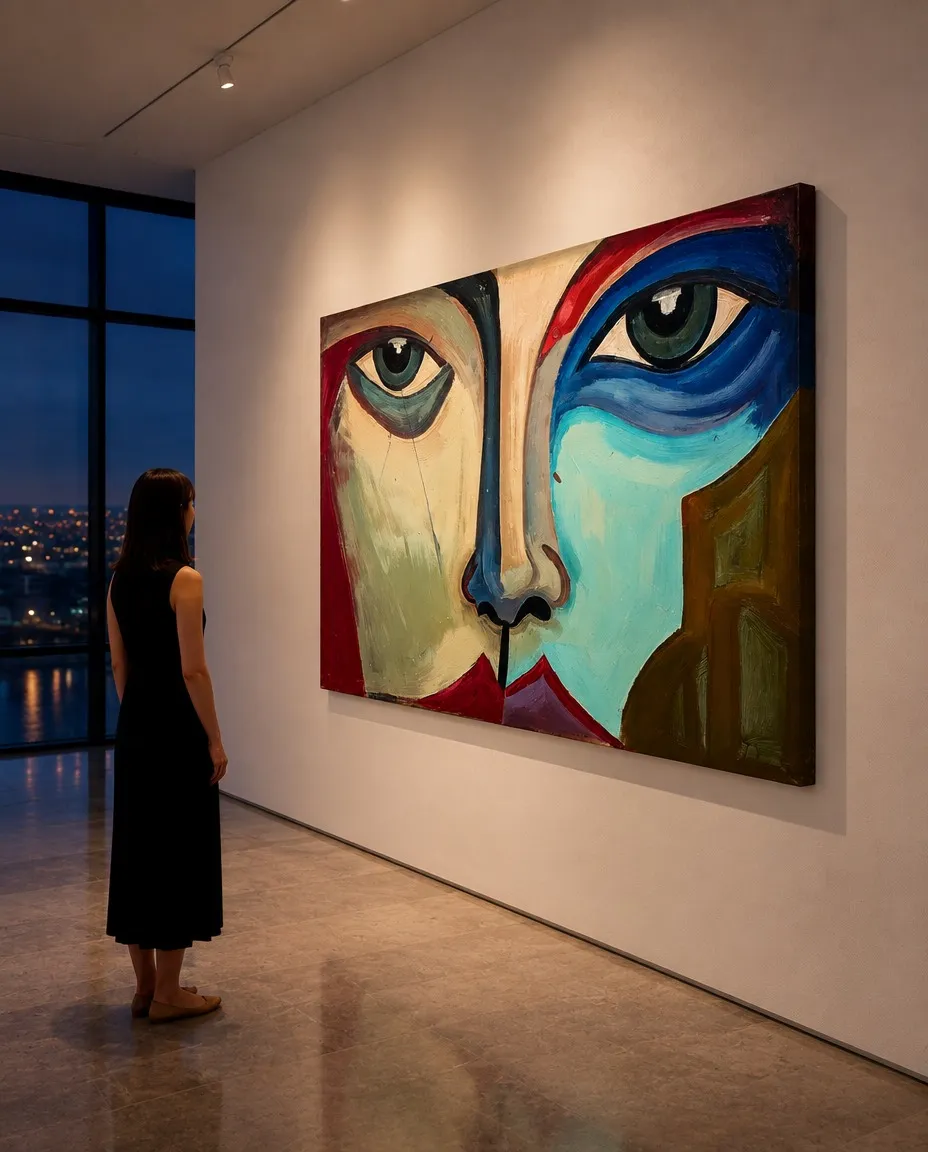
Context study / SIMULACRUM
SIMULACRUM by Maurizio Valch | FACIES Abstract Painting
The scale of SIMULACRUM imposes a presence that exceeds the mere representation of a face, rising instead as a topographical event, a vertical landscape that operates as a physical boundary within the exhibition space. The composition is sharply fragmented by a vertical axis descending along the bridge of the nose, dividing the surface into two opposing thermal and chromatic regimes: to the left of the canvas lie pale greens, earthy ochres, and shadows evoking the degradation of organic matter, while to the right erupts an icy mass dominated by cobalt blue, turquoise, and ultramarine. This drastic asymmetry immediately dismantles the classical notion of communion understood as harmony, reciprocity, or peaceful fusion between two complementary parts. Here, the meeting of these two realities does not seek the dissolution of their differences; on the contrary, communion is defined by the sheer insistence of coexisting on the same support, compelling the gaze to absorb the irreconcilable tension of two halves that touch without merging, revealing that every face, before being a unit of identity, is a territory of material confrontation.
In drawing the curvature of these two almost tectonic eyeballs, I do not seek to capture a psychology, but to establish the scale of a physical confrontation with the canvas. In my process, depth has never been a simulation of classical perspective or a fictive window onto a hidden dimension behind the canvas; for me, it is a material fact, strictly subtractive, which I carry out in an almost surgical manner. For this reason, I made that fine diagonal incision that tears through the figure’s left cheek, a deliberate furrow in which the edge of metal wounds the superimposed layers of dense pigment in search of the bare weave of the linen beneath. That wound in the body of the painting is true depth: not an illusion for the eye, but the revelation of the support’s actual skin, a physical reminder that beneath the simulacrum of colour lies a blind limit, a primary stratum that breathes and resists through the scar I have imposed upon it.
The generosity of this painting manifests itself in the brutality of its physical offering, in the complete absence of technical reserve or formal restraint. Rough impastos of oil and acrylic accumulate without polishing, revealing the marks of brush and palette knife moving urgently across the canvas. The dense carmine surrounding the upper part of the forehead and spilling into the fractured lips functions as a visceral frame that contains the gaze, while the heavy dark mass at the lower right stabilises the composition through an almost geological visual weight. There is no attempt at decorative seduction in these strokes; generosity resides precisely in this exposure, in the honesty of presenting a simulacrum that conceals neither its seams, its asymmetries, nor the violence of its incisions. By exposing its material accidents and failures of symmetry, the work offers a territory free from the tyranny of idealised beauty, turning the vulnerability of the canvas into a raw yet unconditional space of welcome.
For a painter whose work has historically centred on the sobriety of deserted horizons and the solidity of abstract monoliths, the emergence of this face under the title SIMULACRUM represented a rupture in my own method. I constantly ask myself whether this giant effigy acts as a wall obstructing space or whether, on the contrary, the simulacrum of the mask is the only fertile ground on which the generosity of a shared presence and true communion with the other can be possible. I have learned that identity is not a truth hidden beneath the surface, but a succession of constructed layers, a simulacrum that we inhabit in order to be seen; in painting this face, I do not intend to illustrate a portrait of character, but to establish a territory of visual friction. My intention is that the viewer should not find a complacent mirror, but a dense, uneven surface where their gaze and mine inevitably collide in the materiality of pigment, transforming the painting into a threshold of pure confrontation.
Finally, the colossal, fixed eyes of SIMULACRUM reverse the spatial dynamic, returning the gaze with such intensity that they cancel any possibility of contemplative distance or neutrality in those who stand before them. The painting ceases to be a passive object of analysis and becomes an active wall that questions and divides space. At this point of convergence, the physical depth of the cut in the cheek, the chromatic generosity of the overflowing impastos, and the conflicted communion of its two chromatic halves form an indivisible whole. This work demonstrates forcefully that behind the surface of what we call simulation or artifice there is not nothingness, but a dense sedimentation of working time, accumulated material, and painterly memory, waiting with monumental gravity for the precise moment of its deciphering.
- Original artwork
- SIMULACRUM
- Actual dimensions
- 82.7 × 55.1 in / 210 × 140 cm
- Presentation
- Digital contextual visualization
Context references
SIMULACRUM Maurizio Valch FACIES · frontal abstract face painting · large abstract face painting · cobalt blue and carmine painting · contemporary art with geometric face · textured painting with incised lines · abstract work for gallery wall · face painting for modern interior
About this visualization
This visualization places the artwork within an architectural context to help collectors and viewers imagine its presence in a real space. It is an interpretive reference, not an exact reproduction: the original work remains the sole authority for scale, color, surface and material presence.