Context study / SIMULACRUM
SIMULACRUM in a Mediterranean Interior | Maurizio Valch
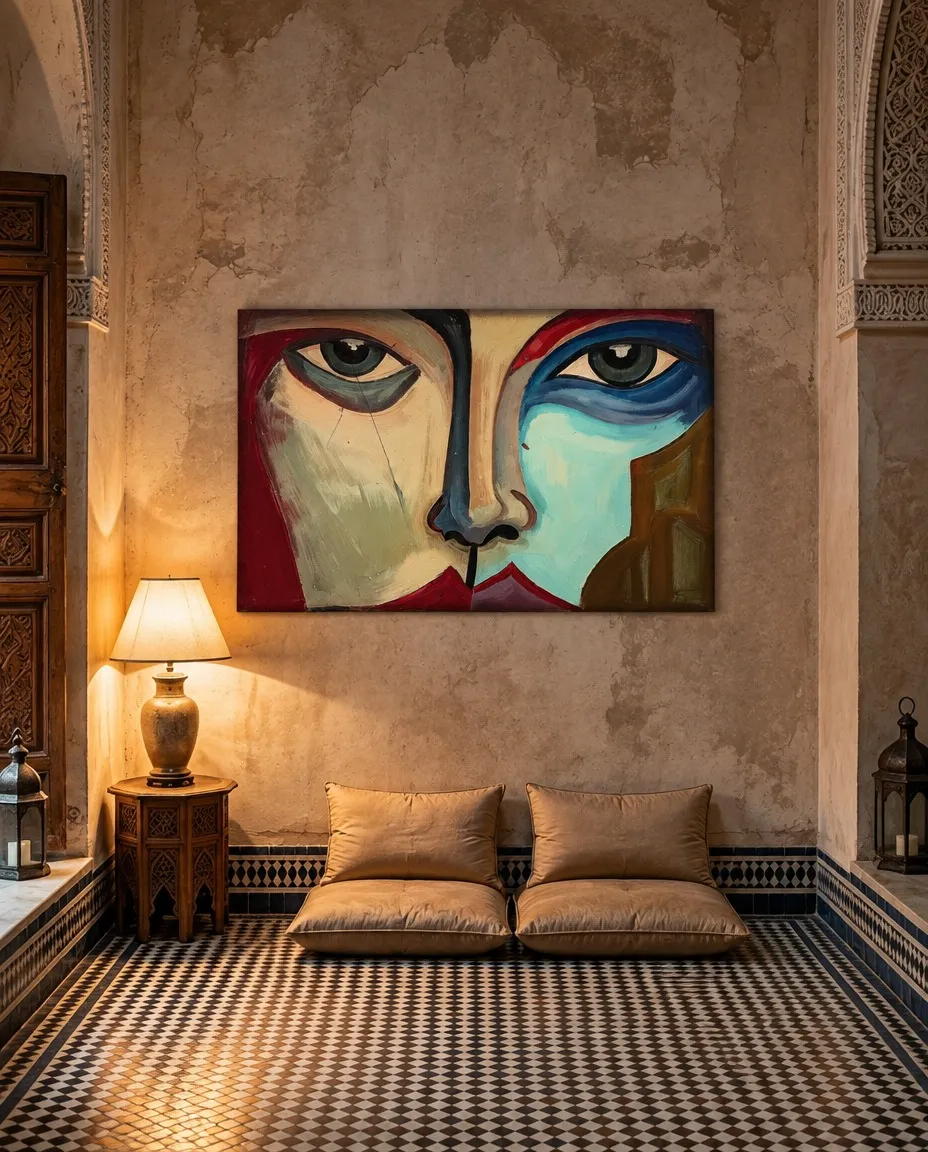
The frontality of SIMULACRUM does not receive: it waits. Its eyes, close and excessively present, seem positioned at the exact height at which the viewer stops looking at a painting and begins to feel watched by a question. The first test requires a small act of violence: mentally cover the painting’s right eye, the one that lives among blues and turquoises, in order to remain only before the left.
What then appears is a face that never quite becomes a face. The deep red on the left neither burns nor accuses; it holds. It has something earthy and veiled about it, like a wall that has absorbed too many seasons and retained the temperature of them all. Beneath the eye, a fine dark incision cuts through the surface without becoming a narrative wound. It does not say: something happened here. Rather, it says: here the image ceased to be certain of its own continuity.
Michel de Montaigne, a man attentive to the variations of his own thought, pauses before that left eye as one who discovers that a face never fully coincides with the version it has of itself. He first suspects that the red contains an intimacy. Then he corrects himself: perhaps it contains nothing; perhaps it weighs. He then doubts even that weight, because the visible brushwork does not enclose a secret but exposes it, leaving it out in the open. The left gaze seems to know something, though not necessarily about the person who bears it. Perhaps it looks out from a skin; perhaps from the memory of having been skin.
Montaigne would want to ask who inhabits that place. The nose, turned into a dark vertical bridge, does not let him move forward without paying a kind of toll. On this side, the red and violet mouth seems stitched by a black line: it is neither exactly silence nor speech. It is a seam that keeps apart two edges that may not wish to meet. Seen only from the left, the face takes on a domestic gravity, the heaviness of a closed room. But can a cheek be a room? Can an eye be someone who still does not know whether they are inside or outside themselves?
I do not fully recognize the unity of this face, and perhaps that discomfort does not belong only to the one looking at it. An image can turn away from the question asked of it and return another, less obedient one. I look at its two eyes and find no single intention holding them together; I find a distance that persists. The painting compels me to accept that a painted gaze may know something I do not, or perhaps know nothing and, for that very reason, continue to question me.
Now the test must be reversed. Cover, mentally or with your hand, the red half. Let the right eye exist without its neighbour.
The temperature changes immediately. The almost luminous turquoise does not cool; it opens space. The blue around the right eye forms an exaggerated orbit, a kind of shadow that does not accompany the eye but pushes it forward. It seems to advance ahead of the face that ought to contain it. Here, the gaze does not remain; it moves outward. It crosses the edge of the cheek and occupies a place that may not belong to it.
Béla Bartók, a man who knew how the irregular can make the familiar strange, enters through that right eye without asking permission. He does not translate colours into music; he treats them as forces that interrupt the direction of the gaze. The blue arrives an instant early. The turquoise lingers. Black sustains a hard pulse around the eye. And the brown form beside the cheek falls like a misplaced blow: door, piece of furniture, mask, truncated staircase, impossible room. It does not accompany the face. It throws it out of time.
The reader can now carry out a brief, precise test. Cover the left half of the reproduction with one hand, or imagine doing so for a few seconds. Notice how the right side intrudes, how it drives the gaze into a lateral space. Then cover the right side and return to the reddish area: something holds, weighs, perhaps cools from within. This is not a matter of choosing which half “expresses” more. It is a matter of noticing that the viewer’s body alters its breathing according to the side to which it submits. Once the hand is withdrawn, it is no longer possible to return to a peaceful unity: the two halves continue to produce incompatible climates within a single face.
Bartók then detects that the mouth does not reconcile the pulses. The red part seems to arrive from one bar, the violet from another. The dark line that divides them does not function as an effective suture: it marks the place where two tempos brush against one another without coinciding. The right eye moves ahead; the mouth tries to catch up; the nose remains still, almost ceremonial, as though it were the only institution that still believes in symmetry.
But Bartók falls silent before the fissure beneath the left eye. It is too fine to become rhythm, too irregular to be merely a pause. He cannot count it. He cannot make it fit a measure. While he remains silent, Montaigne looks again at the brown form on the right and discovers, with an unease that changes what came before, that the portrait’s supposed interiority may not have been in the earthy area. Perhaps it is there: in that architectural object embedded in the cheek, with the appearance of a door that does not fully open and a room that never quite takes shape.
Then a small question arises, almost childlike in its precision: brown form, why did you choose to live in a face, and what would happen to this face if you left? It does not ask what you symbolize. It does not seek an adult answer. It asks about your will, as though you could shift slightly, withdraw from the cheek, and leave behind a hollow shaped like your absence. Perhaps the face would become more human. Perhaps it would collapse. Perhaps, without that presence, the two eyes would no longer have a house over which to argue.
I do not want the painting to close what it opens. One part of it resists my desire to recognize, order, or reconcile. Montaigne looks for an inhabitant and Bartók for a measure, but perhaps the face desires neither owner nor metre. The brown form need not decide whether it is a door or a room; its resistance already changes everything around it. Before it, I do not feel that an explanation is missing: I feel that the expectation that a face should obey unity is excessive.
The two eyes may not be arguing over a tragedy. They may be arguing, with an almost comic obstinacy, over which one has the right to call that face “home.” The left insists: home is what holds, what preserves a shadow and a crack. The right replies: home is what opens, what admits an unexpected architecture even at the cost of disfiguring the cheek. Neither convinces the other. The dark nose remains in between, a vertical border between two coins, two climates, two timetables.
And the initial question shifts. It is no longer only what kind of face appears when one half remembers having been skin and the other insists on being a room. It may be: what kind of viewer appears when they look at a skin as if it were a wall and a room as if it had a pupil? It may also be: how much of a face must be lost before it begins truly to look?
At the end, the fissure beneath the left eye draws attention once again. It had seemed a minor detail, a thin interruption beneath a heavy gaze. Now it fits neither the left nor the right; it belongs neither entirely to the skin nor to the room. It is a line that neither joins nor separates cleanly. The viewer returns to it and understands that perhaps the face was never divided in two. Perhaps it was their own gaze that was learning, too late and without remedy, to look in fragments.
- Original artwork
- SIMULACRUM
- Actual dimensions
- 82.7 × 55.1 in / 210 × 140 cm
- Presentation
- Digital contextual visualization
Context references
SIMULACRUM Maurizio Valch · contemporary abstract face · horizontal painting for a Mediterranean interior · red blue and turquoise wall art · face painting with frontal gaze · contemporary painting for living room
About this visualization
This visualization places the artwork within an architectural context to help collectors and viewers imagine its presence in a real space. It is an interpretive reference, not an exact reproduction: the original work remains the sole authority for scale, color, surface and material presence.