Context study / SIMULACRUM
SIMULACRUM by Maurizio Valch | Abstract Face
SIMULACRUM — a score for the gaze: two eyes, a fissure, and a door
First entry: do not look at the whole face yet.
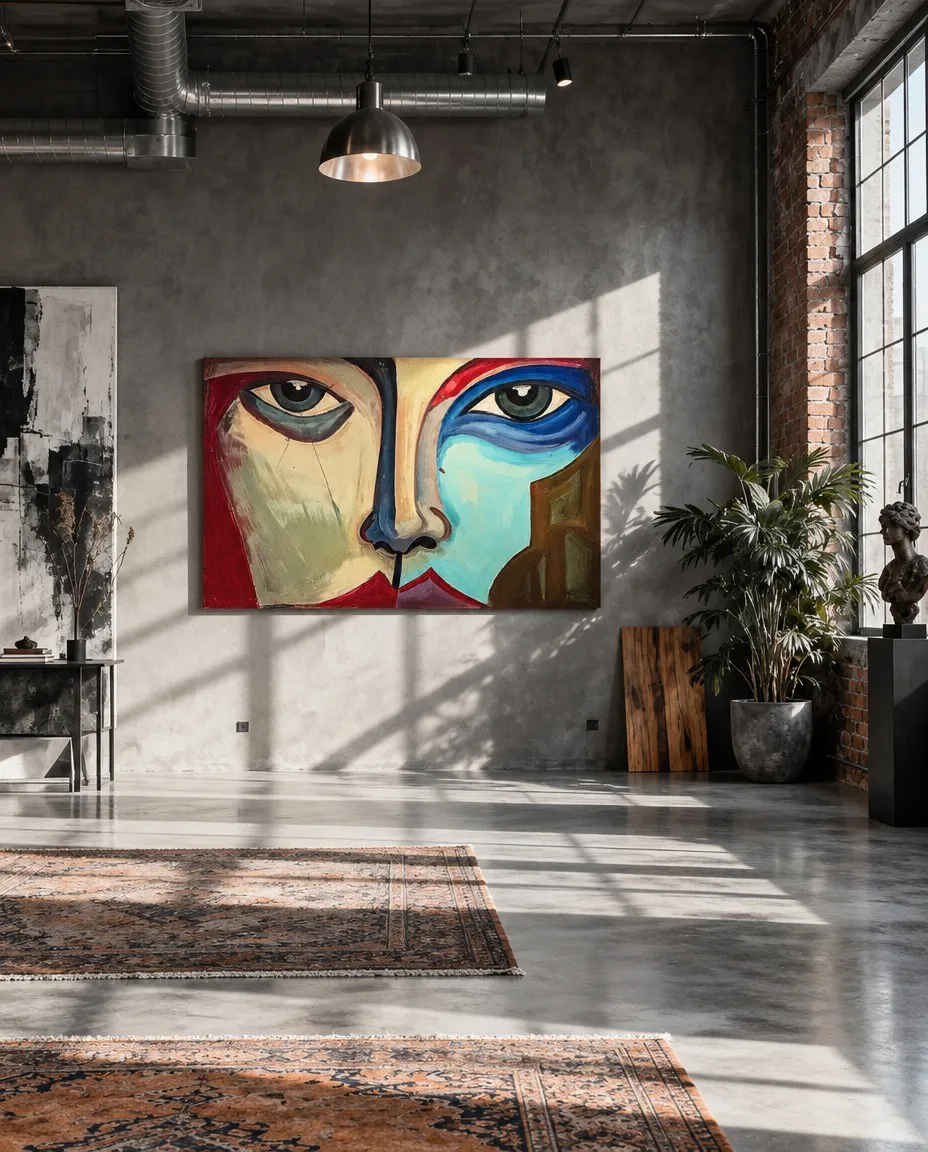
The left eye arrives first, like a dense temperature. Above it is a red mass that never quite becomes shadow, eyebrow, or bandage; below it, earthen skin opens in layers that seem to retain heat. There is no softness in this half: the surface feels cut and insistent, as though each colour had had to claim its place by pushing aside the one before it. The pupil does not ask for intimacy. It watches from an almost uncomfortable proximity.
Then the other eye appears, on the right, and refuses to enter the same climate. The intense blue surrounding it does not cool anything down: it presses. The turquoise cheek seems to advance towards the viewer, while the eye retreats behind its dark band, as if it were looking from a few seconds earlier or later. A frontal face should coincide with itself. This one never quite does.
Misalignment: count to two, but lose the two.
What happens when one eye arrives late to the same face the other eye is already looking at?
The question is felt in the body before it finds words. The gaze jumps from red to blue, and the neck makes a tiny movement, a correction that resolves nothing. The earthen eye weighs downward; the blue one remains higher, sharper. One seems to have woken in a charged room; the other, under a light that does not belong there. The black, vertical nose attempts to bridge them, but it may also be a taut seam. It descends, narrows, stumbles against the dark nostrils, and reaches a red mouth that does not quite settle the argument.
Henri Matisse, an artist who discovered that colour could cease to obey the visible world and make it more intense, freer, and stranger.
Here, his intelligence would want to bring the two halves closer without reconciling them: it would suspect that red does not simply cover an area of the face, but alters how its weight is felt; that blue does not describe a shadow, but a different emotional anatomy. If turquoise supports the right cheek, the face changes its gravity. The blue gaze seems more distant not because it is painted “cold,” but because colour has altered its breathing. Yet this reading, so certain of its freedom, meets immediate resistance: red does not free itself; it also coagulates. Blue does not open; it also holds back. The painting does not allow colour to be an escape.
Brief silence over the surface.
From two metres away, the face occupies the wall as a broad, almost domestic presence: not a person sitting before someone, but a wall that has learned to look. Up close, by contrast, the edges cease to obey. In some areas, tones seem to brush against one another without blending; in others, a dark mark cuts through brightness like an interrupted sentence. The painting is three centimetres deep, but the face seems to dispute that measurement: it advances through the insistence of its planes and withdraws through its eyes.
I look at this finished face and feel that it is no longer waiting where I thought I had left it. I try to hold both eyes at once, but one hardens while the other recedes; the dark line of the nose does not join them, but forces me to breathe between them.
Displaced entry: the beat does not fall where it should.
Astor Piazzolla, a composer and bandoneon player who made tango into music of broken breaths, urban tensions, and turns that never arrive where one expects.
He would not allow the gaze to pass smoothly from one pupil to the other. He would detect a syncopation: left eye, suspension; nasal axis, dry strike; right eye, an entry ahead of or behind the beat—it is impossible to decide. The face offers no stable meter. The viewer believes they are reading a symmetry and suddenly falls out of time, like someone placing a foot down expecting level ground and finding a step.
Piazzolla might say that the central fissure organises the rhythm, that the darkness of the nose holds the two voices together. Too certain. Matisse undoes him without speaking: it is enough to look at the turquoise beside the brown at the right edge to see that no line truly leads anywhere. Rhythm does not direct; it disperses. Colour does not liberate; it thickens. The painting contradicts them both and leaves a third possibility: not to look at the face as one recognises a face, but to listen to it with the eyes, attentive to its collisions of temperature.
A lateral object persists.
At the lower right, a brown form rises like something left against the wall that should not, however, be there. It resembles a door, but it is still too soon to call it one. It has verticality, an edge, an inner darkness; it does not participate in the face’s frontality, and that is why it unsettles. While the eyes compel a frontal gaze, this form offers a lateral escape. It opens nothing. It is simply there. It has the stubbornness of a badly placed chair in a room: no one wants to talk about it, yet no one stops moving around it.
Then a small question appears, almost unutterable because of how serious it becomes: what if the blue eye is looking from behind that door?
There is no need to answer. It is enough to let the gaze travel down the nasal line, cross the divided mouth, brush the turquoise edge of the cheek, and stop at the brown. There, scale shifts. The lateral form no longer seems small beside the monumental face; it seems as though the entire face had been built around its presence, trying not to touch it. The right eye does not look towards it, yet something of its blue is caught by that edge.
Repetition with a difference.
The door—now, indeed, a door, though it retains its disobedience—does not amount to an exit or a secret. It may be a vertical rhythm interrupting the face. It may be an earthly weight that prevents the turquoise from evaporating. It may be a second nose, displaced and mute, doubling the division at the centre. Its function changes whenever the gaze returns to it: at first it seemed like a lateral addition; later, it seems to hold open an interval between the blue eye and the painting’s edge.
I cannot accept that this door is a resolution or a resting place for the gaze. I see it blocking the way just as the blue seems to want to advance, and I also see it making my own distinction between inside and outside unreadable; perhaps it is not at the face’s edge—perhaps the face is taking place at its edge.
Slower breathing.
On returning to the left eye, the red no longer seems only red: it has been contaminated by the delay of the blue. The dark eyelid weighs as though it had to wait for an answer that never arrives. On returning to the right eye, blue no longer seems an autonomous region: within it, a brown lateral tension emerges, something like the presence of the door transferred into the socket.
And the childlike question changes shape. It is no longer whether the blue eye looks from behind a door. It is whether the door has learned to look through the blue eye without having to open.
The nose descends once more in its narrow darkness. It neither fully sutures nor fully breaks. On one side remains the red and earthen mass, with its slower time. On the other, blue holds beside the brown door, as though they shared a fraction of a second the rest of the face cannot reach.
- Original artwork
- SIMULACRUM
- Actual dimensions
- 82.7 × 55.1 in / 210 × 140 cm
- Presentation
- Digital contextual visualization
Context references
SIMULACRUM Maurizio Valch · contemporary abstract face painting · abstract face painting with eyes · large blue and red face painting · wall art for an industrial loft · contemporary painting 210 × 140 cm
About this visualization
This visualization places the artwork within an architectural context to help collectors and viewers imagine its presence in a real space. It is an interpretive reference, not an exact reproduction: the original work remains the sole authority for scale, color, surface and material presence.