Context study / QUIES
QUIES by Maurizio Valch | Vertical abstract painting with strata
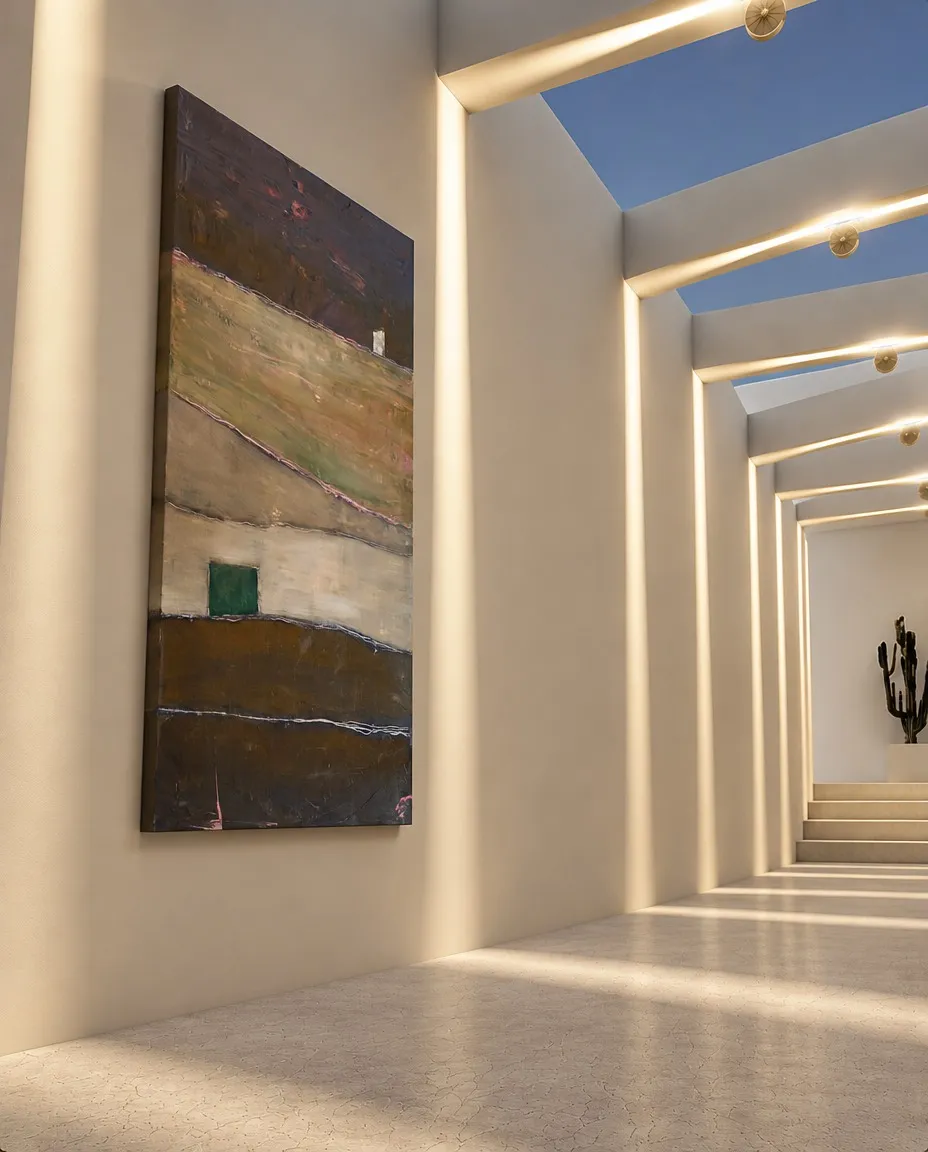
The upper section retains a dense darkness, not quite closed in: within it are reddish rubbings, small variations, matter that seems to have been pushed back and forth without deciding to disappear. Below, a lighter band begins to tilt the gaze. There is no stable point from which to look at it. The eye believes it has found ground and immediately discovers that this ground also shifts, that it has veins, abrasions, a kind of horizontal fatigue.
The thin lines—white at times, pink at others—cross these fields as though they had arrived too late to put something in order. They seem like edges, yet do not quite separate. They seem like seams, yet reveal that the join remains open. Up close, they would ask the body to move nearer until the image as a whole was almost lost; from a distance, they become little more than a vibration, a nervous indication that no band is entirely still.
Alvar Aalto enters this instability. He was an architect attentive to the ways a space can care for the body without stifling it. His first impulse would be to subject this surface to a simple, difficult test: where could someone remain without feeling cast out? The broad pale central zone offers a modest promise; it does not shelter, but it eases the pressure of the upper darkness. Below it, the green rectangle seems to demand weight, contact, a base. It is not large, but it alters the scale of everything: suddenly the bands might be walls that are too extensive, or layers of ground seen from an uncertain height, or even skin stretched over something that refuses to be named.
Aalto would seek a threshold in the lines. Perhaps one of those pale threads could carry the passage from one band to another, give the body an orientation, prevent the gaze from slipping towards the dark lower edge. But the painting does not cooperate. Each line that seems useful becomes tremulous; every edge that might contain opens into an escape. The green rectangle does not seem accommodated: it seems barely tolerated. Aalto would want to give it a place, a firmer wall behind it, a breathable distance from the darkness. Yet here, not every constructed form wishes to become a house.
I find myself before a surface that no longer entirely coincides with the intention that may once have brought me close to it. I look at the high white area and cannot treat it as an answer; I feel it interrupting the gaze before the gaze can grow comfortable. I move closer to the lines and discover that they, too, separate me from what I thought I saw. I would like one band to support the next, but the surface returns a distance to me: the painting does not end where its edge ends, and I cannot decide which part of that interruption belongs to me.
The small white shape above does not fall. It barely holds itself within the darkness, like a reserve of clean surface that never quite opens. If it were an opening, it would allow something to be crossed; but it offers no passage. If it were a stain, it would not possess the precision of a retained object. Aalto would measure its relation to the green: one seems distant not because of height but because of a lack of weight; the other is below, closer, yet without visible foundation. Between the two rectangles, the painting tests a particular gravity. It does not pull downward with certainty: it compels an uneasy floating.
Then a question arises, one a child might ask without asking permission of the gallery: why does the green rectangle not sink if the white line beneath it is broken? The question refuses to accept that a line is decorative. Nor does it grant the lower dark field the dignity of a base. From that moment on, the green can no longer be seen as a still presence. Its left edge is slightly uncertain, its density seems to gather against the surrounding air. Perhaps it is standing. Perhaps it has been falling so slowly for so long that falling has become its way of being.
Then Rabindranath Tagore arrives. He was a poet capable of listening to the world’s matter before demanding an explanation from it. Where Aalto detects a plane that ought to be made habitable, Tagore finds a pause that does not ask to be occupied. The high white area would be neither entrance nor exit, but a suspended breath within the dark. Yet this listening does not remain intact either. The pink lines do not easily become music: they are too rough, too close to a wound that does not seek to move us. They cross and break off; they seem to recall writing, though writing erased as it tries to take shape.
Tagore alters the test: perhaps the question is not where to place the body, but how much silence can exist between two zones that do not touch. Aalto, affected by that idea, begins to hear one of the pale lines as a verse that cannot find its ending. Tagore, in turn, tries to measure with his shoulders and breath the distance between the green and the dark lower edge. Neither obtains a satisfactory measure. The first discovers that a room without shelter has not necessarily failed; the second discovers that a pause can have weight, resistance and a kind of cold.
I cannot accept that the white is only air, because it returns a hardness I did not expect. Nor can I believe that the green rests: the longer I look at it, the more I feel my own gaze must support it. I disagree with the idea that silence makes it gentle; in this painting, silence also pushes. There is a pale zone in which I still recognise nothing, and that ignorance does not recede when I look away: it seems to remain before me, as if the painting had begun to look from there.
The child’s question changes form. It is no longer only about the broken line beneath the green. It concerns what kind of ground would allow a heavy form to remain without becoming fixed in place or sinking; what kind of sky would tolerate a white that does not illuminate, does not save, but simply cuts across. Aalto would offer thicknesses, edges capable of distributing a load. Tagore would offer intervals, the right of a thing not to explain its presence. But both instruments fail a little, and that failure opens a third perception: perhaps the rectangles are not within the fields; perhaps they are disruptions in the habit of asking fields to be recognisable.
The bands change again as the gaze moves downward. The central pale zone, previously almost calm, contains scratches and modulations that prevent it from being treated as rest. Below, the dark brown does not crush; it spreads with an opaque slowness. A fine line crosses it and reappears near the edge, as though it had found a route beneath the surface. It guarantees nothing. It is easy to imagine that it joins the parts; it is equally easy to see that it separates them more clearly.
Towards the end, QUIES sounds like a syllable held still before settling in the mouth. It may be stillness, a cut, a small resistance in the air. It does not need to be translated in order to act: it rests between the white rectangle and the line that cannot reach its conclusion, in the moment of silence where Aalto stops offering shelter and Tagore stops turning the pause into song. The word does not name the stability of the two rectangles; perhaps it names the effort not to fall entirely into an explanation.
When I return to the green, it is no longer possible to see it in isolation. Beneath its lower edge, the pale pink line seems only slightly more crooked than before, almost a thread left there carelessly. Yet now it trembles as though it bore an impossible part of the rectangle’s weight, and as though it might come loose at any moment without ever quite doing so.
- Original artwork
- QUIES
- Actual dimensions
- 31.5 × 47.2 in / 80 × 120 cm
- Presentation
- Digital contextual visualization
Context references
QUIES Maurizio Valch · vertical abstract painting for hallway · contemporary entryway wall art · dark abstract painting with earth tones · painting with strata and incised lines · minimalist vertical abstract art · contemporary painting for minimalist architecture · artwork from the STRATA series
About this visualization
This visualization places the artwork within an architectural context to help collectors and viewers imagine its presence in a real space. It is an interpretive reference, not an exact reproduction: the original work remains the sole authority for scale, color, surface and material presence.