Context study / QUIES
QUIES — Maurizio Valch | STRATA Abstract Painting
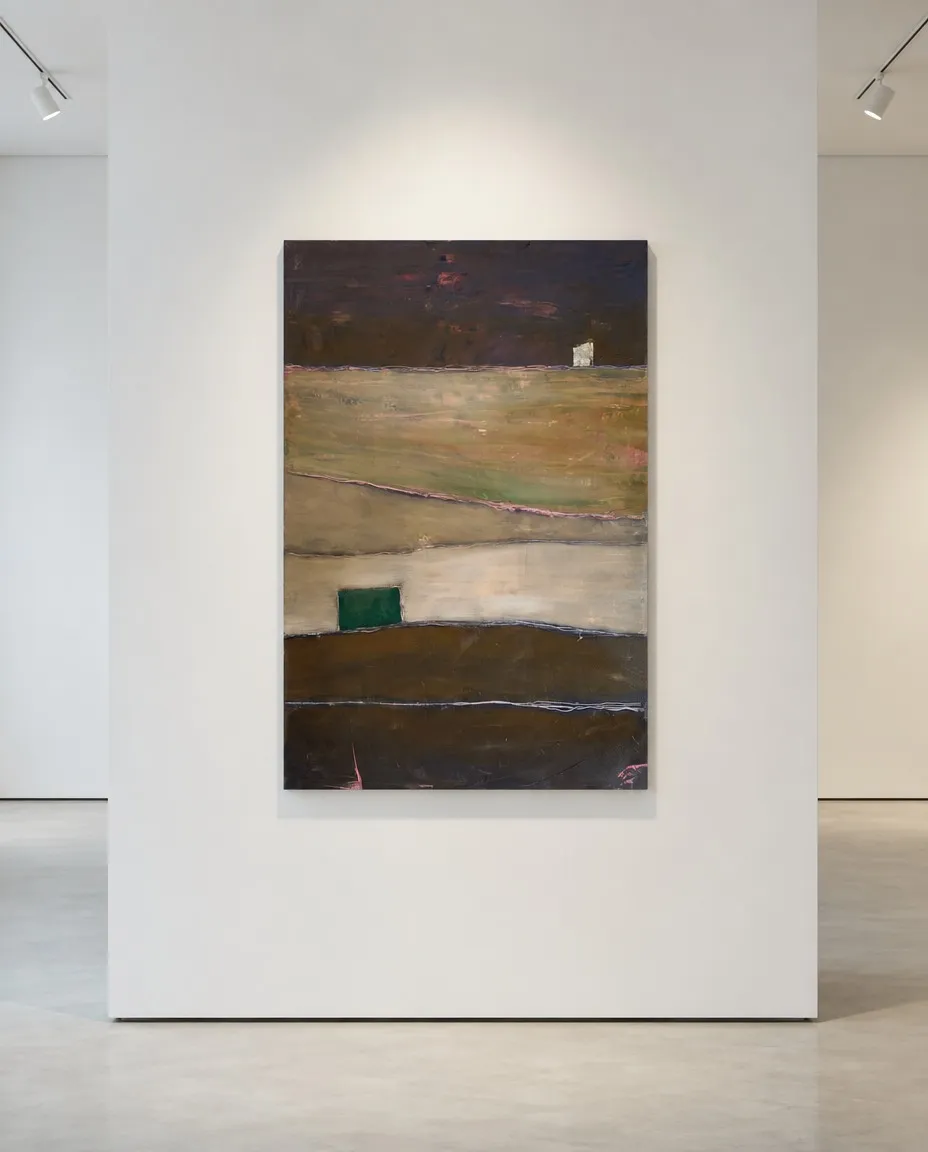
The composition stands vertically like an accumulation of terrains compressed against one another. Above, a dense, almost mineral darkness receives reddish, violet, and bluish glazes that do not succeed in dispersing it; they remain suspended within it like remnants of light held beneath a layer of soot. Below, the bands open out into greenish, ochre, and earthy expanses, muted by matter that seems to have been spread, removed, and covered again. Towards the lower centre, a pale, veiled zone appears, with a pallor that does not fully illuminate, before the dark masses at the base return the painting to a more enclosed weight. There are no clean divisions between these fields: there are incised marks, worked edges, cuts through the paint, and pale, irregular lines running horizontally across the surface, as though each stratum had retained an exposed seam. Two rectangles interrupt this continuity: one small and pale, shifted to the right in the upper band; the other dark green, lower and to the left, fixed against a pale zone. Their isolation matters more than their possible identity. They do not describe a recognisable place; they alter the scale of the bands and cause the space, until then extended, to begin measuring distances. QUIES: what kind of repose is this, if every boundary seems to retain the memory of friction?
I work by allowing the surface to build slowly, without deciding too soon what each zone should become. I apply a layer, cover it, reduce it, press it; sometimes I return to it with a glaze, and sometimes I need to cut or incise the edge so that it does not remain a comfortable transition. I am not seeking a geography, though I know certain colours and expanses may bring to mind ground, distance, or climate. I am more interested in the point at which a painting begins to organise itself as a territory without becoming a landscape. A line may appear because two masses cannot quite coexist, but I do not want that line to close them off: I need it to remain unstable, to seem like a separation and, at the same time, a zone where something is still happening. The two rectangles did not arrive to explain anything. I saw them as necessary presences within an expanse that was too continuous, small resistances to uniformity. I do not know whether they demarcate, signal, or simply carry weight differently. Looking at them, I discover that stillness may not consist in immobilising matter, but in leaving visible the pressures that have brought it to a stop.
The bands might be read as a historical excavation and also as an excavation of habit. G. I. Gurdjieff, a thinker attentive to the mechanical nature of human life and to the possibility of a more awakened attention, would make it possible to ask whether these horizontal divisions record gestures repeated until they lose their origin: a line drawn to guide a step, a band set apart to contain something, an edge maintained because it was already there before anyone could explain its necessity. The painting does not illustrate an early civilisation, but it allows a condition prior to settled law to emerge: the furrow is not yet a plot, demarcation is not yet an administrative border, enclosure is not yet architecture. The incised marks possess something of this precariousness. They seem to have been made to keep surfaces from becoming indifferent to one another, to force them to acknowledge a difference in temperature, density, or use. Yet the small pale form and the green block do not entirely obey the discipline of the bands. They are within the order, but remain oblique to it; they introduce the possibility of a minimal life that does not coincide with general repetition. A border might protect that life, lull it, orient it, or separate it too completely. In QUIES there is no answer: only the persistence of a structure that seems to precede those who might inhabit it and, at the same time, to depend on an attention that has not yet arrived.
I do not see a society, a ruin, or a map here, though I understand that the painting may approach those ideas. When I look at it from afar, I first see the weight of the upper part and the weight of the lower part, and between them an expanse that does not want to become absolute emptiness. The pale zone needed to breathe, but it could not become light; that is why I worked it until it retained some opacity, some resistance. The green block appeared as a more compact interruption, a presence that concentrated the gaze without claiming the centre. The pale form above arrived differently: more distant, almost held back by the darkness around it. I did not want to balance them as equivalent signs. I was interested in keeping them apart, in having each make the other’s distance felt. Stillness, for me, is not peace or clean silence. It is matter containing suspended movements: layers that have stopped without ceasing to push, edges that appear stable yet remain tense, colour that stays where it was deposited and nevertheless continues to alter what lies beside it. I paint so that this tension does not disappear behind an image that is too recognisable.
Returning to the lines that separate the layers, it becomes difficult to fix their condition: they may recall scars, coasts, faults, taut threads, old demarcations, or, with equal insistence, simple material incisions that have opened the painting from within. Their force lies in not allowing any one reading to become definitive. Each edge organises the field, but also reveals that every organisation depends on an interruption: something must be cut, displaced, or worn away for continuity to acquire thickness. Carl Gustav Jung, a psychiatrist who studied recurrent images and the deeper structures of the psyche, might lead one to seek a hidden centre, a concentrating form able to order the scattered zones. But the painting resists offering one. Perhaps its centre is neither the dark rectangle nor the small brightness above, but the interval between masses: that region where nothing quite happens, though everything remains arranged, measured, and held back. There the surface seems to rest without yielding itself; there divisions cease to be merely limits and become conditions of attention. QUIES remains as a stillness in which nothing appears to advance, yet no boundary is entirely at rest.
- Original artwork
- QUIES
- Actual dimensions
- 31.5 × 47.2 in / 80 × 120 cm
- Presentation
- Digital contextual visualization
Context references
QUIES Maurizio Valch · Maurizio Valch STRATA abstract painting · vertical abstract painting with strata · abstract art with incised lines · material painting in earth and green tones · abstract painting in an art gallery · vertical abstract painting for white wall · vertical-format contemporary abstract art
About this visualization
This visualization places the artwork within an architectural context to help collectors and viewers imagine its presence in a real space. It is an interpretive reference, not an exact reproduction: the original work remains the sole authority for scale, color, surface and material presence.