Context study / QUIES
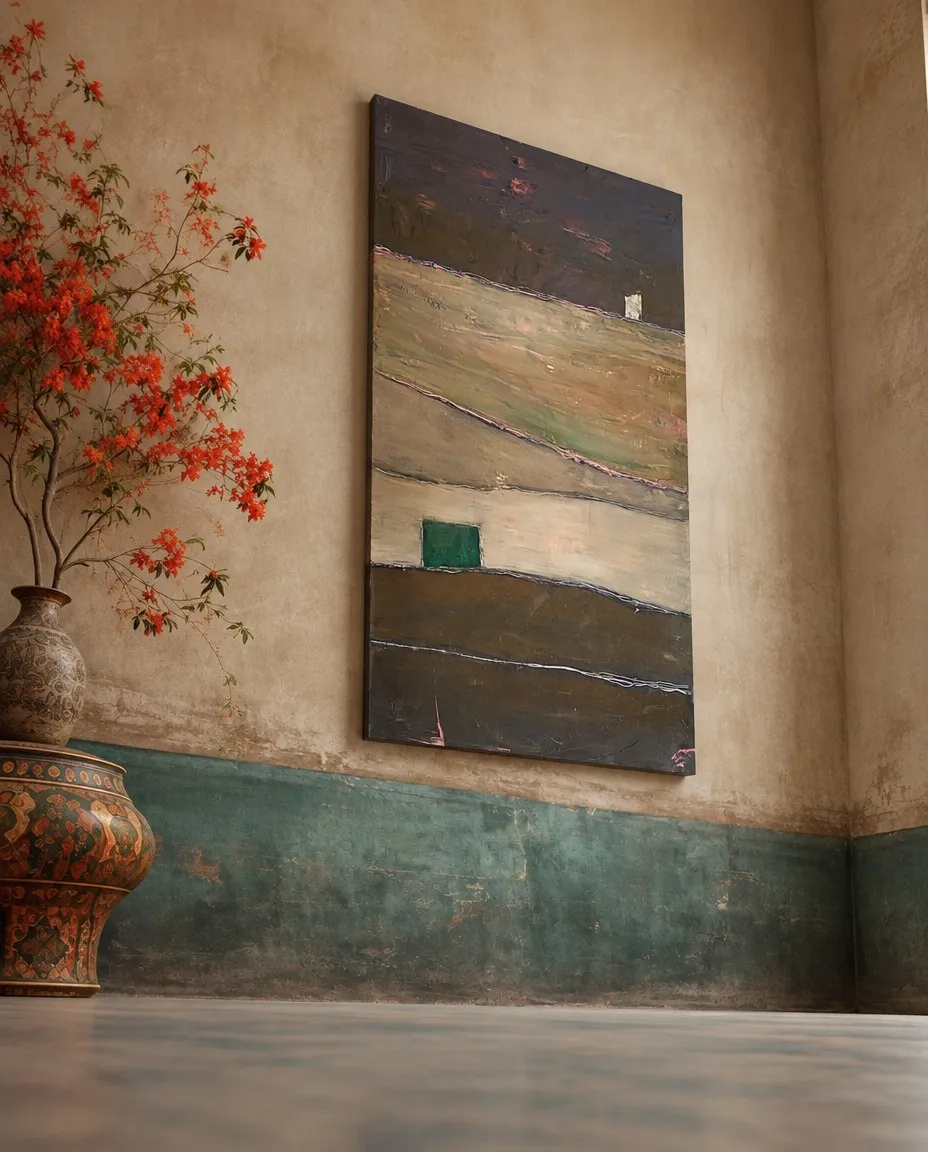
QUIES by Maurizio Valch in a textured-wall interior
QUIES is organised as a vertical field crossed by horizontal strata that never fully settle. In the upper section, a dark, almost black mass of dense, swept material dominates, beneath which muted earth tones, veiled greens, warm greys and areas of murky pallor emerge. The bands overlap without becoming clean stripes: their edges fray, gather paint, break off or tilt slightly. Several light, fine and irregular lines run through this arrangement as incisions across a surface that has already undergone displacement. At the centre, a pale band opens a broad distance, less assertive than suspended; lower down, toward the left, a small dark green block settles with a different density, while an isolated white form persists close to the upper right edge. Wonder appears here without expansive brilliance: it lies in the restraint of these presences, in their capacity to alter a vast territory without dominating it. The sense of exposure does not arise from total absence, but from the impossibility of finding a stable orientation among layers that seem to have been deposited and removed at once. And persistence does not amount to firmness: it can be seen in what remains despite erosion, abrasion and the uncertainty of boundaries.
I work so that a form does not become fixed as an object placed upon an immobile surface. I need it to appear as though it arrived late to the painting, after the field had already been covered, scraped, darkened and reopened. I do not seek to preserve an intact image; I try to make something remain while everything around it continues to move. When I extend a band, cover it with another layer, or allow the earlier colour to show through a crack, I think of a duration inseparable from its wear. I am interested in material having weight, but in that weight offering no guarantee of support. I can leave a light area amid earthy and dark tones without turning it into a place of rest; I can also sustain a small green form or a white patch without giving them a secure place. I want them to remain through insistence, not through protection. For me, painting must admit that every form is exposed to being absorbed, erased or displaced, and that for this very reason its persistence is never neutral.
The relation between the white presence above and the green block positioned lower down establishes a discreet yet decisive tension. The former appears small, narrow, almost attached to the boundary between the upper darkness and the earthy band that follows; its whiteness does not expand, but concentrates. The green block, by contrast, asserts itself within the pale central zone, though it does not occupy it: it remains surrounded by a greyish, veiled expanse that makes it vulnerable. Between the two lies a considerable distance, formed by layers of colour, oblique strokes, altered bands and lines that suggest separations without securing a direction. There is no guarantee of communication between the two forms. One seems to remain at the upper edge, the other near a lower threshold; one is almost a minimal signal, the other a compact yet reduced body. Wonder may arise from this lack of a secure bond: each presence seems alone, yet its very appearance changes the weight of everything else. The white makes the surrounding darkness denser; the green causes the pale band to cease being a mere pause and become a space of exposure. The painting offers no conclusive path between these two points, but an expanse crossed by the possibility that something might endure without joining what belongs to it.
I do not understand the light lines as contours that fully order what takes place. I make them appear as marks that cross the bands, sometimes continuous and sometimes broken, as though the painting had retained the trace of a pressure or a cut without retaining its cause. I do not want the surface to remain intact, because an intact surface can conceal its own fragility too well. I prefer edges to yield, layers to brush against one another, and separations to become visible without turning into firm boundaries. For me, exposure needs no drama: it lies in having no definitive ground, in not knowing whether a form truly belongs to the band in which it appears or is about to detach from it. Yet I do not abandon these forms to disappearance. I leave them in relation to the strata, the cracks and the shifts in density, so that they can remain in another way. I remain attentive to that moment when a line barely sustains a difference, when an edge does not protect but still prevents everything from becoming confused.
Thus, the work does not present itself as a recognisable landscape or as a system of signs to be resolved, although the succession of bands may suggest ground, distance, horizon or sediment. What matters is the way each stratum preserves the trace of an action while simultaneously losing definition beneath the next. The incised lines separate, but also connect; the pale band opens space, but offers no refuge; the green block and the white form persist, although their positions grant them no command over the whole. Within this economy of material, colour and displacement, wonder, exposure and persistence cease to be isolated names. Wonder is contained in a minimal white or in the obstinacy of a dark green; exposure becomes the condition of remaining without assured ground; persistence takes the form of fragile, eroded matter, barely sustained by the edges that cross it. QUIES holds these forces in suspension: it does not reconcile them, but allows something to remain between separation and presence.
- Original artwork
- QUIES
- Actual dimensions
- 31.5 × 47.2 in / 80 × 120 cm
- Presentation
- Digital contextual visualization
Context references
vertical abstract painting in living room · abstract painting on beige wall · contemporary art for earth-toned interior · abstract art mockup with vase · wall decor with vertical abstract painting
About this visualization
This visualization places the artwork within an architectural context to help collectors and viewers imagine its presence in a real space. It is an interpretive reference, not an exact reproduction: the original work remains the sole authority for scale, color, surface and material presence.