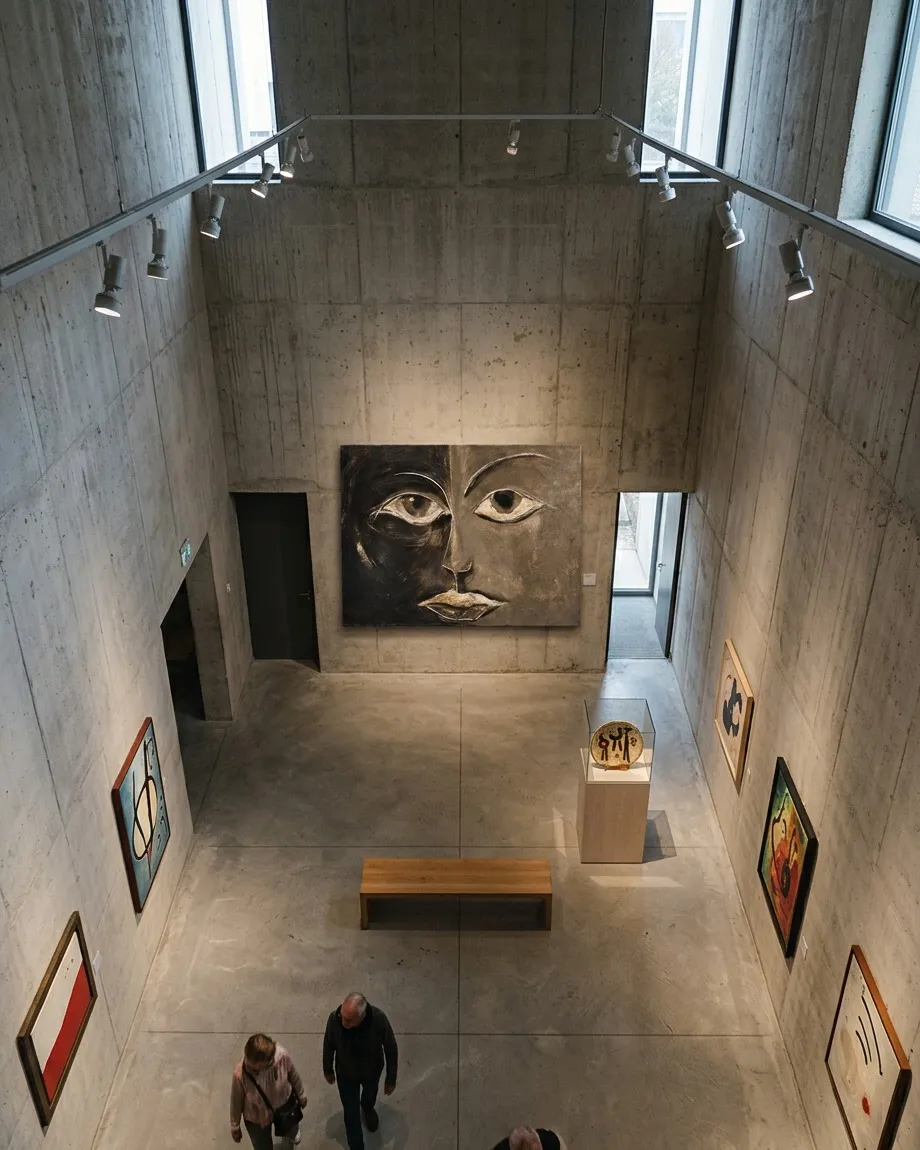
Context study / La mitad de la mirada
La mitad de la mirada - Maurizio Valch | FACIES Series
In La mitad de la mirada, the ninety-by-one-hundred-and-ten-centimeter canvas becomes a threshold where the human representation is cleaved by an implacable vertical axis. On the left half, a dense and nocturnal darkness expands through concentric and impasto brushstrokes that record the physical weight of the pictorial matter. On the right half, the surface is resolved in a flat and severe earthy ochre tone, evoking the texture of stone eroded by wind or leather weathered by the elements. This sharp division of the face establishes a dialectical tension between the visible and the hidden, in close dialogue with the thought of Carl Gustav Jung, whose development of analytical psychology allows us to understand the work as the representation of the struggle between the Persona—the socially constructed mask—and the Shadow—the repressed, formless, and chaotic layer underlying the psyche. The painting does not seek to resolve this duality, but to force the coexistence of both states within the same bone structure, where the flatness of the ochre contains the turbulence of the black.
When facing the canvas in the FACIES series, I do not seek to reproduce the features of a specific subject or elaborate a psychology of portraiture, but to execute a material excavation on the support. The decisive act in my studio occurs when scraping the fresh surface, opening furrows with sharp, white incised marks that penetrate the material to reveal the underlying layers. These lines are not traditional drawing elements; they are physical cuts, cartographic scars that outline the contour of bulging eyes and a cracked mouth, fixing a presence that seems to pre-exist the painting itself. By intervening in the paint in this way, the face emerges not as a figurative invention of modernity, but as a mineral vestige springing from the territory itself, similar to a paleolithic mark engraved in cave stone that resists weathering and claims its right to permanence.
This disproportionate gaze, traced through incised lines that expose the raw white of the support, directly questions the observer about the automatic nature of their own perception. Upon contemplating these fixed, disproportionate eyes, an inevitable friction arises with the ideas of G. I. Gurdjieff, an influential thinker who posited that the ordinary human being lives in a state of waking sleep and constant mechanicalness; under this premise, the fragmented gaze of the work acts as the flash of a divided consciousness trying to remember itself amidst its own lethargy. To this diagnosis of alienation is added the counterpoint of Osho, an Indian philosopher who advocated for the integration of spontaneity and the acceptance of one's own inner nature against the repressive impositions of the external order. From this perspective, the dark half of the face ceases to be a threat, revealing itself as the true repressed vital force, which the social apparatus tries to domesticate and petrify under the motionless, ochre, and apparently ordered surface of the other half.
My stay on the Andalusian coast, under the relentless light and mineral rigor of Nerja, deeply transformed my relationship with matter, allowing the dryness of that limestone land to penetrate my color palette. In this face breathes the formal heritage of the ancient peoples of the Mediterranean, the hieratic quality of Iberian sculptures and the solemnity of Etruscan masks—civilizations that understood the effigy as a threshold of passage between the living and the inert. In painting La mitad de la mirada, I embrace the suspicion that individual identity is never a single compact piece, but a fractured territory, a prehistoric ruin that, paradoxically, functions as a mirror of the fragmentations of our own time. What remains on the canvas is the testimony of that dryness, a face that breaks to show that to exist is to sustain the fissures of our own history.
The materiality of the work culminates in the detailed observation of its edges, where the cracked mouth, defined by the sharp boundaries of the incision, seems to contain an ancestral silence. The vibration emanating from the boundary where the flat ochre and the impasto black meet makes it clear that the canvas does not seek to reconcile the two halves, but to keep the tension of their separation alive. Approaching this surface does not lead to the resolution of a visual enigma, but to a confrontation with a void that returns the question to us. In the end, to contemplate "La mitad de la mirada" is to accept the challenge of holding the gaze of a silent idol, forcing us to indefinitely inhabit the rift that separates what we show in the light from what we keep silent in the shadow.
- Original artwork
- La mitad de la mirada
- Actual dimensions
- 35.4 × 43.3 in / 90 × 110 cm
- Presentation
- Digital contextual visualization
Context references
divided face abstract painting · archaic Mediterranean mask painting · abstract face art Maurizio Valch · textured ochre and black oil painting · minimalist brutalist face wall art
About this visualization
This visualization places the artwork within an architectural context to help collectors and viewers imagine its presence in a real space. It is an interpretive reference, not an exact reproduction: the original work remains the sole authority for scale, color, surface and material presence.