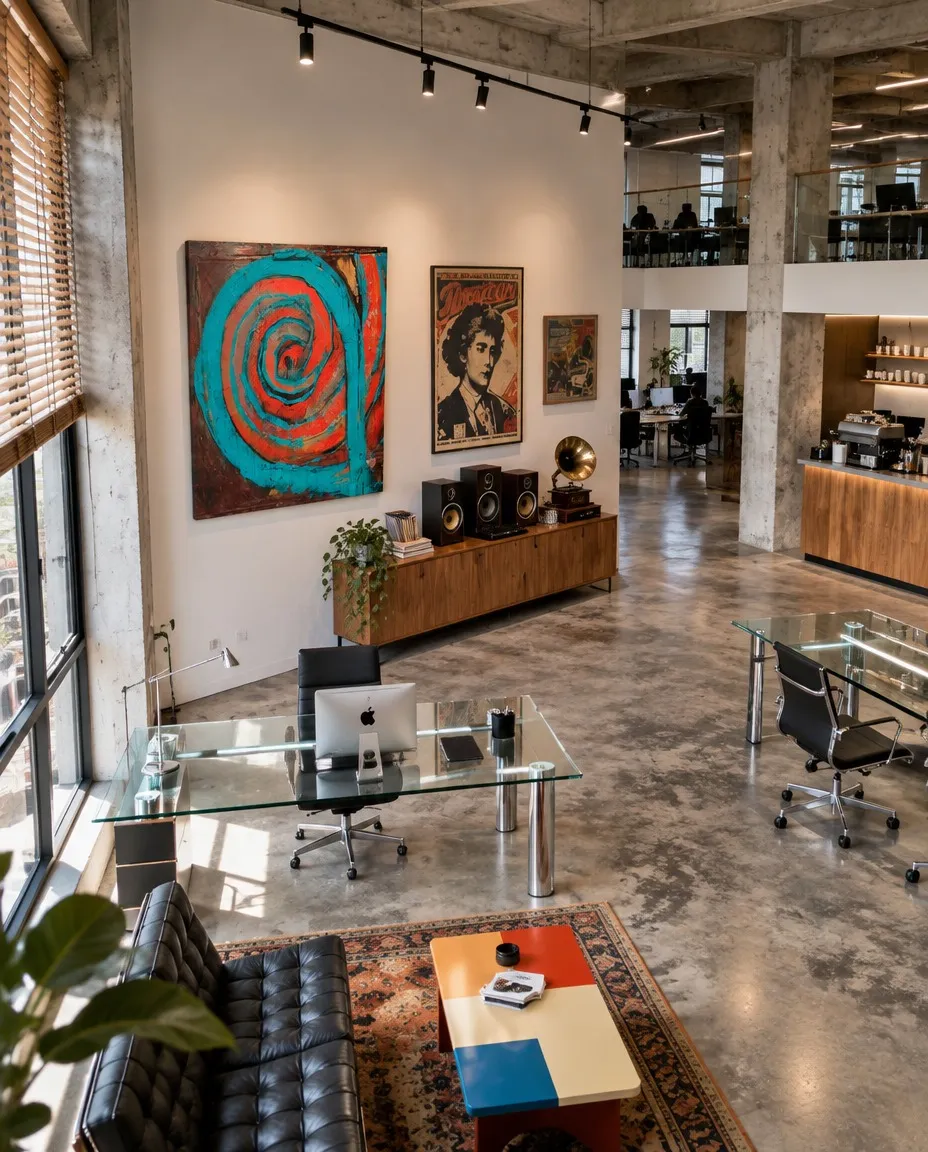
Context study / HAUSTUS
HAUSTUS by Maurizio Valch – Abstract Painting from the VORTEX Series
Step back for a moment from the need to understand. Look first at how the turquoise falls from above and does not finish falling: it curves, thickens, approaches the whirlpool without surrendering to it. It seems to have arrived before the eyes and to have laid out a route. The gaze follows it almost out of obedience, goes down its side, skirts the narrow red, black, earthy passage, and looks for a straight exit. It does not find one. The body slightly leans its chest forward, as if the painting had reduced the available air.
At first, that strip might seem like a protection: something large holding back the violence of the inner turns, a current preventing the whirlpool from spilling over, a creature covering the most vulnerable spot with its back. But the more one looks, the less its size reassures. It does not surround from afar; it invades. It touches the edge of the spin, interrupts it, forces it to bend back on itself. The red does not open up like a field: it remains compressed between turns, scraped by proximity, held in a core that seems to breathe at intervals.
Then a childhood question appears, too precise to fade away: why doesn't that large turquoise spill out of the painting, and why does the small hole in the center seem hungrier than it? There is no need to answer it. It is enough to notice that the center is not still. While the eyes trace the circle, it closes again; while the turquoise strip promises to lead, the nucleus seems to ask for something else: not an exit, perhaps, but space to avoid being fully occupied.
I approach the center and discover that I can no longer assure that the paint obeys an intention I had before seeing it this way. I feel that my hand, my gaze, and the pulse of the surface have separated and are still searching for one another. I do not master that excess; I barely recognize the resistance it returns to me. I look at the turquoise curve and do not know if I followed it or if it led me to a place it did not want to show me.
The presence of Berta Cáceres matters here because she knew that protecting a life also requires asking who controls the course of what sustains it. Before this painting, the turquoise strip ceases to be a color available for calmness. If it were a living current, who would have decided that it must flow down there? Who can approach it, touch it, divert it, cross it? And above all: what happens to the whirlpool when an immense force claims to be caring for it while surrounding it?
The question alters the scale of the painting. The center is no longer just an intimate zone; it seems like fenced territory, a breath whose circulation has been administered from the outside. The great curve could be a defense against what threatens from the edges, but it could also be the threat taking the form of a defense. A waterway can feed; it can also flood. A containment can sustain; it can also freeze what it claims to protect. Under that pressure, red does not mean passion, nor does black mean closure: they are zones that have not yet found a way to expand without being absorbed.
Mario Alonso Puig matters here because he attends to the way fear and attention change what the body believes it is seeing. His intervention does not ask to diagnose the painting, but to test it. He follows the spiral with his eyes without escaping immediately to the edge. The chest responds before words: there is a moment when the center seems too close, too narrow, and the breath is held as if entering there required permission. Afterwards, the turquoise reappears and the gaze is relieved for a second. But that relief is not clean: the very strip that offers direction is the one that prevents crossing the field freely.
Berta interrupts that drift inward. Not every fence is resolved by learning to breathe better inside it. There are protections that are imposed, routes that are privatized, waters that are channeled without asking those who live beside them. Mario, in turn, discovers that this defense is not a metaphor external to the body: a threatened territory alters shoulders, sleep, attention, distance between people, the way of holding the air. Neither manages to have the last word. Between the two, HAUSTUS becomes a body-territory that does not accept being saved at the cost of remaining fixed, nor being interpreted as an inner conflict while the current surrounding it decides for it.
I cannot call everything that covers me a shelter, because I also feel how a covering can weigh upon me. I cannot call every curve that limits my step a prison, because I also find in some curves the only way to avoid dispersing myself. I look at the exit and do not know if I wish to open it or if I fear that, by opening it, I will lose the pressure that keeps something alive in me. I remain before this doubt because I still do not know the place from which the painting breathes.
Go back now to the center, but not as one who looks at a background. The small nucleus seems to step forward, almost touching the surface from this side, while the turquoise curve stops looking like an edge and begins to lean toward it, as if it were learning, without yet succeeding, the rhythm of another's breath.
- Original artwork
- HAUSTUS
- Actual dimensions
- 82.7 × 82.7 in / 210 × 210 cm
- Presentation
- Digital contextual visualization
Context references
turquoise and red abstract painting · contemporary abstract painting large format · abstract spiral on canvas · paintings for modern offices · wall art for industrial living room · maurizio valch haustus
About this visualization
This visualization places the artwork within an architectural context to help collectors and viewers imagine its presence in a real space. It is an interpretive reference, not an exact reproduction: the original work remains the sole authority for scale, color, surface and material presence.