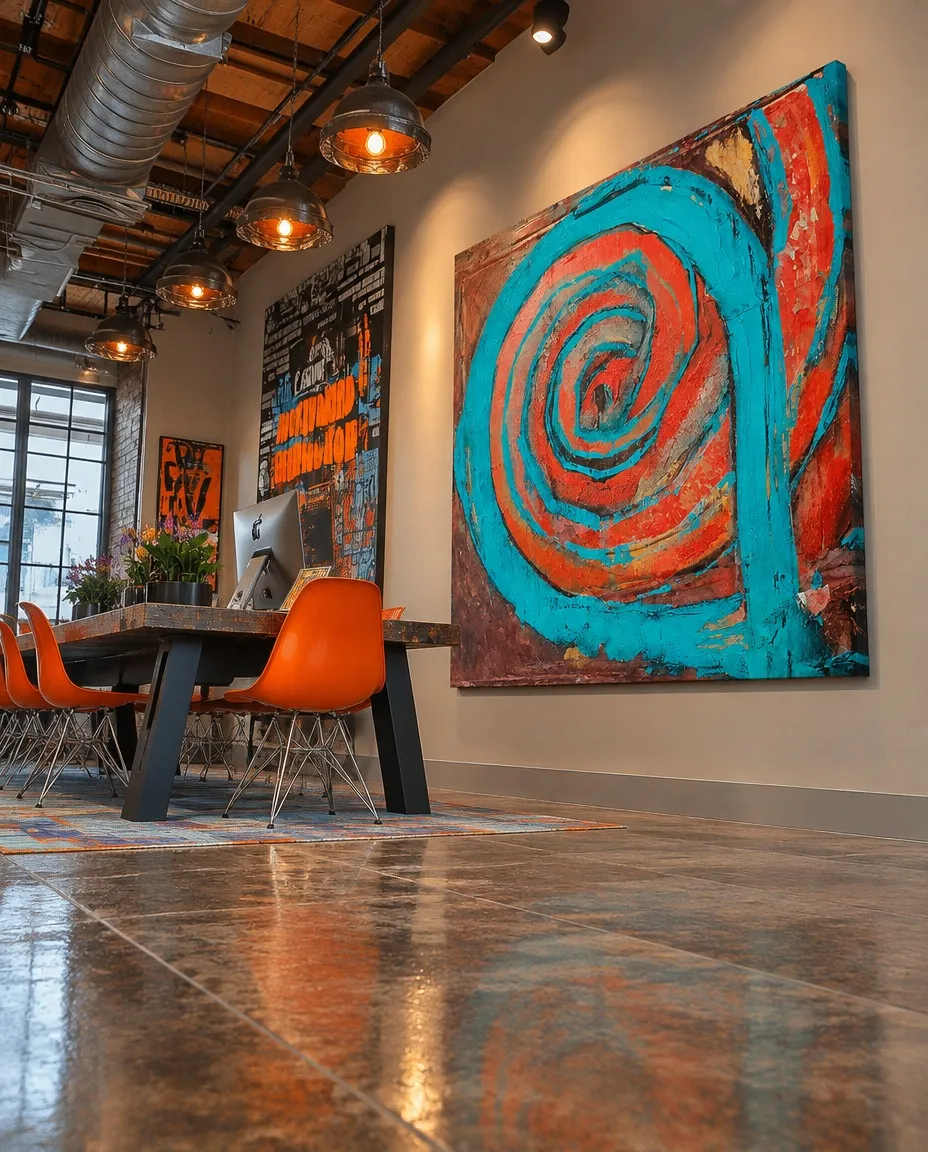
Context study / HAUSTUS
Abstract Artwork HAUSTUS by Maurizio Valch in Creative Office
The monumental scale of HAUSTUS (210 x 210 x 3 cm) imposes an immediate physical confrontation, where the surface of the canvas ceases to act as a mere support to become a brutalist relief of geological texture. The dense impasto of acrylic and oil accumulates in material ridges and valleys that catch the gallery light, fostering an eminently tactile experience. In this territory, the violent contrast between the concentrated turquoise blue and the fiery red-orange is not resolved in harmony, but in a latent chromatic friction on a background of dark, earthy browns. This embodied vortex does not function as a geometric ornament; rather, it evokes the deep memory of archaic Europe, recalling the circular Neolithic petroglyphs of Newgrange or the movement of water eroding and swirling in the depths of the Nerja caves. The canvas here is the stage of an archaeological excavation where color has been sedimented and eroded with physical violence.
When confronting this large-scale support, I do not seek to illustrate an idea, but to register the very resistance of the matter under the push of my hands. The oil and acrylic demand a hand-to-hand combat; the palette knife does not slide smoothly, but produces a rough friction, a metallic scraping sound as it drags the dense layers of pigment across the fabric. In this process, color loses its two-dimensional status to transform into a deep furrow, an open wound in the pictorial mass. Each mark incised in the spiral is not a line delimiting a contour, but an excavated channel, a drain where the paint accumulates and moves under almost tectonic pressure. The physical gesture of piercing the surface seeks to reveal what lies beneath, letting the lower layers of color emerge as witnesses of a time accumulated on the canvas.
This fierce rotation opens a space of insurmountable intellectual tension between order and dissolution. On one hand, Carl Gustav Jung, the psychiatrist who analyzed concentric diagrams as manifestations of psychic order, would see in this circular design a primal mandala attempting to structure the surrounding chaos and redirect consciousness toward the Self. However, this integrating search is sabotaged by the centripetal force of the painting, which evokes the perspective of Georges Bataille, the philosopher who proposed the notion of a low materialism devoid of elevated aspirations; from this viewpoint, the core of the canvas is an orifice of pure material abjection, a sinkhole that devours all intellectual pretense to return us to the raw reality of the earth and wet paint. Added to this dispute is the warning of George Gurdjieff, the thinker who analyzed the dynamics of human automation: one might wonder if this spiral represents the closed, uninterrupted circuit of our own sleepwalking existence, or if it constitutes the point of violent friction where the viewer is forced to spin in the opposite direction to awaken from daily lethargy.
The title HAUSTUS functions for me as a conceptual axis that defines the behavior of the painting in the space it occupies. I do not understand this painting as a passive window, but as a threshold that extracts, swallows, and pours the energy of the environment, absorbing the light and silence of the room to return them charged with a mineral density. I firmly distance myself from simplistic spiritual interpretations or complacent esotericism; I do not intend to build a portal to another reality. My interest lies in the physical presence of the work, in its autonomy as a firm, rugged ground that remains there, vibrating with its own internal logic, untouched by the need to be deciphered by external discourses.
Observing the overall composition of HAUSTUS, it becomes evident how the perfect rotation of the vortex is abruptly interrupted on its right flank. A heavy vertical block of turquoise color cuts the circular inertia, functioning as a structural limit, a seam, or a brutalist column that stops the centripetal suction and anchors the image to the real plane of the wall. This formal containment prevents the whirlwind from dissolving in its own dynamism, forcing the eye to fluctuate between the infinite spin of the center and the rigidity of this vertical boundary. Before this violent encounter of forces that cancel each other out, are we facing a flow of matter seeking to free itself from its physical limits, or a stone container designed to hold back a torrent that threatens to overflow the habitable space?
- Original artwork
- HAUSTUS
- Actual dimensions
- 82.7 × 82.7 in / 210 × 210 cm
- Presentation
- Digital contextual visualization
Context references
large format paintings for offices · creative office decor · contemporary turquoise abstract art · Maurizio Valch HAUSTUS · orange chairs office decor
About this visualization
This visualization places the artwork within an architectural context to help collectors and viewers imagine its presence in a real space. It is an interpretive reference, not an exact reproduction: the original work remains the sole authority for scale, color, surface and material presence.