Context study / HAUSTUS
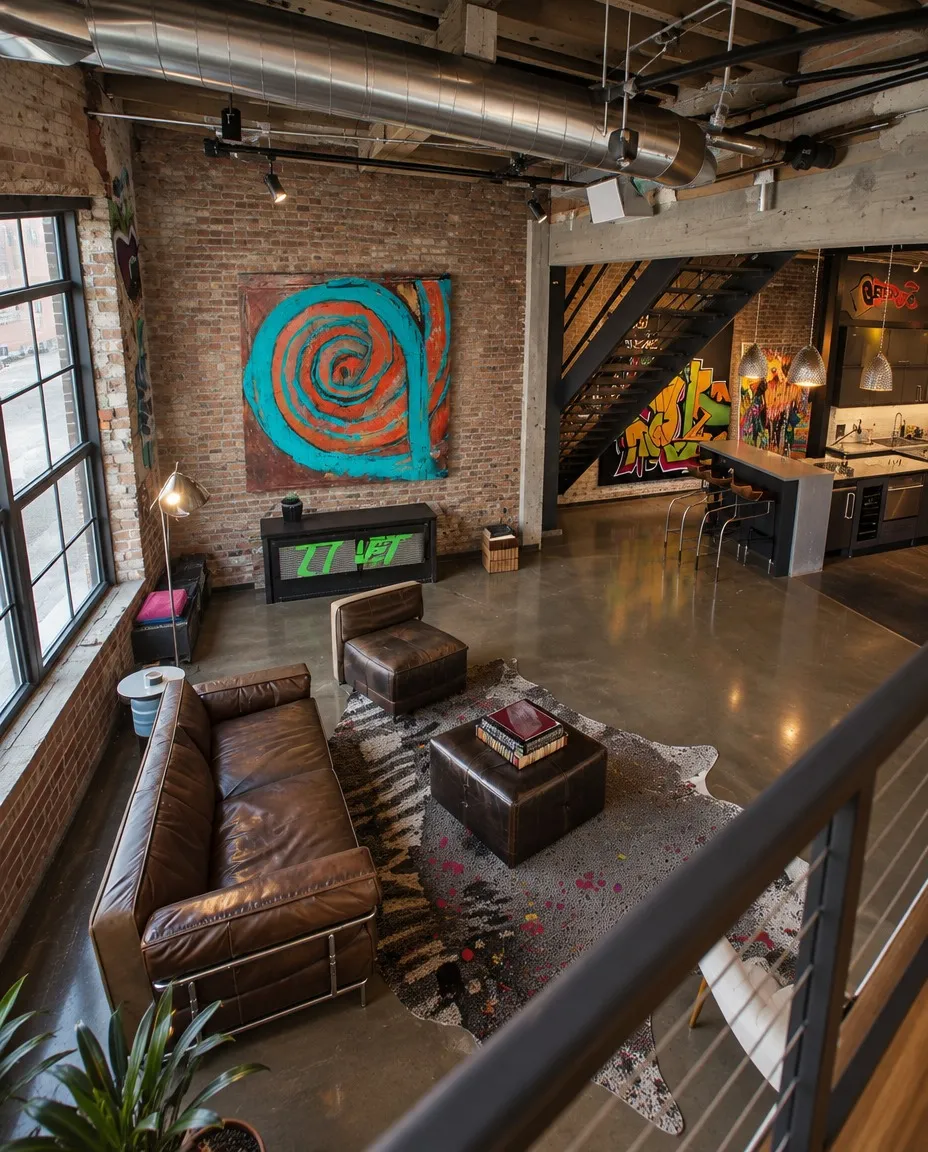
Large Abstract Painting HAUSTUS by Maurizio Valch in Loft Living Room
Confronting the monumental scale of HAUSTUS implies undergoing a direct physical confrontation with a quadrangular plane of 210 x 210 centimeters that cancels the observer's peripheral vision. On its surface, a violent yet contained spiral of brilliant turquoise oil and acrylic dominates the composition, exerting a centripetal force that seems to suck the surrounding air and space toward its own nucleus. This chromatic spin, with dense, rough impastos, sits in an almost geological manner on a background of crimson and dull brown oil. This earthy, incandescent base radiates a dull heat, a latent chromatic temperature that contrasts with the electric coldness of the blue. The pictorial matter is not offered smooth or uniform; on the contrary, its rugged relief, the lumpy accumulations of pigment on the edges of the palette knife, and the visible accidents of scraping demand an attitude of visual listening from the viewer. It is not about deciphering a code, but about pausing before the topography of the canvas, perceiving the material accumulation as the record of a physical and relentless pulse that still vibrates on the plane.
When I confronted this support of two meters per side, I knew that the scale demanded an absolute bodily involvement, a combat where the square format became an insurmountable limit. The circular, enveloping gesture with which I traced the spiral was a deliberate act of abandonment for me; I needed to detach myself from the analytical rigidity of straight lines, grids, and geometric trenches that had structured my previous works. I remember with precision the thermal density of the crimson oil accumulating under the palette knife, that dense, pasty heat that stubbornly resisted drying, challenging the studio's timing. Guiding the turquoise stroke over that wet mass was not the result of cold planning, but of constant listening to the actual resistance of the support and the pictorial matter itself. Every advanced centimeter required calibrating the pressure of my arm, responding immediately to the slips, sudden stops, and friction of pigment that refused to be domesticated, allowing the paint to dictate its own course.
From an analytical standpoint, the compositional tension of the work lies in the unresolved conflict between the rotational dynamism of the spiral and the presence of a thick vertical strip of turquoise color located on the right margin of the canvas. This column acts as a threshold or a tactile shore that halts the inertia of the spin, preventing the centripetal force from escaping the painting or dissolving entirely. It is in this violent formal interruption where the concept of abandonment is most radically embodied: the painting renounces the perfect, predictable symmetry of rotational movement to surrender to gravity, overflow, and material accident at the points of contact. The chromatic contrast between the cool tones of turquoise and the warm tones of the crimson background ceases to be a mere decorative resource and becomes a regulator of the work's physical temperature. At this boundary, the mineral stillness of the column and the vibration of the spiral coexist in an unstable equilibrium, forcing the eye to move from one end to the other in search of an order that the matter insists on sabotaging.
In titling this work HAUSTUS, I appealed to the etymology of the word: the physical act of drinking, swallowing, or taking a deep breath of air. The nucleus of the spiral functions precisely in this way: it is a dense, magnetic void that seems to absorb the sound of the studio itself, a point of suction where matter collapses. Painting that center demanded a radical exercise of abandonment of my own will as a creator; I had to silence the mind and allow the body to act from pure tactile immediacy, taking the risk of irreversible error on the large surface. Ultimately, I understand the canvas not as a representation, but as a physical device for listening to the absolute silence that ensues when the agitation and noise of collective thought dissolve in the friction of materials: in that persistent heat of the red background and in the cold, almost geological incision of the blue cutting through the surface.
In its spatial resolution, HAUSTUS does not behave as an illusionistic window nor as a projection of psychological states; it imposes itself on the wall as an autonomous three-dimensional object, a monolith that breathes with its own weight and alters the room's acoustics. The constant friction between the latent heat of the deep crimson and the seismicity of the turquoise generates a zone of somatic resonance that directly impacts the viewer's body. Before this monumental canvas, the possibility of a purely discursive reading is canceled; the viewer is invited to inhabit the territory of painting stripped of narrative demands. To achieve this, it is necessary to operate an abandonment of analytical haste, renouncing the desire to classify or conceptualize immediately to instead surrender to a purely tactile and sensory listening of a surface that remembers its own strata, cuts off abruptly, and remains open to space.
- Original artwork
- HAUSTUS
- Actual dimensions
- 82.7 × 82.7 in / 210 × 210 cm
- Presentation
- Digital contextual visualization
Context references
decorate industrial living room large painting · giant paintings for loft · abstract art rustic living room · Maurizio Valch HAUSTUS · turquoise and crimson spiral
About this visualization
This visualization places the artwork within an architectural context to help collectors and viewers imagine its presence in a real space. It is an interpretive reference, not an exact reproduction: the original work remains the sole authority for scale, color, surface and material presence.