Context study / HAUSTUS
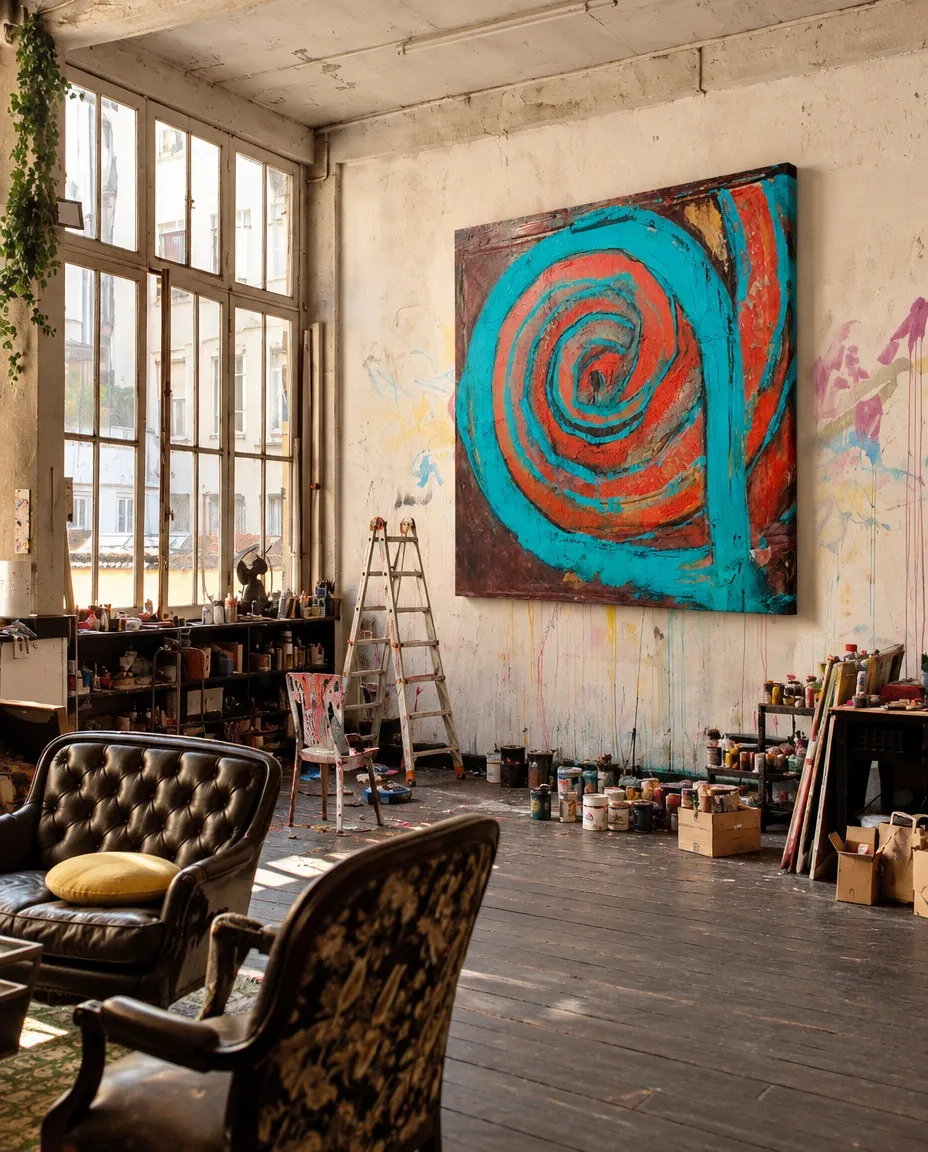
HAUSTUS by Maurizio Valch - Original Artwork in the Studio
Manual for Breathing Inside a Spiral That Does Not Turn
One enters through the edge, where the turquoise does not seem like a color but a thing that has acquired weight. It advances like a wide, irregular band, loaded with cuts, crusts, reddish interruptions, and areas where the surface seems to have held a pressure for too long. It does not simply encircle the 210-centimeter square: it occupies it like a conduit that has grown without knowing it had to respect the limits of a wall.
At first, it may seem like a recognizable gesture: a spiral. But it takes only a few seconds for the word to begin to fail. The curve does not maintain a regular distance from itself. It narrows, thickens, breaks; it encounters gray, brown, oxidized zones, and instead of pulling away, it drags them along. There are stretches where the turquoise looks like a very thick rope; in others, an open wall; in others, the edge of something that should not have an edge.
A young girl might ask: what if the turquoise is tired of carrying us inward and that is why it has lain down on the red?
There is no need to answer just yet. The question is just the right size for this painting: small, but difficult to get out of one's head.
Follow the turquoise band with your eyes without lifting them from it. Do not look for the center. Do not try to understand the overall shape. Walk through this corridor of color as if the body had to pass through there sideways, brushing against the cracks. Let the curve decide where to advance. At some point, a slight dizziness will appear: the feeling that the gaze is being bent, returned, forced to pass once more through a place it had already crossed.
Then something strange happens. The journey does not lead cleanly inward. Every curve that seems to bring us closer to the center also pushes outward. The spiral absorbs and expels at the same time. One desires to touch this visual thickness, to check if the band is warm, if it offers resistance, if its roughness scrapes. But there is also the need to step back: not out of fear of a threatening image, but because the eye begins to feel enclosed in its own insistence.
I stand before the finished work and cannot manage to see it as something that has remained still. I recognize it by its body, by its wounds of color, but I also feel it moving away from any decision that might have led it here. I look at it and it seems to have found a direction of its own, a direction that does not entirely include me.
The surface does not deliver a stable depth. The red appears amidst the turquoise, not as an obedient background but as a material that insists on showing through. There is a dull, earthy red, almost covered by glazes of shadow; there are areas that seem brushed by a dirty gray; there is a central dark space that does not open exactly like a hole nor close like a stain. In the cavity, something tiny is glimpsed: a folded figure? A crack that watches? The point where the spiral stopped wanting to explain itself?
The painting is of sufficient scale for the spiral to stop being a drawing. In front of it, the body cannot master it at a glance. It behaves more like a room with no visible door. The square, so precise in its measurements, contains a shape that rejects the discipline of the square. Circle, cut, spill: each attempts to order the others and fails.
Antoni Gaudí was an architect capable of imagining living structures, curves, weight, and growth.
Upon approaching this turquoise band, his attention would not seek an emblem but a load. He would want to know where that curve rests, what secret column sustains its progress, how such a wide mass can bend without falling. He would read in it an impossible architecture: a vault that curves over itself, a staircase that rises as it crumbles, a passage that seems built by gravity and against it.
But the painting withdraws the ground. Here there is no habitable building. There is no interior that can be entered without becoming part of the transit. The turquoise band promises a circulation and immediately denies it: it becomes too thick to be a corridor, too broken to be a wall, too bodily to be a structure. What seemed to sustain the space begins to swallow it. Gaudí discovers that this curve does not raise a house: it sinks the gaze into a matter that has decided to breathe alone.
Heraclitus was a thinker who observed continuous change and suspected that nothing remains identical to itself.
He does not easily accept Gaudí's trust in the curve. He sees that the spiral forces the eye to move, but the surface does not move. It preserves a fire without a flame: red held back, turquoise stopped in full torsion, shadows that seem to have arrived too late to become night. The current is motionless. The transformation has been compressed until it becomes skin.
Where Gaudí still seeks the intelligence of a structure, Heraclitus finds a suspicion: perhaps no curve sustains anything; perhaps it only postpones the fall. If the band seems alive, it is not because it grows but because it does not finish settling before the gaze. Every time one attempts to remember its path, a part of it changes place. Not in the painting, but in the person looking at it.
Gaudí insists: something must bear that weight.
Heraclitus answers without answering: the weight also changes when looked at too much.
Between the two lies a less comfortable third possibility. It is not a construction or a flow, but a place where the gaze acquires thickness. The eye enters, gets stuck, retraces its steps. The material seems to breathe because it forces a different breathing: shorter near the cavity, wider when returning toward the edges. The painting does not represent a whirlpool; it turns attention into a whirlpool.
I do not know what the center keeps, and I do not need to pretend that I do. I believed for a moment that the entire work led toward that darkness, but now the darkness seems to be working in another direction: it disorients, returns, lets each turn arrive with less certainty than the last. Perhaps the painting does not want to lead anyone; perhaps it only wants to prevent one from leaving intact.
The girl's question reappears, but it has changed. It no longer matters if the turquoise is tired of carrying us inward. Perhaps it is tired of being a path. Perhaps that is why it spills over the red, covering it without hiding it, letting it breathe through the fissures. Just as when one tries to untangle a headphone cord and each tug produces a new knot, following the spiral promises clarity and delivers more entanglement. There is something almost tender about this obstinacy: an enormous shape unable to decide whether to embrace, squeeze, or let escape.
La cavidad central continúa allí, sin convertirse en respuesta. Parece más pequeña después de recorrer el borde; luego vuelve a crecer cuando la mirada se acerca. No hay que conquistarla. Su oscuridad no es un final, ni una boca, ni una semilla, ni una amenaza correctamente nombrable. Es el punto en que la pintura se reserva el derecho de no colaborar.
The return does not happen along the same path. Now the turquoise no longer functions as a guide, but as a residue of all the turns taken. In the lateral areas, where it seemed simply to define the movement, small overflows appear: reddish fragments caught under its path, darkened areas that make it seem heavier, edges that do not advance but accumulate.
And below, almost toward one of the sides, the turquoise does not curve with the same authority as at the beginning. It thickens, breaks, seems to run out of space, and barely overflows onto the shadow surrounding it. There one notices something that was not there upon entering: not all of the spiral is leading us toward its center. A part of it has spent a while trying to escape through the edge.
- Original artwork
- HAUSTUS
- Actual dimensions
- 82.7 × 82.7 in / 210 × 210 cm
- Presentation
- Digital contextual visualization
Context references
original artwork by maurizio valch · photos of paintings in art studios · textured expressionist painting · two-meter painting in studio · vortex series creation process
About this visualization
This visualization places the artwork within an architectural context to help collectors and viewers imagine its presence in a real space. It is an interpretive reference, not an exact reproduction: the original work remains the sole authority for scale, color, surface and material presence.