Context study / HAUSTUS
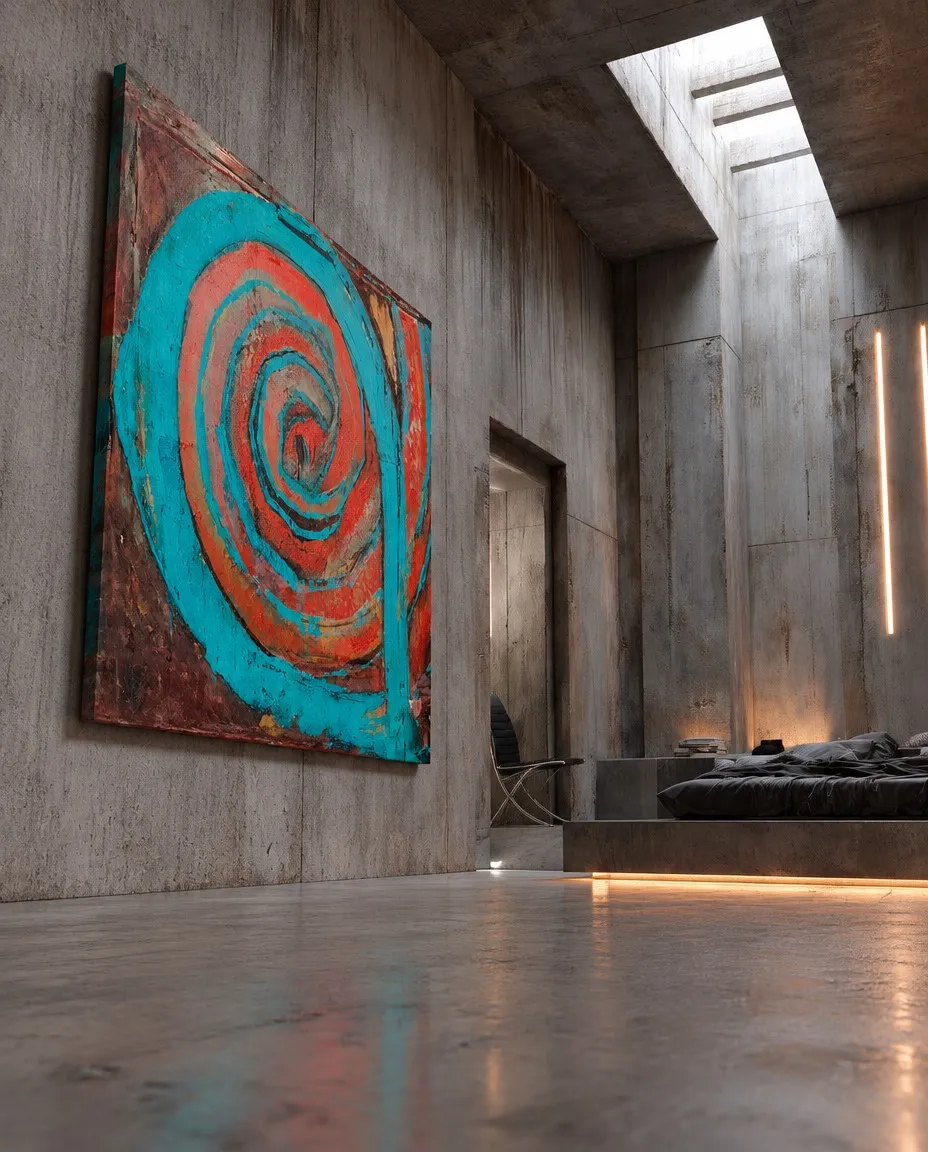
HAUSTUS by Maurizio Valch - Abstract Artwork in Industrial Loft
From a distance, HAUSTUS still grants an illusion of obedience. Its 210-centimeter sides hold something that seems recognizable: a spiral? A tunnel? A rose that grew against its own will? An organism enlarged until it loses the courtesy of its proportions? The turquoise seems to begin a wide turn around a red, gray, and dark core. But soon the gaze stumbles. The curve does not complete its duty. It thickens, cuts off, veers; instead of guiding, at times it pushes. The eye tries to enter, and the painting responds with a kind of gasp: not so fast.
You must step back for the swirl to happen. You must draw closer for it to come undone.
Louis Pasteur, a scientist who learned to distrust the invisible and to transform a tiny suspicion into a new way of understanding life.
His attention might linger on the points where the turquoise neither covers nor accompanies the red, but seems to coexist with it without becoming one. There are scuffs, visual cracks, layers that seem to have arrived late to a meeting or that have not yet decided if they should touch. Pasteur would not diagnose an illness: he would propose caution. What if each visible strip were the trace of a tiny life organizing itself without asking permission from the general form? Not a spiral designed from above, but a propagation of presences that draw near, interrupt each other, pass on a direction, and then abandon it.
The hypothesis does not last long, because the painting does not allow itself to be placed under an imaginary glass. It has too much edge, too much resistance, too much surface that seems to rise against the desire to observe it cleanly. It is not a specimen. It is not a colony. It is not a phenomenon waiting to be named and reassured.
I look at the finished painting and feel that its breathing does not match my own. I think I am following the turquoise, but it moves ahead, becomes thick, pulls away, and the center always remains a little further than my gaze needs. I do not know if that opening welcomes me or sends me back. I know there is a moment when I stop searching for what I wanted to reach and begin to listen to how the painting breathes without me.
The center attracts without giving itself up. It may look like a mouth, yes, but a mouth that does not finish opening; an eye that does not look outward; a wound whose depth is not dramatic but obstinate; a refuge so narrow that perhaps no one would fit there. These possibilities clash. If it is a mouth, why does it seem sealed? If it is an eye, why does it give the impression of being covered by its own eyelids of color? If it is a refuge, why does it force one to step back?
A child's question disarms the adult effort to find a name for it: why does the fat turquoise not let the red out?
The question shifts the scale. One is no longer looking at a great swirl: one is witnessing a slow, almost clumsy pursuit between two materials that seem to know each other too well. The turquoise does not surround with the gentleness of one who protects. Sometimes it seems to pursue; at others, it arrives late; at others, it flattens itself against the limits of the canvas like a huge creature that has forgotten how to turn the corner. Its monumentality has something endearing about it: so much will to envelop, and so little discipline to achieve it.
Tadao Ando, an architect who makes concrete, light, and emptiness force the body to feel space before explaining it.
Before HAUSTUS, his question would not be what the spiral represents, but where the body should place itself so that the turquoise stops being a line and begins to act as a wall. Up close, the wide curve does not lead: it delimits. It raises an enclosure without a roof. It promises an entrance toward the core, but also organizes a circulation where each turn can become a confinement. The center, for Ando, could be a final chamber: not the beginning of something, but the place arrived at after having accepted too many narrow passages.
Pasteur would want to follow a propagation; Ando, to measure a threshold. One might suspect an origin that multiplies. The other, an arrival that compresses. Between both appears a third, less stable possibility: perhaps this painting is neither organism nor building, but the bodily instant in which something attempts to pass through a place that is too narrow. A breath. A sip. An urgency that does not fit entirely and must deform to move forward.
There, the title begins to work without explaining itself. Haustus: an intake that does not guarantee its opposite. Is the painting inhaling the center, trying to pull it inside? Or is it expelling it, unable to retain that which insists on appearing? The swirl stops being a path and becomes a pressure.
Then it is best to escape to the edges. There, the turquoise reveals another behavior. It no longer pretends to be a current or a turn: it seems like an obstacle, a spill, a badly placed wall. Its interruptions matter more than its continuity. The color approaches the limit and does not settle; it seems to erode it, test it, leave it marked. What from afar could be read as a circular unity suddenly depends on these fractures that do not heal. The spiral exists because it fails.
I do not believe the turquoise contains the center. I see it escaping toward the edges and returning without obeying me, as if each interruption opened an exit that is also a trap. I cannot decide if the painting keeps something or if it has already lost that which it seemed to guard. When I return to the center, I do not find an answer: I find the pressure of having looked too closely.
After that return, the core no longer retains its old privilege. It continues to call, but the edge has learned to compete with it. The gaze understands that the spiral does not necessarily lead inward: it can expel outward to the sides, forcing one to stop where there seemed to be nothing more than a margin.
And yet, the center continues to breathe. Not as a solution, but as an opening that the painting does not finish granting or withdrawing.
- Original artwork
- HAUSTUS
- Actual dimensions
- 82.7 × 82.7 in / 210 × 210 cm
- Presentation
- Digital contextual visualization
Context references
art for high ceiling lofts · large paintings for concrete walls · hallway decoration with abstract art · vortex maurizio valch haustus · two meter square paintings
About this visualization
This visualization places the artwork within an architectural context to help collectors and viewers imagine its presence in a real space. It is an interpretive reference, not an exact reproduction: the original work remains the sole authority for scale, color, surface and material presence.